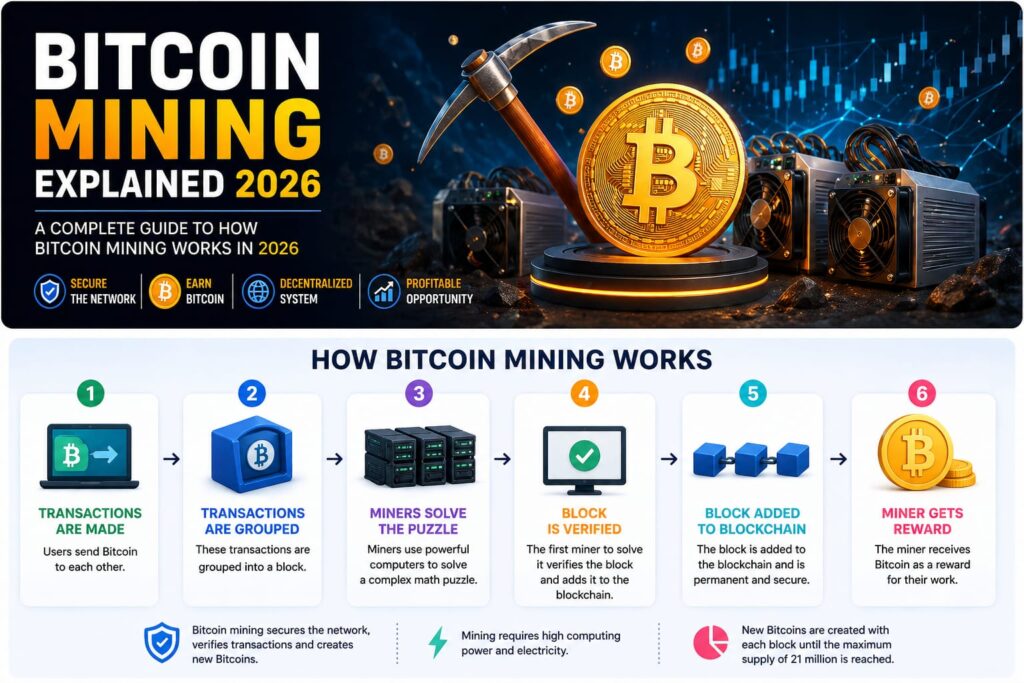
A blockchain is a digital database that stores information in blocks that are linked together in chronological order.
Each block contains:
Transaction data
Timestamp
Cryptographic hash of the previous block. This structure creates a secure chain of blocks, making it extremely difficult to alter past records. The concept of blockchain was first introduced in 2008 by Satoshi Nakamoto, the mysterious creator of Bitcoin.
How blockchain technology Works?
Blockchain works through a network of computers called nodes. These nodes verify and record transactions on the network.
Here is the simple process:
1. Transaction Request
A user requests a transaction, such as sending cryptocurrency.
2. Transaction Broadcast
The request is sent to a network of computers.
3. Verification
Nodes verify the transaction using algorithms.
4. Block Creation
Verified transactions are grouped into a block.
5. Block Added to Chain
The block is added to the blockchain permanently.
Once added, the data becomes almost impossible to change.

Key Features of crypto network
Decentralization
Traditional systems are controlled by a central authority such as a bank. Blockchain removes the need for intermediaries.
Transparency
All transactions are visible to everyone on the network.
Security
Blockchain uses advanced cryptography to protect data.
Immutability
Once information is recorded on the blockchain, it cannot be easily altered.
According to data from CoinMarketCap, Bitcoin remains the largest cryptocurrency by market capitalization.
Real World Uses of blockchain technology
Blockchain technology is not limited to cryptocurrencies. Many industries are exploring its potential.
Finance
Banks are using blockchain for faster and cheaper cross-border payments.
Healthcare
Blockchain can securely store patient data.
Supply Chain
Companies can track goods from production to delivery.
Digital Identity
Blockchain can help create secure digital identity systems.
Blockchain vs Traditional Databases
| Feature | Blockchain | Traditional Database |
| Control | Decentralized | Centralized |
| Security | High | Moderate |
| Transparency | Public | Private |
| Data Editing | Very difficult | Easy |
Advantages of Blockchain
Some major advantages include:
Improved security
Transparency
Reduced costs
Faster transactions
No middlemen
Because of these benefits, blockchain is considered a game-changing technology.
According to data from CoinGecko, Bitcoin remains the largest cryptocurrency by market capitalization.
Challenges of Blockchain
Despite its advantages, blockchain also faces challenges.
Scalability
Some blockchain networks process transactions slowly.
Energy Consumption
Certain networks require large amounts of electricity.
Regulation
Many governments are still developing regulations for blockchain and cryptocurrency.
Future of Blockchain
Experts believe blockchain will play a major role in the future digital economy. Technologies like decentralized finance (DeFi) and NFTs are already built on blockchain.
Projects like Ethereum are constantly improving the technology to make it faster and more efficient.
In the coming years, blockchain could transform industries such as banking, real estate, healthcare, and logistics.
Blockchain technology is no longer limited to cryptocurrencies. Today, governments, banks, healthcare companies, supply chain businesses, gaming platforms, and financial institutions are adopting blockchain to improve transparency, security, and efficiency. As Web3 continues to grow in 2026, understanding blockchain has become one of the most valuable skills for anyone interested in digital technology or cryptocurrency.
Also Read
If you’re completely new to digital assets, start with our beginner-friendly guide on What Is Cryptocurrency? to understand the foundation of the crypto ecosystem.
Blockchain powers cryptocurrencies like Bitcoin. Read our complete guide on What Is Bitcoin? to see how blockchain technology was first introduced to the world.
Smart contracts are one of blockchain’s biggest innovations. Explore our guide on What Is Ethereum? to understand how blockchain evolved beyond digital payments.
Every blockchain network records and verifies transactions securely. Learn how this process works in our guide on How Cryptocurrency Transactions Work on Blockchain.
After understanding blockchain technology, continue with our guide on What Is Web3? to discover how blockchain is shaping the next generation of the internet.
Also Read
Learn how blockchain technology works, why it is secure, and its real-world applications in this educational guide from Binance Academy.
Explore the official Ethereum.org documentation to understand blockchain fundamentals, smart contracts, and decentralized applications.
Read the original Bitcoin Whitepaper by Satoshi Nakamoto to understand the invention and core principles of blockchain technology.
Conclusion
Blockchain technology is one of the most important innovations of the 21st century. It provides a secure, transparent, and decentralized way of recording transactions.
While it started with cryptocurrencies like Bitcoin, its potential goes far beyond digital currency. As adoption grows, blockchain may reshape how businesses and governments operate.
Understanding blockchain today can help you stay ahead in the rapidly evolving digital economy.
join our Telegram for instant crypto updates.
Subscribe to our youtube Channel
For detailed crypto market analysis, price predictions, and investment strategies,
subscribe to our YouTube channel Coin Alert

Dr. Khushwant Rana is the founder of Coin Alert and has 15+ years of business experience. He creates beginner-friendly crypto educational content focused on Bitcoin, blockchain, Web3, crypto security, and real-world crypto awareness in India.