What Is Tokenomics in Crypto?
Imagine two cryptocurrencies.
Both have excellent websites.
Both have active communities.
Both claim to become the next Bitcoin.
One coin increases 300%.
The other loses 90%.
Why?
Most beginners think the answer is marketing, community, or luck.
In reality, one of the biggest reasons is Tokenomics.
Tokenomics is one of the most important concepts in cryptocurrency investing, yet it is also one of the most ignored by beginners.
Many investors spend hours watching YouTube videos, reading social media posts, or following influencers, but they never check how a cryptocurrency actually works economically.
Professional investors always do.
That is why understanding tokenomics can help you avoid many common investment mistakes.
In this guide, you will learn everything about crypto tokenomics in simple language.
Why Tokenomics Is Important
Think of cryptocurrency like a country’s economy.
If a government prints unlimited money every month, the value of that currency usually falls because supply keeps increasing.
The same principle applies to cryptocurrencies.
If a project keeps releasing millions of new tokens into the market while demand stays the same, existing holders may face selling pressure.
On the other hand, projects with well-designed tokenomics often create healthier long-term ecosystems.
Good tokenomics does not guarantee success.
Bad tokenomics, however, can become a major warning sign.
That is why experienced investors never ignore it.
How Tokenomics Works
The word Tokenomics is a combination of two words:
Token + Economics
It explains the economic model behind a cryptocurrency.
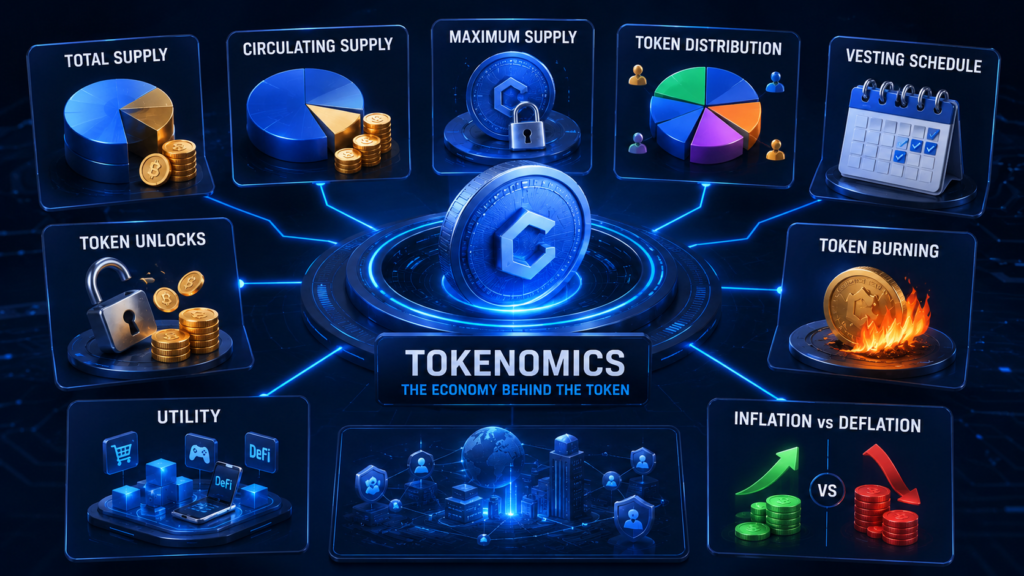
It answers important questions like:
- How many tokens exist?
- Who owns those tokens?
- When will new tokens be released?
- Can the supply increase?
- Can tokens be burned?
- What is the real utility of the token?
These factors influence price, scarcity, demand, and long-term sustainability.
Total Supply vs Circulating Supply
One of the first things every investor should check is the difference between Total Supply and Circulating Supply.
Total Supply
The total number of tokens that currently exist, excluding permanently burned coins.
Circulating Supply
The number of tokens that are actually available in the market for buying and selling.
For example:
- Total Supply = 1 Billion Tokens
- Circulating Supply = 250 Million Tokens
This means only 25% of all tokens are currently available.
The remaining tokens may be locked for founders, investors, advisors, or future rewards.
Understanding this difference is essential because future token releases can affect market prices.
Maximum Supply
Some cryptocurrencies have a fixed maximum supply.
Bitcoin is the most famous example.
Maximum Supply:
21 Million BTC
No matter how much demand increases, Bitcoin’s maximum supply will never exceed this limit.
Some cryptocurrencies, however, have no fixed maximum supply.
This does not automatically make them bad investments.
But investors should understand how additional tokens are created and why.
Token Distribution
One of the biggest mistakes beginners make is looking only at the token price.
Professional investors first check who owns the tokens.
Every crypto project distributes its tokens among different groups. This is called Token Distribution.
A healthy token distribution usually includes:
- Development Team
- Early Investors
- Advisors
- Community Rewards
- Staking Rewards
- Ecosystem Growth
- Treasury
- Public Sale
Imagine a project where:
- Team owns 60%
- Community owns 10%
- Public owns 5%
Even if the project looks attractive, such a distribution creates a high centralization risk because a small group controls most of the supply.
A balanced distribution generally creates better trust and reduces the possibility of market manipulation.
What Is a Token Unlock?
Many investors see a coin rising and immediately buy it without checking one important thing:
When will new tokens enter the market?
This is called a Token Unlock.
Projects usually lock tokens for:
- Founders
- Developers
- Venture Capital Investors
- Advisors
- Marketing
- Ecosystem Funds
These tokens are released according to a schedule.
When a large number of locked tokens become available at once, the circulating supply increases.
If demand does not increase at the same speed, selling pressure may also increase.
That is why professional investors always check the Token Unlock Calendar before investing.
What Is a Vesting Schedule?
A Vesting Schedule explains when and how locked tokens will be released.
Instead of releasing all tokens on one day, projects often release them gradually.
For example:
- Month 1 → 5%
- Month 2 → 5%
- Month 3 → 10%
- Month 6 → 20%
This gradual release helps reduce sudden market shocks.
A transparent vesting schedule is generally considered healthier than an unclear or hidden release plan.
What Is Token Burning?
Some cryptocurrency projects permanently remove tokens from circulation.
This process is called Token Burning.
Burned tokens cannot be recovered or spent again.
The main goal is to reduce supply.
A lower supply does not automatically increase price, but if demand remains strong while supply decreases, scarcity may support long-term value.
One well-known example is BNB, where periodic token burns are part of the ecosystem design.
Inflation vs Deflation
Understanding whether a cryptocurrency is inflationary or deflationary is another important part of tokenomics.
Inflationary Token
New tokens continue to enter circulation.
Examples may include block rewards, staking rewards, or newly minted coins.
Inflation is not necessarily bad, provided that the new supply supports network security or ecosystem growth.
Deflationary Token
The available supply gradually decreases through token burns or fixed maximum supply.
Bitcoin is often discussed as a scarce asset because its maximum supply is fixed at 21 million coins.
Some projects combine inflation and token burning to balance ecosystem growth with supply management.
Real-World Example
Imagine two projects.
Project A
- Fixed Maximum Supply
- Transparent Vesting
- Healthy Token Distribution
- Active Development
- Real Utility
Project B
- Unlimited Supply
- No Clear Vesting
- Team Controls 70% of Tokens
- No Real Product
- Heavy Marketing Only
Even if both coins look similar on social media, Project A generally presents fewer obvious tokenomics concerns than Project B. This doesn’t guarantee success, but it gives investors a stronger basis for evaluation.
Common Tokenomics Mistakes
Many beginners make these mistakes:
- Buying only because the price is low.
- Ignoring token unlock schedules.
- Looking only at total supply.
- Ignoring circulating supply.
- Never reading the token allocation.
- Believing influencer recommendations without checking project fundamentals.
- Confusing popularity with strong tokenomics.
Good tokenomics cannot guarantee profits, but poor tokenomics can increase investment risk.
Final Thoughts
Understanding tokenomics is one of the most valuable skills for every crypto investor.
Many beginners spend hours searching for the next “100x coin” but ignore the project’s economic model. Professional investors take the opposite approach—they study supply, distribution, utility, token unlocks, and vesting schedules before making investment decisions.
Remember:
A strong project is not judged only by its price chart but also by its tokenomics.
Before investing in any cryptocurrency, always analyze:
- Total Supply
- Circulating Supply
- Maximum Supply
- Token Distribution
- Vesting Schedule
- Token Unlock Events
- Utility
- Burning Mechanism
Doing this simple research can help you make more informed decisions and avoid many common beginner mistakes.
Continue Learning:
- What Is DYOR in Crypto?
- What Is Bitcoin? Complete Beginner Guide
- What Is Blockchain?
- Crypto Fear & Greed Index
- Crypto Events Calendar
Useful Resources:
FAQ
1. What is tokenomics in cryptocurrency?
Tokenomics refers to the economic model of a cryptocurrency. It explains how a token is created, distributed, used, managed, and how its supply changes over time.
2. Why is tokenomics important before investing?
Tokenomics helps investors understand whether a project has a healthy economic structure. Poor tokenomics can increase risks such as excessive selling pressure or token inflation.
3. What is the difference between Total Supply and Circulating Supply?
Total Supply = Total existing tokens (excluding permanently burned tokens).
Circulating Supply = Tokens currently available for buying and selling in the market.
4. What is a Token Unlock?
A Token Unlock is the scheduled release of previously locked tokens into circulation. Large unlock events may increase selling pressure if market demand does not grow accordingly.
5. What is a Vesting Schedule?
A Vesting Schedule defines when and how locked tokens will be released to founders, investors, advisors, or the team over time.
6. Does Token Burning increase the price?
Not necessarily. Burning reduces supply, but the price also depends on market demand, utility, and broader market conditions.
7. Which websites can I use to check tokenomics?
Reliable sources include:
CoinMarketCap
CoinGecko
Messari
Token Unlocks
Official Project Website
Official Whitepaper
Continue Your Crypto Learning Journey
Learning tokenomics is just one step toward becoming a smarter crypto investor.
Explore more beginner-friendly crypto guides on Coin Alert and build a strong foundation before investing.
🌐 Visit Coin Alert
▶ Subscribe on YouTube
📢 Join Our Telegram Community

Dr. Khushwant Rana is the founder of Coin Alert and has 15+ years of business experience. He creates beginner-friendly crypto educational content focused on Bitcoin, blockchain, Web3, crypto security, and real-world crypto awareness in India.