In recent years, decentralized finance (DeFi) has become one of the fastest-growing sectors in the cryptocurrency industry. DeFi aims to replace traditional financial systems such as banks, lenders, and brokers with blockchain-based technology that is open, transparent, and accessible to anyone.
Decentralized Finance (DeFi) is transforming the traditional financial system by removing intermediaries like banks and giving users full control over their digital assets. Built on blockchain technology, DeFi platforms allow users to lend, borrow, trade, and earn interest without relying on centralized institutions.
In simple words, DeFi allows people to access financial services without relying on centralized institutions. Instead of banks controlling transactions, smart contracts running on blockchain networks manage everything automatically.
As we move into 2026, DeFi continues to evolve rapidly with new platforms, better security, and increasing adoption worldwide. In this guide, we will explain what DeFi is, how it works, and why it is becoming an important part of the digital financial ecosystem.
What Is DeFi?
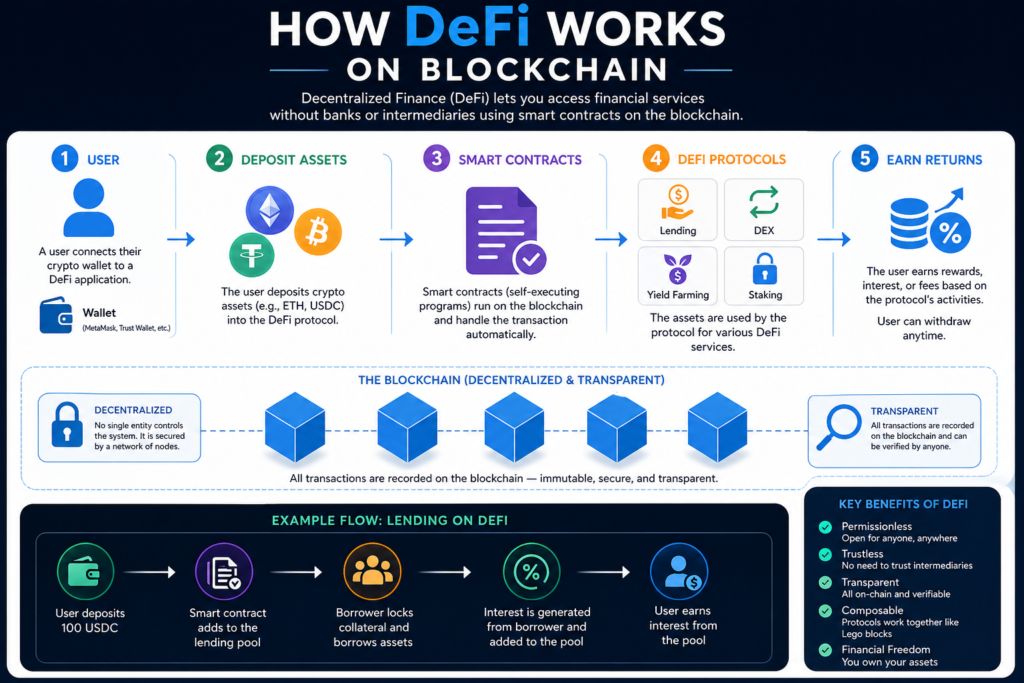
Decentralized Finance, commonly known as DeFi, refers to a financial system built on blockchain technology that operates without intermediaries such as banks or financial institutions.
Traditional finance requires trusted institutions to manage transactions. For example, when you send money through a bank, the bank verifies and processes the transaction.
In contrast, DeFi uses blockchain networks and smart contracts to handle financial operations automatically.
These smart contracts execute transactions when certain conditions are met, removing the need for third parties.
This means anyone with an internet connection and a crypto wallet can access financial services such as lending, borrowing, trading, and earning interest.
How Does DeFi Work?
DeFi operates using several key technologies and components that work together to create a decentralized financial system.
Blockchain Technology
Blockchain serves as the foundation of DeFi. It is a decentralized ledger that records all transactions securely and transparently.
Most DeFi applications are built on the Ethereum blockchain, although other networks such as Binance Smart Chain and Solana are also gaining popularity.
Smart Contracts
Smart contracts are self-executing programs stored on the blockchain.
They automatically carry out transactions based on predefined rules. For example, a smart contract can automatically send interest payments to users who deposit crypto into a lending protocol.
Crypto Wallets
To interact with DeFi platforms, users need a cryptocurrency wallet. Wallets allow users to store digital assets and connect to decentralized applications.
Popular wallets used in DeFi include browser wallets and mobile wallets that support decentralized apps.
Decentralized Applications (DApps)
DeFi services operate through decentralized applications. These applications provide financial services such as trading, lending, and staking directly on the blockchain.
Popular DeFi Use Cases
DeFi platforms provide many financial services that traditionally require banks or financial institutions.
Crypto Lending and Borrowing
Users can lend their crypto assets and earn interest or borrow crypto by providing collateral.
Lending platforms automatically match lenders with borrowers using smart contracts.
Decentralized Exchanges
Decentralized exchanges allow users to trade cryptocurrencies without relying on centralized exchanges.
Transactions happen directly between users using liquidity pools.
Yield Farming
Yield farming allows users to earn rewards by providing liquidity to DeFi platforms.
Users deposit crypto into liquidity pools and earn interest or additional tokens as rewards.
Staking
Staking involves locking cryptocurrency in a blockchain network to help secure the network while earning rewards.
Advantages of DeFi
DeFi offers several advantages compared to traditional financial systems.
Financial Accessibility
Anyone with internet access can participate in DeFi services without requiring approval from banks.
Transparency
All transactions on blockchain networks are publicly visible, making the system transparent and verifiable.
Control Over Assets
Users maintain full control of their funds since they store assets in personal wallets rather than centralized institutions.
Innovation
DeFi allows developers to create new financial products quickly without needing permission from traditional financial authorities.
Risks of DeFi
Although DeFi offers many benefits, it also comes with certain risks.
Smart Contract Vulnerabilities
If a smart contract contains bugs or security flaws, hackers may exploit them.
Market Volatility
Cryptocurrency prices can change rapidly, which may affect DeFi investments.
Rug Pulls and Scams
Some DeFi projects are fraudulent and disappear after collecting funds from users.
Because of these risks, it is important to research projects carefully before investing in DeFi platforms
The Future of DeFi
DeFi continues to expand as blockchain technology improves and more users adopt decentralized financial services.
In the coming years, DeFi is expected to integrate with traditional financial institutions, creating hybrid systems that combine decentralization with regulatory compliance.
Experts believe that DeFi could reshape the global financial system by providing open access to financial services for billions of people.
With advancements in blockchain scalability and security, decentralized finance may become a major part of the global economy by 2030.
Also Read
Before exploring decentralized finance (DeFi), start with our beginner-friendly guide on What Is Blockchain? to understand the technology that powers decentralized applications.
DeFi is built on smart contract platforms like Ethereum. Read our complete guide on What Is Ethereum? to learn why it became the foundation of the DeFi ecosystem.
To understand where DeFi fits into the future of the internet, explore our detailed guide on What Is Web3? and discover how decentralized technologies are transforming online services.
Using DeFi requires a non-custodial crypto wallet. Learn how to securely store and manage digital assets in our guide on What Is a Crypto Wallet?.
After understanding DeFi, continue with our guide on Centralized vs Decentralized Exchanges (CEX vs DEX) to learn how decentralized exchanges enable permissionless crypto trading.
Also Read
Learn how decentralized finance (DeFi) works, its core components, and real-world use cases in this comprehensive guide from Binance Academy.
Explore the official Ethereum.org DeFi Guide to understand lending, borrowing, decentralized exchanges, and smart contracts.
Track the growth of the DeFi ecosystem, total value locked (TVL), protocols, and blockchain networks using DefiLlama, one of the industry’s leading DeFi analytics platforms.
Conclusion
Decentralized finance represents a revolutionary shift in how financial services operate. By removing intermediaries and using blockchain technology, DeFi enables secure, transparent, and accessible financial systems.
While the industry still faces challenges such as security risks and regulation, its rapid growth suggests that decentralized finance will play a significant role in the future of digital finance.
For beginners interested in cryptocurrency, understanding DeFi is an important step toward exploring the broader blockchain ecosystem.
FAQ
join our Telegram for instant crypto updates.
Subscribe to our youtube Channel
For detailed crypto market analysis, price predictions, and investment strategies,
subscribe to our YouTube channel Coin Alert

Dr. Khushwant Rana is the founder of Coin Alert and has 15+ years of business experience. He creates beginner-friendly crypto educational content focused on Bitcoin, blockchain, Web3, crypto security, and real-world crypto awareness in India.