Learn what Web3 is and how it will change the future of the internet in 2026. A beginner-friendly guide explaining Web3 technology, benefits, and real-world examples.
The internet has evolved dramatically over the past few decades. From static web pages to social media platforms, technology continues to reshape how we communicate, work, and share information. Now a new concept called Web3 is emerging, promising to transform the internet once again.
Web3 is a decentralized version of the internet built on blockchain technology. Instead of relying on large centralized companies, Web3 gives users more control over their data, identity, and digital assets.
What Is Web3?
Web3 refers to the next generation of the internet powered by blockchain technology. Unlike the traditional internet where companies control platforms and data, Web3 allows users to interact directly with decentralized networks.
In Web3, applications run on blockchain systems and smart contracts instead of centralized servers.
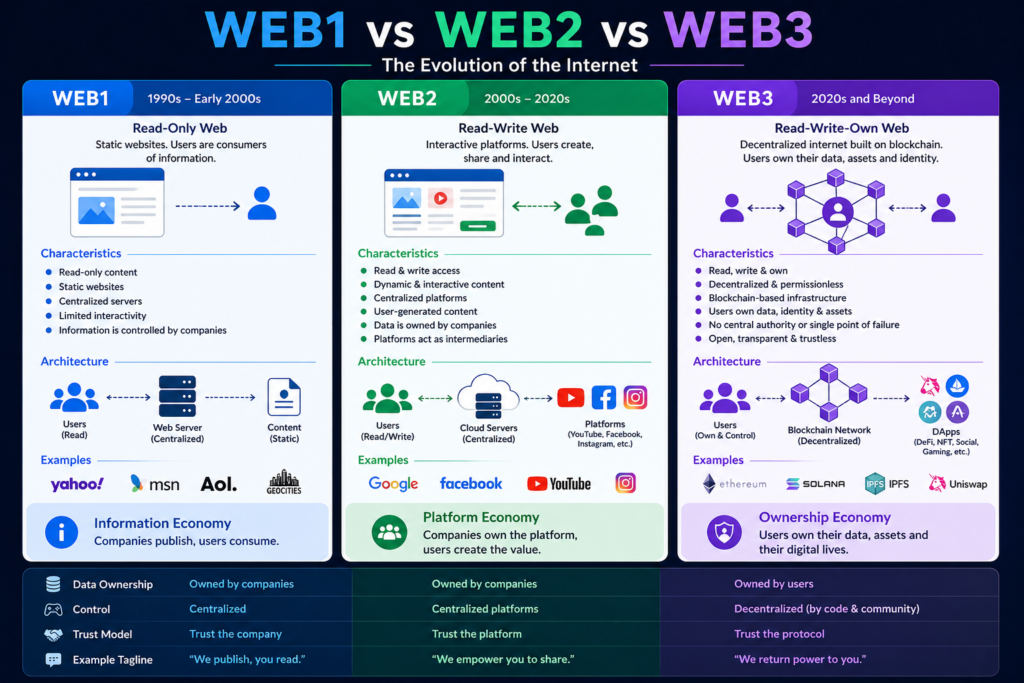
Evolution of the Internet: Web1 vs Web2 vs Web3
Web1
The early internet was mainly read-only websites where users could only consume information.
Web2
Web2 introduced social media, user-generated content, and interactive platforms. However, companies like social networks control most of the data.
Web3
Web3 focuses on decentralization, user ownership, and blockchain-powered applications.
Key Features of Web3
Decentralization
Web3 platforms operate on decentralized blockchain networks rather than centralized servers.
User Ownership
Users control their digital identity and assets through crypto wallets.
Smart Contracts
Automated blockchain programs enable secure transactions without intermediaries.
Token Economy
Many Web3 platforms use cryptocurrencies or tokens for transactions and governance.
How Web3 Works
Web3 works through blockchain technology, smart contracts, and decentralized networks. Instead of storing data on centralized servers controlled by a single company, Web3 applications distribute information across thousands of computers worldwide.</p>
Users interact with Web3 applications through crypto wallets such as MetaMask or Trust Wallet. These wallets act as digital identities and allow users to access decentralized services without relying on traditional usernames and passwords.
Smart contracts automate agreements and transactions without requiring intermediaries. This creates a trustless environment where users can exchange value directly with each other.
Real Examples of Web3 Applications
Several popular blockchain projects already use Web3 technology.
- Ethereum – Smart contracts and decentralized applications
- Uniswap – Decentralized crypto trading
- OpenSea – NFT marketplace
- Aave – Decentralized lending platform
- Polygon – Scalable blockchain infrastructure
These projects demonstrate how Web3 can provide alternatives to traditional internet services.
Benefits of Web3
- Greater user control over personal data
- Reduced dependence on centralized platforms
- Improved privacy and security
- Digital ownership of assets and content
- New earning opportunities through blockchain ecosystems
One of the biggest advantages of Web3 is ownership. Users can truly own their digital assets instead of relying on third-party platforms.
Challenges of Web3
Despite its potential, Web3 still faces several challenges.
- Scalability limitations
- Complex user experience
- Regulatory uncertainty
- Security vulnerabilities
- Slow mainstream adoption
Many developers are actively working to solve these problems through Layer-2 solutions, better user interfaces, and improved blockchain infrastructure.
Also Read
Before exploring Web3, start with our beginner-friendly guide on What Is Blockchain? to understand the decentralized technology that powers the next generation of the internet.
If you’re new to digital assets, read our complete guide on What Is Cryptocurrency? to build a strong foundation before diving into the Web3 ecosystem.
Most Web3 applications are built on smart contract platforms like Ethereum. Learn more in our detailed guide on What Is Ethereum?.
Web3 enables decentralized ownership through digital assets such as NFTs. Explore our complete guide on What Are NFTs and How Do They Work? to understand their role in the decentralized web.
After understanding Web3, continue with our guide on What Is DeFi? to discover how decentralized finance is transforming traditional financial services.
Also Read
Learn what Web3 is, how it works, and why it represents the next evolution of the internet in this educational guide from Binance Academy.
Explore the official Ethereum.org Web3 Guide to understand decentralized applications, wallets, smart contracts, and digital ownership.
Discover educational resources and research on the future of decentralized technologies from the Web3 Foundation, the organization supporting the development of the decentralized web.
FAQ
What is Web3 in simple terms?
Web3 is the next generation of the internet that uses blockchain technology to give users more control over their data and digital assets.
Is Web3 the future of the internet?
Many experts believe Web3 will play a major role in the future internet by enabling decentralized applications and digital ownership.
Do you need cryptocurrency to use Web3?
Most Web3 platforms require a crypto wallet and sometimes cryptocurrency to interact with decentralized applications.
Is Web3 the same as blockchain?
No. Blockchain is the technology, while Web3 is a broader internet ecosystem built using blockchain.
Why is Web3 important?
Web3 aims to reduce dependence on centralized companies and give users ownership of their data and digital assets.
Can Web3 replace Web2?
Web3 is more likely to coexist with Web2 rather than completely replace it.
Which cryptocurrencies are related to Web3?
Ethereum, Polygon, Chainlink, Polkadot, Avalanche, and Solana are some popular Web3-related projects.
join our Telegram for instant crypto updates.
Subscribe to our youtube Channel
For detailed crypto market analysis, price predictions, and investment strategies,
subscribe to our YouTube channel Coin Alert

Dr. Khushwant Rana is the founder of Coin Alert and has 15+ years of business experience. He creates beginner-friendly crypto educational content focused on Bitcoin, blockchain, Web3, crypto security, and real-world crypto awareness in India.