Smart contracts are one of the most important technologies behind modern blockchain systems. They allow agreements to be executed automatically without the need for intermediaries such as banks or legal authorities.
In the cryptocurrency world, smart contracts power decentralized applications, DeFi platforms, NFT marketplaces, and many other blockchain services.
These digital contracts run on blockchain networks like Ethereum, enabling secure and transparent transactions.
In this guide, we will explain what smart contracts are, how they work, and why they are essential for the future of decentralized technology.
Many decentralized organizations rely on smart contracts, which is why understanding what is DAO in crypto is important when learning about blockchain governance systems. https://coinalert.in/what-is-dao-in-crypto-decentralized-autonomous-organization-2026-guide/
What Is a Smart Contract
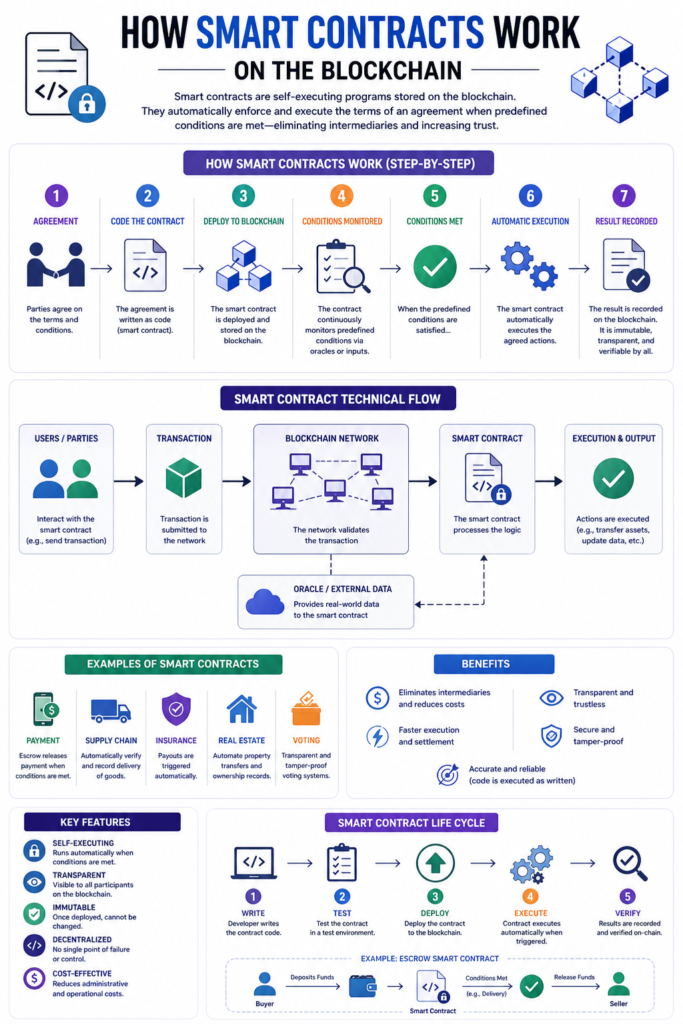
A smart contract is a self-executing digital agreement stored on a blockchain. It automatically performs actions when certain conditions are met.
For example:
If a payment is received → the contract releases the product or service automatically.
Because smart contracts run on blockchain technology, they are:
Transparent
Secure
Tamper-resistant
Automated
The concept of smart contracts was first introduced by computer scientist Nick Szabo in the 1990s.
How Smart Contracts Work
Smart contracts operate using blockchain technology and predefined rules written in code.
Here is how they work:
1. Code Creation
Developers write the smart contract code that defines the rules and conditions.
2. Deployment on Blockchain
The contract is deployed on a blockchain network such as Ethereum.
3. Trigger Conditions
When the predefined conditions are met, the contract executes automatically.
4. Permanent Record
All transactions are recorded on the blockchain, making them transparent and immutable.
Platforms such as CoinMarketCap track thousands of projects that rely on smart contract technology.
Smart contracts operate on blockchain networks, so learning how cryptocurrency transactions work can help beginners understand how these automated agreements function. https://coinalert.in/how-cryptocurrency-transactions-work-on-blockchain-in-2026/
Examples of Smart Contract Use Cases
Smart contracts are used in many areas of the crypto ecosystem.
DeFi Platforms
Decentralized finance platforms use smart contracts to manage lending, borrowing, and trading.
Example:
Uniswap allows users to trade tokens directly without centralized exchanges.
NFT Marketplaces
NFT platforms use smart contracts to verify ownership and automate sales.
Example:
OpenSea uses smart contracts to manage NFT transactions.
According to Binance Academy, this guide explains what are smart contracts and how they automatically execute blockchain agreements. https://academy.binance.com/en/articles/what-are-smart-contracts
Crypto Payments
Smart contracts can automatically process payments when conditions are fulfilled.
This eliminates the need for intermediaries.
Benefits of Smart Contracts
Smart contracts offer several advantages.
Automation
Transactions are executed automatically without human involvement.
Transparency
All contract activity is recorded on the blockchain.
Security
Blockchain technology protects smart contracts from manipulation.
Cost Reduction
Smart contracts remove intermediaries, reducing transaction costs.
Risks of Smart Contracts
Despite their advantages, smart contracts also have some risks.
Coding Errors
Bugs in smart contract code can lead to vulnerabilities.
Security Exploits
Hackers may exploit weaknesses in poorly designed contracts.
Irreversible Transactions
Once deployed, smart contracts cannot easily be changed.
Educational platforms like Binance Academy provide detailed learning resources about smart contracts and blockchain technology.
Platforms like CoinMarketCap show a list of smart contract crypto projects that power decentralized applications and DeFi services. https://coinmarketcap.com/view/smart-contracts/
Latest Smart Contract Trends in 2026
Smart contracts are becoming one of the most important technologies in the blockchain industry. In 2026, they are being used not only for cryptocurrencies but also for decentralized finance (DeFi), NFTs, gaming, digital identity, real estate, and supply chain management. Ethereum remains the largest smart contract platform, while newer blockchains such as Solana, Base, Arbitrum, and Polygon continue to expand smart contract adoption worldwide.
Conclusion
Smart contracts are revolutionizing how agreements and transactions work in the digital world. By removing intermediaries and automating processes, they make blockchain systems more efficient and transparent.
From decentralized finance to NFTs and Web3 applications, smart contracts are the backbone of modern blockchain innovation.
Understanding smart contracts is essential for anyone exploring cryptocurrency and the future of decentralized technology.
Also Read
Blockchain GuideEthereum Layer 2 Guide
Arbitrum Guide
DAO Guide Governance Token Guide
FAQ
What is a smart contract in cryptocurrency?
A smart contract is a self-executing program on a blockchain that automatically performs actions when predefined conditions are met.
Which blockchain uses smart contracts?
Several blockchain networks support smart contracts, including Ethereum, Solana, and BNB Chain.
Are smart contracts safe?
Smart contracts can be secure if properly coded, but vulnerabilities in the code may sometimes be exploited.
Can smart contracts be changed after deployment?
Most smart contracts cannot be changed once deployed, although some projects use upgradeable smart contracts.
Are smart contracts legal?
The legality of smart contracts depends on the country and the specific use case.
Which blockchain uses smart contracts the most?
Ethereum is currently the most widely used smart contract blockchain.
Can smart contracts hold cryptocurrency?
Yes. Smart contracts can store, receive, and send cryptocurrencies according to predefined rules.
What is the biggest risk of smart contracts?
Coding bugs and security vulnerabilities are among the biggest risks.
join our Telegram for instant crypto updates.
Subscribe to our youtube Channel
For detailed crypto market analysis, price predictions, and investment strategies,
subscribe to our YouTube channel Coin Alert
For more beginner-friendly crypto education, in-depth guides, and documentary-style crypto stories, visit Coin Alert regularly.
🌐 Website: https://coinalert.in
📢 Telegram: https://t.me/coinalert
🎥 YouTube: Coin Alert
Stay informed. Stay secure. Learn before you invest.

Dr. Khushwant Rana is the founder of Coin Alert and has 15+ years of business experience. He creates beginner-friendly crypto educational content focused on Bitcoin, blockchain, Web3, crypto security, and real-world crypto awareness in India.