BlackRock History is one of the most fascinating stories in modern finance. Today BlackRock manages more than $11 trillion in assets and influences markets around the world. But this financial giant began after a painful $100 million mistake by Larry Fink. This documentary-style story explores how BlackRock survived crises, built the ALADDIN risk system, dominated ETFs through iShares, and eventually became one of the biggest forces behind Bitcoin ETF adoption.
If you are new to crypto, first read our Bitcoin Beginner Guide to understand why BlackRock’s Bitcoin ETF became such a historic event.Long before BlackRock became the most powerful asset manager in the world, Larry Fink was a rising star on Wall Street.
During the 1980s, Fink worked at First Boston, one of the biggest investment banks of that era.
He became famous for helping develop the mortgage-backed securities market.
At the time, mortgage-backed securities were considered one of the most innovative financial products in the industry.
Investors loved them.
Banks loved them.
Wall Street loved them.
And Larry Fink was one of the brightest minds behind their growth.
Everything looked perfect.
Until it wasn’t.
The $100 Million Mistake
Success on Wall Street can sometimes create overconfidence.
One day, a major interest-rate prediction went wrong.
The result was catastrophic.
The trading desk lost approximately $100 million.
For many people, such a loss would have ended their careers.
But for Larry Fink, it became the most important lesson of his life.
The experience taught him something powerful:
Markets are unpredictable.
Risk is everywhere.
And the biggest danger is not seeing the risk before it arrives.
That lesson would later become the foundation of BlackRock.
The Birth of BlackRock
In 1988, Larry Fink and several partners launched a new company.
Its mission was different from most Wall Street firms.
While others focused on maximizing returns, BlackRock focused on understanding risk.
The company started under the umbrella of Blackstone.
Over time, it grew independently and eventually became BlackRock.
At the beginning, few people imagined that this small startup would one day manage trillions of dollars.
But Larry Fink had a different vision.
He wanted to create a company where risk management was as important as profit generation.
That philosophy became BlackRock’s competitive advantage.
Building a Different Kind of Financial Company
Most investment firms at the time focused on one question:
“How much money can we make?”
BlackRock focused on a different question:
“What can go wrong?”
This sounds simple.
But in finance, it is revolutionary.
The company built systems, processes, and teams designed to identify hidden risks before they became disasters.
Institutional clients loved this approach.
Pension funds trusted it.
Insurance companies trusted it.
Governments trusted it.
And BlackRock began growing rapidly.
But Larry Fink wanted more than experienced analysts.
He wanted technology.
ALADDIN: The Machine That Could See Risk
During the 1990s, BlackRock developed one of the most important financial technologies ever created.
Its name was ALADDIN.
ALADDIN stands for:
Asset
Liability
Debt
Derivative
Investment
Network
While the name sounds simple, its impact was enormous.
ALADDIN became BlackRock’s digital brain.
It could analyze massive amounts of financial data.
It could run risk scenarios.
It could identify weaknesses in portfolios.
It could simulate future market conditions.
Instead of trying to predict the future, ALADDIN helped investors understand potential risks.
That distinction made all the difference.
Many Wall Street firms relied on experience.
BlackRock combined experience with technology.
And over time, ALADDIN became one of the company’s biggest competitive advantages.
To understand how modern financial technology works, it is also important to understand the role of blockchain technology in risk management and digital asset infrastructure.The 2008 Financial Crisis
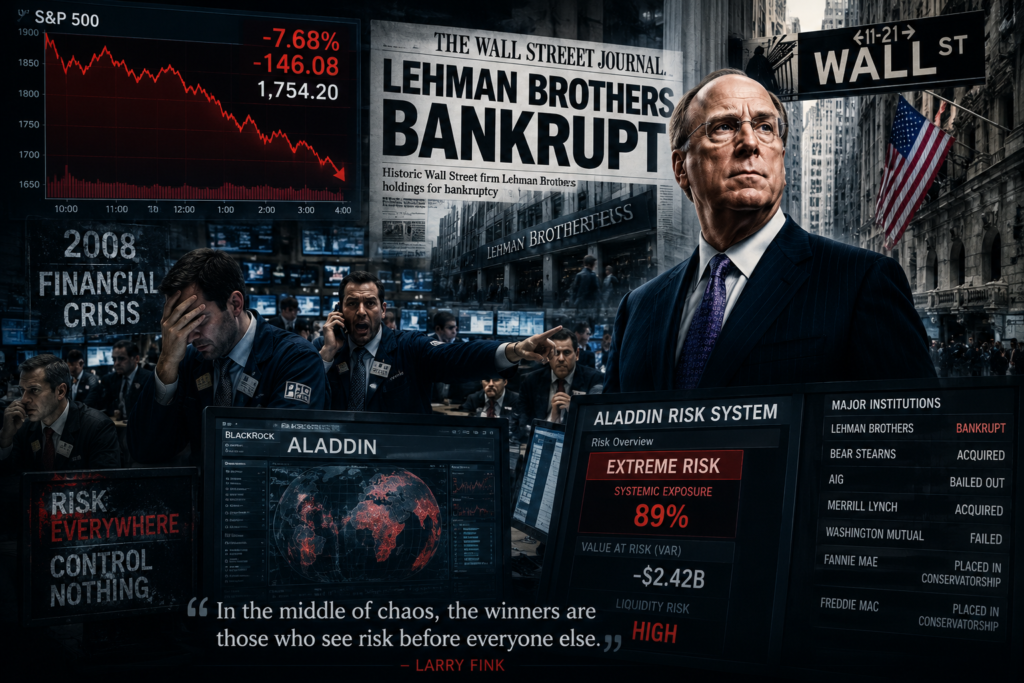
Then came 2008.
The crisis that changed modern finance forever.
Ironically, the same mortgage market that made Larry Fink famous was now collapsing.
For years, banks had aggressively issued home loans.
These loans were packaged into complex financial products and sold to investors worldwide.
As long as housing prices kept rising, everything seemed fine.
But eventually, the bubble burst.
Defaults increased.
Housing prices fell.
Banks started failing.
And panic spread throughout the financial system.
One of the biggest moments came when Lehman Brothers collapsed.
Global markets entered chaos.
Investors wanted answers.
Governments wanted answers.
And many institutions simply did not know how much risk was hidden inside the system.
BlackRock had an advantage.
ALADDIN.
The platform that had been built for years suddenly became one of the most valuable tools in finance.
Governments and regulators turned to BlackRock for help analyzing damaged assets and understanding systemic risk.
The crisis transformed BlackRock’s reputation.
It was no longer just another investment company.
It became a trusted advisor during one of the worst financial disasters in history.
The Acquisition That Changed Everything
The 2008 financial crisis was slowly coming to an end.
But for Larry Fink, the next chapter was just beginning.
History often follows a simple pattern.
Crises destroy weak companies.
But they make strong companies even stronger.
After 2008, BlackRock had three major advantages:
- Trust
- Technology
- Timing
And Larry Fink knew this was the moment to make a move that could change the future of the company forever.
A massive move.
A deal that shocked the financial world.
BlackRock announced its acquisition of Barclays Global Investors, commonly known as BGI.
For most retail investors today, the name BGI may not sound familiar.
But at the time, it was one of the largest asset managers in the world.
More importantly, it owned one of the most valuable businesses in modern finance.
iShares.
The ETF Revolution
To understand why this deal mattered, we first need to understand ETFs.
ETF stands for Exchange Traded Fund.
In simple terms, an ETF is a basket of investments that trades like a stock.
Instead of buying individual stocks, investors can buy one ETF and gain exposure to an entire market.
This made investing easier, cheaper, and more accessible.
And among all ETF providers, iShares was the king.
Larry Fink saw something many others underestimated.
The future of investing would be passive.
More people would choose diversified investment products.
More institutions would use ETFs.
And BlackRock needed to be at the center of that revolution.
In 2009, BlackRock acquired BGI in a deal worth approximately $13.5 billion.
The impact was immediate.
Assets under management exploded.
BlackRock became the largest asset manager in the world.
The company was no longer just a successful Wall Street firm.
It became a global financial institution.
From Asset Manager to Financial Infrastructure
After the acquisition, BlackRock’s influence expanded rapidly.
The company entered new markets.
New countries.
New industries.
New governments.
At the same time, ALADDIN continued growing.
Initially developed for internal use, the platform eventually became valuable to other institutions.
Banks used it.
Insurance companies used it.
Pension funds used it.
Asset managers used it.
Suddenly, BlackRock wasn’t just managing money.
It was helping manage financial risk across the entire system.
This is why many analysts describe BlackRock as financial infrastructure rather than simply an investment company.
The company wasn’t just controlling assets.
It was controlling information.
And in finance, information is power.
By the mid-2010s, BlackRock had become one of the most influential organizations on the planet.
Governments knew it.
Central banks consulted it.
Institutional investors trusted it.
And Larry Fink had become one of the most respected figures on Wall Street.
But while BlackRock was dominating traditional finance, something unexpected was happening elsewhere.
Something most financial institutions ignored.
Bitcoin.
The Man Who Hated Bitcoin
When Bitcoin launched in 2009, few people paid attention.
Most investors dismissed it.
Many called it a scam.
Others called it a bubble.
And Larry Fink was among the skeptics.
At the time, BlackRock represented everything Bitcoin challenged.
Traditional finance.
Regulation.
Centralized institutions.
Risk management.
Bitcoin was the opposite.
No CEO.
No headquarters.
No central bank.
No government support.
For someone who spent decades building trust within regulated financial markets, Bitcoin looked risky.
And during the 2010s, Larry Fink made several public statements criticizing Bitcoin.
One of his most famous comments suggested that Bitcoin was an indicator of money laundering demand.
Crypto supporters strongly disagreed.
But from Larry’s perspective, the concerns were understandable.
The crypto industry was still immature.
Regulations were unclear.
Major exchanges lacked proper oversight.
Security breaches were common.
Scams were everywhere.
As a risk manager, Larry focused on worst-case scenarios.
Bitcoin believers focused on potential.
Both sides saw different parts of the picture.
Bitcoin Refused To Die
Something unusual happened over the next decade.
Bitcoin survived.
It survived crashes.
It survived regulations.
It survived negative headlines.
It survived exchange failures.
Every time critics declared Bitcoin dead, it returned stronger than before.
Gradually, the market started changing.
The people buying Bitcoin were changing.
Early on, Bitcoin was mostly used by technology enthusiasts and retail investors.
But over time, institutions began paying attention.
Hedge funds entered.
Public companies entered.
Family offices entered.
And eventually, BlackRock’s own clients started asking questions.
Questions that could no longer be ignored.
Should we have Bitcoin exposure?
Can Bitcoin be a long-term asset?
Is Bitcoin digital gold?
Should institutions allocate capital to it?
At that moment, the discussion stopped being about Larry Fink’s personal opinion.
It became about client demand.
And in finance, client demand is impossible to ignore forever.
The Digital Gold Narrative
Then came COVID-19.
The world changed overnight.
Governments launched massive stimulus programs.
Central banks printed unprecedented amounts of money.
Inflation concerns began growing.
And Bitcoin gained a new identity.
Digital Gold.
The idea was simple.
For centuries, gold had been used as a store of value.
Bitcoin supporters argued that Bitcoin could serve a similar purpose in a digital world.
Initially, many traditional investors rejected this argument.
But over time, institutional interest kept increasing.
More companies added Bitcoin to their balance sheets.
More funds researched Bitcoin.
More investors requested exposure.
And BlackRock noticed.
The data was becoming difficult to ignore.
The Bitcoin ETF Filing That Changed History
Then came one of the most important moments in Bitcoin history.
June 2023.
A filing was submitted.
Just a few pages.
But those pages changed the future of Bitcoin.
The applicant was BlackRock.
The application was for a Spot Bitcoin ETF.
This was not just another ETF application.
This was BlackRock.
The world’s largest asset manager.
A company with a powerful reputation and one of the strongest ETF approval records in history.
The filing sent a message to the entire financial world.
Bitcoin was no longer just a crypto asset.
It was becoming a legitimate institutional asset.
And suddenly, Wall Street started paying attention.
Again.
The Great U-Turn
The transformation was remarkable.
The same Larry Fink who once criticized Bitcoin was now discussing its potential.
The same executive who questioned the asset was now helping bring it into traditional finance.
In interviews, Larry began describing Bitcoin as an international asset.
He acknowledged growing global demand.
He discussed Bitcoin as a potential alternative store of value.
The shift was impossible to ignore.
And when BlackRock changes its opinion, the market notices.
Because BlackRock rarely moves without years of research.
Years of analysis.
Years of risk assessment.
The company had studied Bitcoin.
And its conclusion was clear.
Institutional demand was real.
BlackRock Today
Today, BlackRock manages more than $10 trillion in assets.
It is one of the most powerful financial institutions in history.
Its products influence global markets.
Its ETF business dominates the industry.
Its ALADDIN platform helps monitor trillions of dollars in risk.
And its Bitcoin ETF has become one of the most successful ETF launches ever seen.
What started as a company built around risk management eventually became one of the biggest bridges between traditional finance and digital assets.
Why BlackRock Matters for Crypto
Many people think Bitcoin changed after BlackRock entered.
The reality is more complicated.
Bitcoin itself did not change.
The perception of Bitcoin changed.
For years, institutions viewed Bitcoin as risky.
BlackRock helped transform that conversation.
The company gave traditional investors a familiar way to access Bitcoin.
A regulated structure.
A trusted brand.
A product they understood.
Whether someone loves or hates BlackRock, one fact is difficult to deny:
The company played a major role in bringing Bitcoin into mainstream finance.
And that may become one of the most important chapters in Bitcoin’s history.
Conclusion
The story of BlackRock is not just a story about money.
It is a story about risk.
A story about technology.
A story about learning from failure.
Larry Fink’s career began with a devastating $100 million mistake.
That mistake inspired the creation of a company focused on understanding risk better than anyone else.
Over the decades, BlackRock built ALADDIN.
Survived the financial crisis.
Acquired iShares.
Became the world’s largest asset manager.
And eventually embraced the very asset class it once criticized.
From Wall Street startup to Bitcoin ETF giant.
The journey of BlackRock proves that in finance, the most dangerous word is never.
Because today’s impossible idea often becomes tomorrow’s reality.
Also Read
To understand how BlackRock became important in crypto, read our What Is Bitcoin ETF?.
You should also read Bitcoin Journey: 2 Pizza Se BlackRock ETF Tak to understand Bitcoin’s journey from early adoption to Wall Street.
For the beginner foundation, read What Is Bitcoin?.
To understand why institutions started taking crypto seriously, read our What Is Blockchain?.
If you want to understand market cycles before institutional adoption, read What Is Crypto Bull Run?.
Also Read
BlackRock Official WebsiteU.S. Securities and Exchange Commission (SEC)
iShares Official Website
FAQ
Who owns BlackRock?
BlackRock is a publicly traded company owned by institutional and retail shareholders. No single person owns the company.
Who founded BlackRock?
BlackRock was founded in 1988 by Larry Fink and several partners.
What is ALADDIN?
ALADDIN is BlackRock’s risk management and portfolio analysis platform used by financial institutions worldwide.
Why is BlackRock important for Bitcoin?
BlackRock’s Spot Bitcoin ETF helped increase institutional access to Bitcoin and improved mainstream acceptance of the asset.
How much money does BlackRock manage?
BlackRock manages over $10 trillion in assets, making it the largest asset manager in the world.
Is BlackRock bigger than most banks?
In terms of assets under management, BlackRock oversees more money than the GDP of many countries, making it one of the most influential financial organizations globally.
What is BlackRock?
BlackRock is the world’s largest asset management company with over $11 trillion in assets under management.
Does BlackRock own Bitcoin?
BlackRock offers Bitcoin exposure through its Spot Bitcoin ETF and related investment products.
Read More on Coin Alert
join our Telegram for instant crypto updates.
Subscribe to our youtube Channel
For detailed crypto market analysis, price predictions, and investment strategies,
subscribe to our YouTube channel Coin Alert
For more beginner-friendly crypto education, in-depth guides, and documentary-style crypto stories, visit Coin Alert regularly.
🌐 Website: https://coinalert.in
📢 Telegram: https://t.me/coinalert
🎥 YouTube: Coin Alert
Stay informed. Stay secure. Learn before you invest.

Dr. Khushwant Rana is the founder of Coin Alert and has 15+ years of business experience. He creates beginner-friendly crypto educational content focused on Bitcoin, blockchain, Web3, crypto security, and real-world crypto awareness in India.