Common Crypto Scams Beginners should know about are becoming more dangerous in 2026. Every year, thousands of new investors lose money because they do not recognize fake websites, phishing attacks, scam projects, and fraudulent social media accounts.
Learning about Common Crypto Scams Beginners face is one of the most important steps for protecting your crypto investments.
Cryptocurrency offers exciting opportunities, but it also attracts scammers looking to steal money from beginners.
Every year, thousands of crypto investors lose funds because of fake websites, phishing attacks, scam projects, and fraudulent social media accounts.
Many beginners enter crypto without understanding security risks.
That is why learning about common crypto scams is extremely important.
In this beginner-friendly guide, you will learn:
- Most common crypto scams
- How scammers target beginners
- Warning signs to watch for
- How to avoid losing crypto
- Important crypto security tips
Understanding these scams can help protect your cryptocurrency investments.
Why Crypto Scams Are Increasing
Crypto transactions are:
- Fast
- Global
- Usually irreversible
Once crypto is sent to scammers, recovering funds is extremely difficult.
Scammers target beginners because:
- Many users lack security knowledge
- Crypto transactions cannot easily be reversed
- Fake websites are easy to create
This makes crypto security awareness essential.
1. Fake Airdrop Scams
Fake airdrops are one of the most common crypto scams.
Scammers promise:
- Free crypto
- Free NFTs
- Giveaway rewards
Users are asked to:
- Connect wallets
- Approve malicious transactions
- Share seed phrases
After connecting wallets, scammers may steal funds instantly.
Warning Signs
- “Limited time free crypto”
- Requests for seed phrases
- Unknown Telegram links
- Fake celebrity promotions
Always verify projects through official websites.
2. Phishing Website Scams
Phishing websites are fake websites designed to look identical to trusted crypto platforms.
Scammers copy:
- Exchanges
- Wallet websites
- NFT marketplaces
Users accidentally enter:
- Passwords
- Seed phrases
- Wallet approvals
This can lead to complete wallet theft.
How To Stay Safe
- Double-check URLs
- Bookmark official websites
- Avoid random social media links
- Never enter seed phrases online
Phishing scams are extremely common in crypto.
3. Fake Crypto Wallet Apps
Scammers create fake wallet apps that look similar to trusted wallets.
These apps may:
- Steal seed phrases
- Track wallet activity
- Install malware
Common Targets
- MetaMask
- Trust Wallet
- Ledger users
Always download wallets from:
- Official websites
- Trusted app stores
Avoid random APK files and unofficial links.
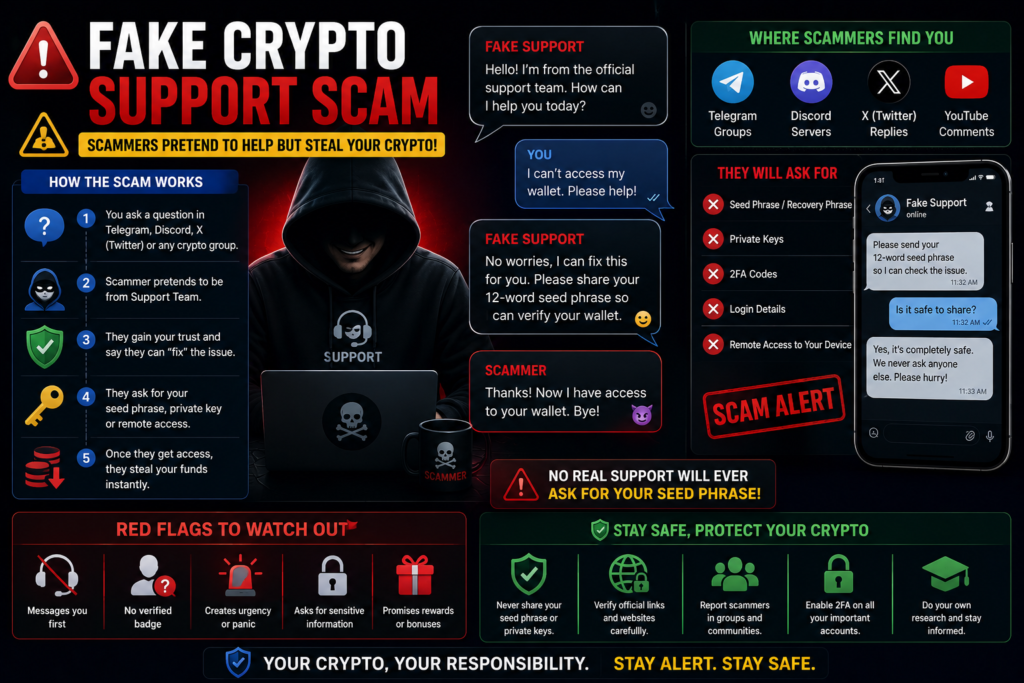
4. Fake Crypto Support Scams
Scammers often pretend to be:
- Customer support agents
- Telegram admins
- Exchange employees
They message users claiming:
- Wallet problems
- Verification issues
- Security alerts
Then they ask for:
- Seed phrases
- Passwords
- Remote device access
Important Rule
No legitimate support team will ever ask for your recovery phrase.
5. Rug Pull Scams
A rug pull happens when crypto project developers suddenly disappear after collecting investor money.
This is common in:
- Meme coins
- Fake DeFi projects
- Scam NFT collections
Developers may:
- Remove liquidity
- Abandon projects
- Sell large token holdings
Investors are left with worthless tokens.
Warning Signs
- Anonymous teams
- Unrealistic promises
- No real utility
- Fake social media followers
Always research projects carefully before investing.
6. Giveaway Scams
Scammers often impersonate celebrities or crypto influencers.
Fake giveaways promise:
- Double your Bitcoin
- Free Ethereum rewards
- Exclusive investment offers
Users are asked to send crypto first.
After sending funds, victims receive nothing.
Common Platforms Used
- YouTube livestreams
- Twitter/X
- Telegram
- Discord
Legitimate giveaways never require sending crypto first.
7. Pump And Dump Schemes
In pump-and-dump scams:
- Groups artificially hype low-value coins
- Prices rise temporarily
- Early investors sell quickly
- New investors lose money
These scams are common on:
- Telegram groups
- Discord communities
- Small exchanges
Be cautious of “guaranteed profit” claims.
8. Romance Crypto Scams
Some scammers build fake online relationships before introducing crypto investments.
Victims are convinced to:
- Invest on fake trading platforms
- Send crypto for “profits”
- Trust fake account balances
Eventually, victims cannot withdraw funds.
These scams can continue for weeks or months.
9. Malware And Fake Browser Extensions
Malware may:
- Track passwords
- Record keystrokes
- Steal wallet information
Fake browser extensions may also compromise wallets.
Stay Safe By
- Using antivirus software
- Avoiding suspicious downloads
- Installing official browser extensions only
Device security is extremely important for crypto users.
Biggest Crypto Scam Warning Signs
Be Careful If You See
- Guaranteed profits
- Urgent pressure to invest
- Free crypto offers
- Requests for seed phrases
- Anonymous project teams
- Fake social media followers
If something sounds too good to be true, it probably is.
How To Protect Yourself From Crypto Scams
1. Never Share Seed Phrases
Your recovery phrase controls your wallet completely.
Keep it private and offline.
2. Use Official Websites Only
Always verify URLs carefully before connecting wallets.
Bookmark trusted websites whenever possible.
3. Enable Two-Factor Authentication
Use 2FA on:
- Exchanges
- Email accounts
- Crypto platforms
This adds additional security.
4. Research Before Investing
Before buying any crypto:
- Check project websites
- Research development teams
- Read community discussions
- Verify utility and roadmap
Never invest blindly because of hype.
5. Use Hardware Wallets For Large Holdings
Cold wallets like Ledger and Trezor provide stronger long-term security.
Many experienced investors store large holdings offline.
Common Crypto Scams Beginners Should Know
Common Crypto Scams Beginners encounter include phishing scams, fake giveaways, rug pulls, impersonation scams, and fake investment platforms.
Most scammers target inexperienced investors who are unfamiliar with blockchain security practices.
Understanding Common Crypto Scams Beginners face can help investors avoid major financial losses.
Warning Signs of Crypto Scams
Some common warning signs include:
- Guaranteed profits
- Pressure to invest quickly
- Fake celebrity endorsements
- Requests for private keys or seed phrases
- Suspicious websites with poor design
If you notice any of these signs, avoid sending money or connecting your wallet.
Also Read
Before learning about common crypto scams, it’s important to understand the basics of blockchain technology. Read our Blockchain: The 5000-Year Story of Trust, Records, and Digital Revolution to understand how legitimate blockchain projects actually work.
Many crypto scams target beginners who don’t fully understand cryptocurrencies. Start with our What Is Cryptocurrency? Ultimate Beginner’s Guide To Crypto In 2026 to build a strong foundation before investing.
Before investing in any cryptocurrency, learn how to identify fake projects by reading our How to Spot Fake Crypto Projects in 2026 | Complete Ultimate Beginner Safety Guide.
Scammers often take advantage of hype during bull markets and Altcoin Season. To understand real market cycles and avoid emotional investing, read our What Is a Bull Run in Crypto? How Investors Profit During Market Booms (2026) and What Is Altcoin Season in Crypto? Best Beginner Guide for 2026.
After learning about common crypto scams, continue with our NFT Scams Beginners Must Avoid in 2026 – Ultimate Complete Safety Guide to discover how to protect yourself from NFT rug pulls, phishing attacks, fake marketplaces, and other Web3 scams.
Also Read
Learn about hardware wallet protection on the official Ledger wallet website
Explore crypto security education on the official Ethereum website
Learn about online scam awareness on the official Federal Trade Commission website
Final Thoughts
Crypto scams are becoming more advanced every year.
Beginners are often targeted because they lack security experience.
However, learning basic crypto safety can significantly reduce risks.
Always remember:
- Never share seed phrases
- Avoid suspicious links
- Verify websites carefully
- Ignore guaranteed profit claims
- Research projects before investing
Crypto security awareness is one of the most important skills for every investor.
Protecting your wallet properly can help secure your investments long term.
FAQ
What Is The Most Common Crypto Scam?
Fake airdrops and phishing websites are among the most common crypto scams.
Can Crypto Scams Be Reversed?
In most cases, crypto transactions cannot easily be reversed.
How Do Scammers Steal Crypto?
Scammers use fake websites, phishing links, malware, and fake support messages to steal crypto.
Are Telegram Crypto Groups Safe?
Some Telegram groups are legitimate, but many scams also operate through Telegram.
How Can Beginners Avoid Crypto Scams?
Beginners should use official websites, protect seed phrases, and avoid unrealistic investment promises.
Why are beginners targeted by crypto scammers?
Beginners often lack experience and may not recognize warning signs used by scammers.
Are crypto scams increasing in 2026?
Yes. As cryptocurrency adoption grows, scammers continue developing new methods to target investors.
join our Telegram for instant crypto updates.
Subscribe to our youtube Channel
For detailed crypto market analysis, price predictions, and investment strategies,
subscribe to our YouTube channel Coin Alert

Dr. Khushwant Rana is the founder of Coin Alert and has 15+ years of business experience. He creates beginner-friendly crypto educational content focused on Bitcoin, blockchain, Web3, crypto security, and real-world crypto awareness in India.