Ethereum is one of the most popular blockchain networks in the world.
It powers:
- Smart contracts
- NFTs
- DeFi platforms
- Web3 applications
- Blockchain gaming
But Ethereum also has one major issue:
High gas fees
Many beginners become confused when they see expensive transaction costs while sending crypto or using decentralized apps.
In this beginner-friendly guide, we will understand:
- What Ethereum gas fees are
- Why gas fees become expensive
- What Gwei means
- Network congestion explained
- How Layer 2 solutions reduce fees
- Ways to save gas fees in 2026
What Are Ethereum Gas Fees?
Gas fees are transaction fees paid on the Ethereum blockchain.
Whenever users:
- Send ETH
- Buy NFTs
- Swap crypto
- Use DeFi apps
- Interact with smart contracts
they must pay gas fees.
These fees help:
- Process transactions
- Secure the network
- Reward validators
Why Is It Called “Gas”?
Ethereum uses the word:
Gas
to describe the computational power required to perform actions on the blockchain.
Simple actions need less gas.
Complex actions require more gas.
Simple Example
Imagine Ethereum as a highway.
Every transaction is like:
A car entering the highway
Gas fees are:
The toll fee
When traffic increases:
- Tolls become expensive
- Movement slows down
This is similar to Ethereum network congestion.
Why Do Ethereum Gas Fees Become Expensive?
Gas fees increase mainly because:
Too many people use Ethereum at the same time.
Examples:
- NFT launches
- Meme coin hype
- DeFi trading activity
- Bull market surges
When network demand rises:
- Users compete to process transactions faster
- Validators prioritize higher-paying transactions
- Fees increase significantly
What Is Network Congestion?
Network congestion happens when:
Ethereum receives more transactions than it can handle efficiently.
This creates:
- Slower processing
- Higher fees
- Delayed transactions
Ethereum scalability has been a major challenge for years.
What Is Gwei?
Gas fees are measured in:
Gwei
Gwei is a small unit of Ethereum.
Think of it like:
- Dollars and cents
- Rupees and paise
1 ETH contains billions of Gwei units.
Gas prices are usually displayed in Gwei.
What Is Gas Limit?
Gas limit refers to:
The maximum amount of gas a transaction can use.
Simple ETH transfers need less gas.
More complex activities like:
- Smart contracts
- NFT minting
- DeFi interactions
require higher gas limits.
What Is Gas Price?
Gas price is:
The amount users are willing to pay per gas unit.
Higher gas price:
- Faster transaction processing
Lower gas price:
- Slower confirmation times
Example of Ethereum Gas Fees
Suppose:
- Network is busy
- Many users are trading
Then:
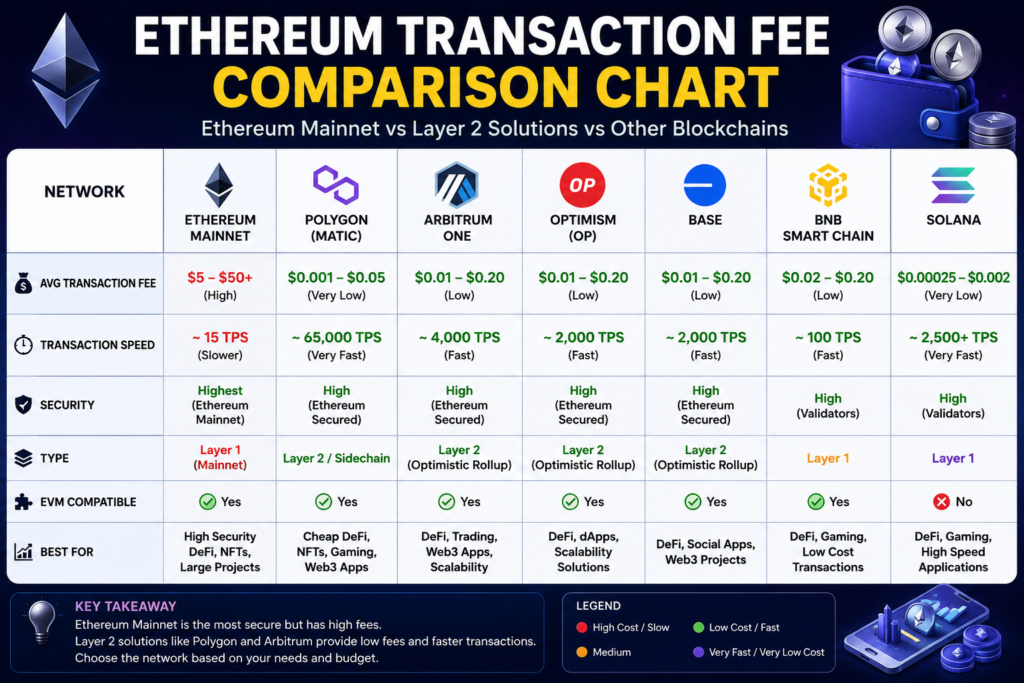
- Gas fees may rise to $20–$100 or more
During quiet periods:
- Fees may become much lower
This is why Ethereum fees constantly change.
Why Ethereum Gas Fees Are a Problem
High gas fees create problems for:
- Beginners
- Small investors
- Gamers
- NFT traders
Sometimes fees become more expensive than the transaction itself.
This limits blockchain adoption.
How Layer 2 Solutions Reduce Gas Fees
Layer 2 solutions help Ethereum scale more efficiently.
Popular Layer 2 networks include:
- Polygon
- Arbitrum
- Optimism
- zkSync
These networks:
- Process transactions more efficiently
- Reduce congestion
- Lower transaction costs
Polygon and Ethereum Gas Fees
Polygon became popular because:
It offers much cheaper transactions than Ethereum mainnet.
Many users moved to Polygon to:
- Save money
- Use DeFi cheaply
- Trade NFTs with lower fees
Arbitrum and Gas Fee Reduction
Arbitrum uses:
Optimistic Rollups
This technology bundles transactions together to improve efficiency.
Benefits include:
- Lower fees
- Faster transactions
- Better scalability
Ethereum Upgrades and Future Improvements
Ethereum developers continue working on:
- Scalability upgrades
- Better efficiency
- Lower costs
Future blockchain improvements may help reduce gas fees further.
How to Save Ethereum Gas Fees
1. Use Layer 2 Networks
Polygon and Arbitrum can reduce costs significantly.
2. Avoid Peak Hours
Gas fees usually increase during:
- Heavy trading periods
- Major NFT launches
- Bull market hype
Using Ethereum during quiet times may reduce fees.
3. Check Gas Fee Trackers
Websites and wallets can show:
- Current gas prices
- Best transaction times
4. Avoid Unnecessary Transactions
Each blockchain interaction costs money.
Always double-check before confirming transactions.
Ethereum vs Other Blockchains
Some newer blockchains offer:
- Lower fees
- Faster speed
Examples:
- Solana
- Avalanche
- BNB Chain
However, Ethereum remains the largest smart contract ecosystem.
Real-World Use Cases Affected by Gas Fees
Gas fees impact:
- NFT minting
- DeFi trading
- Blockchain gaming
- Crypto transfers
- Web3 applications
This is why Ethereum scaling solutions became important.
Future of Ethereum Gas Fees in 2026
As Layer 2 adoption grows:
- Ethereum congestion may reduce
- Transactions may become cheaper
- Web3 usage may improve
Scaling technology is expected to become a major part of blockchain growth.
Also Read
Before learning about Ethereum Gas Fees, it’s important to understand the foundation of Ethereum and blockchain technology. Read our Ethereum Story: How Vitalik Buterin Created Ethereum and Changed Crypto.
Ethereum Gas Fees are paid whenever you send crypto or interact with smart contracts. To understand how blockchain transactions are processed, read our How Cryptocurrency Transactions Work on Blockchain in 2026.
Want to know why Ethereum Gas Fees become expensive during periods of high network activity? Read our What Is Optimism Crypto? Ultimate Complete Beginner Guide to Ethereum Layer 2 (2026) to discover how Layer 2 networks significantly reduce transaction costs.
Smart contracts are the biggest reason users pay Gas Fees on Ethereum. Learn how they work in our What Is Smart Contract in Blockchain? Complete Ultimate Beginner Guide for 2026.
After learning about Ethereum Gas Fees, continue with our What Is Base Chain? Ultimate Complete Beginner Guide (2026) to see how modern Ethereum Layer 2 networks offer faster transactions and dramatically lower gas fees while maintaining Ethereum’s security.
Also Read
Ethereum Official Website. https://ethereum.org/
Ethereum Gas Tracker. https://etherscan.io/gastracker
Polygon Official Website. https://polygon.technology/
Final Thoughts
Ethereum gas fees are transaction costs required to use the Ethereum blockchain.
Fees become expensive when:
- Network demand increases
- Congestion rises
- More users compete for transaction processing
Layer 2 solutions like Polygon and Arbitrum help solve these problems by improving scalability and reducing costs.
Understanding gas fees is essential for anyone entering crypto, Web3, NFTs, or decentralized finance in 2026.
FAQ
What are Ethereum gas fees?
Gas fees are transaction fees paid to use the Ethereum blockchain.
Why are Ethereum gas fees expensive?
Fees increase when network congestion becomes high.
What is Gwei?
Gwei is a small unit used to measure Ethereum gas prices.
How can I reduce Ethereum gas fees?
You can use Layer 2 networks like Polygon or Arbitrum.
Which Layer 2 network is popular?
Polygon and Arbitrum are among the most popular Ethereum scaling solutions.
join our Telegram for instant crypto updates.
Subscribe to our youtube Channel
For detailed crypto market analysis, price predictions, and investment strategies,
subscribe to our YouTube channel Coin Alert

Dr. Khushwant Rana is the founder of Coin Alert and has 15+ years of business experience. He creates beginner-friendly crypto educational content focused on Bitcoin, blockchain, Web3, crypto security, and real-world crypto awareness in India.