Avalanche is one of the fastest-growing blockchain networks in the cryptocurrency industry. It was created to solve major blockchain problems like slow transaction speeds, high fees, and scalability limitations.
Avalanche is known for:
- Fast transactions
- Low fees
- Smart contracts
- Web3 support
- DeFi applications
- NFT ecosystems
The native cryptocurrency of Avalanche is called AVAX.
In this beginner-friendly guide, we will understand what Avalanche is, how it works, what AVAX coin is used for, staking, subnet technology, advantages, disadvantages, and the future of Avalanche in 2026.
What Is Avalanche?
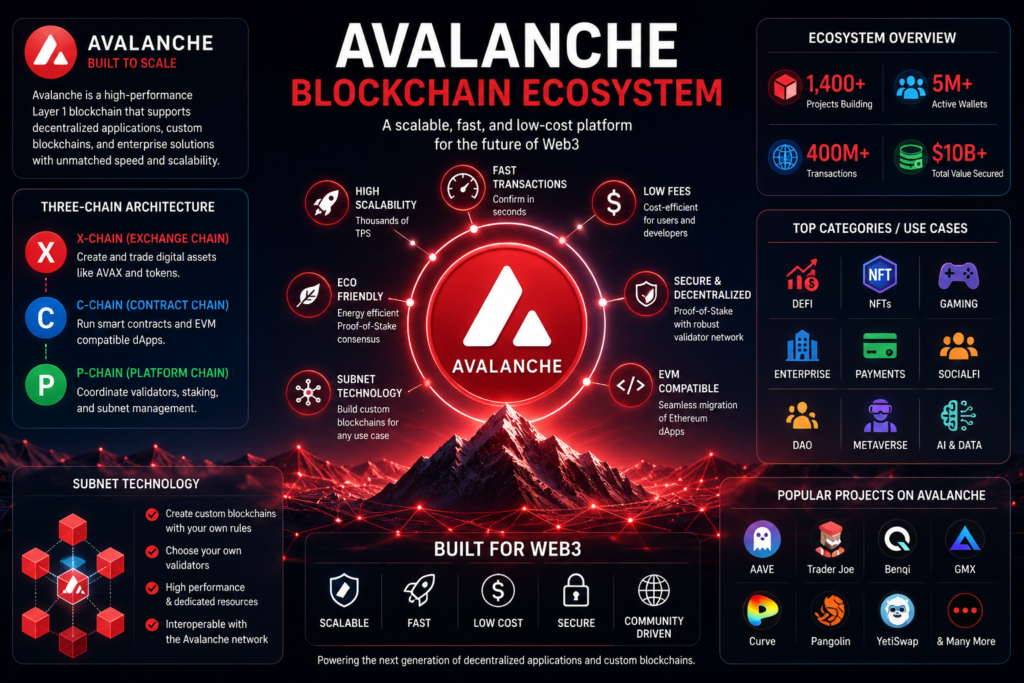
Avalanche is a Layer 1 blockchain platform designed for decentralized applications (dApps), smart contracts, DeFi projects, NFTs, and enterprise blockchain solutions.
What Is Ethereum and How Does It Work in 2026?
It competes with major blockchains like:
- Ethereum
- Solana
- BNB Chain
- Polkadot
Avalanche focuses heavily on:
- Speed
- Scalability
- Security
- Low transaction costs
Who Created Avalanche?
Avalanche was created by Ava Labs.
The project was co-founded by:
- Emin Gün Sirer
- Kevin Sekniqi
- Maofan “Ted” Yin
Avalanche officially launched in 2020.
What Is Solana (SOL)? Complete Beginner Guide in 2026
The goal was to create a blockchain network that is:
- Faster than Ethereum
- More scalable
- More decentralized
What Problem Does Avalanche Solve?
Older blockchains like Ethereum often face problems such as:
- Slow transaction speeds
- High gas fees
- Network congestion
Avalanche solves these problems by offering:
- Near-instant transactions
- Low fees
- High scalability
- Support for thousands of transactions per second
This makes Avalanche attractive for developers and users.
How Does Avalanche Work?
Avalanche uses a unique consensus mechanism called the Avalanche Consensus Protocol.
Unlike Bitcoin mining, Avalanche uses a Proof-of-Stake system.
The network validates transactions quickly and securely using validators instead of miners.
This helps Avalanche achieve:
- High speed
- Low energy consumption
- Better scalability
Avalanche’s Three Blockchain Structure
Avalanche has a unique architecture with three blockchains.
X-Chain (Exchange Chain)
Used for:
- Creating assets
- Sending and receiving tokens
C-Chain (Contract Chain)
Used for:
- Smart contracts
- Ethereum-compatible applications
- DeFi projects
P-Chain (Platform Chain)
Used for:
- Validators
- Staking
- Subnet management
This structure improves efficiency and network performance.
What Is Polkadot (DOT)? Complete Beginner Guide in 2026
What Are Avalanche Subnets?
Subnets are custom blockchain networks built inside Avalanche.
Developers can create their own blockchains with:
- Custom rules
- Custom tokens
- Different permissions
Example:
A gaming company could create a special subnet only for blockchain games.
This makes Avalanche flexible for enterprise and Web3 development.
What Is AVAX Coin?
AVAX is the native cryptocurrency of the Avalanche network.
AVAX is used for:
- Paying transaction fees
- Staking
- Governance
- Network security
- Running validators
AVAX also helps secure the network through staking.
Avalanche Staking Explained
Avalanche uses Proof-of-Stake instead of mining.
Users can stake AVAX coins and earn rewards.
Example:
If someone holds AVAX for the long term, they can stake their coins to generate passive income while supporting the network.
This process uses much less electricity compared to Bitcoin mining.
What Is Binance Coin (BNB)? Complete Beginner Guide in 2026
Why Is Avalanche Popular?
Fast Transactions
Avalanche transactions finalize in seconds.
Low Fees
Transaction fees are cheaper compared to Ethereum during high traffic periods.
Ethereum Compatibility
Developers can easily move Ethereum applications to Avalanche.
Strong DeFi Ecosystem
Many DeFi projects operate on Avalanche.
Eco-Friendly
Proof-of-Stake consumes less energy.
Real-World Uses of Avalanche
Avalanche supports many blockchain industries.
DeFi Applications
Supports lending, staking, and decentralized exchanges.
NFT Platforms
Used for NFT marketplaces and gaming projects.
Enterprise Solutions
Companies can build custom blockchains.
Web3 Development
Supports decentralized internet applications.
Gaming Ecosystems
Blockchain games can run on Avalanche subnets.
Advantages of Avalanche
High Speed
Avalanche processes transactions very quickly.
Scalable Network
Subnet technology improves scalability.
Developer Friendly
Supports Ethereum tools and smart contracts.
Energy Efficient
Uses Proof-of-Stake consensus.
Growing Ecosystem
Many projects are building on Avalanche.
Disadvantages of Avalanche
Strong Competition
Competes with Ethereum, Solana, and other Layer 1 blockchains.
Market Volatility
AVAX price can be highly volatile.
Complex Ecosystem
Beginners may find subnet technology difficult initially.
Adoption Risk
Still growing compared to Ethereum.
Is Avalanche Safe?
Avalanche is considered a secure blockchain network because of its advanced consensus mechanism and validator system.
Official Avalanche Website. https://www.avax.network
However, users should still:
- Use trusted wallets
- Protect private keys
- Avoid scam projects
- Enable security features
Best Wallets for Avalanche (AVAX)
Popular AVAX wallets include:
- Core Wallet
- MetaMask
- Trust Wallet
- Ledger Wallet
- Coinbase Wallet
Hardware wallets are safest for long-term crypto storage.
Can Avalanche Compete With Ethereum?
Avalanche is often called an Ethereum competitor because:
- It supports smart contracts
- It offers lower fees
- It processes transactions faster
However, Ethereum still has the largest ecosystem.
Many investors believe Avalanche could become one of the leading blockchain networks in Web3.
Is Avalanche a Good Investment?
Avalanche remains one of the strongest Layer 1 blockchain projects because of:
- Fast technology
- Strong development team
- Growing ecosystem
- DeFi adoption
- Web3 support
However, cryptocurrency investments are risky and highly volatile.
Always research properly before investing.
Avalanche Docs. https://docs.avax.network
Future of Avalanche in 2026
Avalanche continues expanding in:
- Web3
- Gaming
- NFTs
- Enterprise blockchain solutions
- DeFi ecosystems
If adoption continues growing, Avalanche could become one of the most important blockchain networks in the crypto industry.
CoinMarketCap – Avalanche (AVAX). https://coinmarketcap.com/currencies/avalanche
Final Thoughts
Avalanche is a fast, scalable, and developer-friendly blockchain network designed for the future of Web3.
Its subnet technology, low fees, and high transaction speed make it one of the most promising crypto projects in 2026.
For beginners who want to understand modern blockchain technology, Avalanche is an important project to learn about.
FAQ
What is Avalanche used for?
Avalanche is used for smart contracts, DeFi, NFTs, gaming, staking, and Web3 applications.
What is AVAX coin?
AVAX is the native cryptocurrency of the Avalanche blockchain.
Is Avalanche better than Ethereum?
Avalanche offers faster transactions and lower fees, but Ethereum still has a larger ecosystem.
Can I stake AVAX?
Yes, AVAX holders can stake coins and earn rewards.
What are Avalanche subnets?
Subnets are custom blockchain networks built inside Avalanche.
join our Telegram for instant crypto updates.
Subscribe to our youtube Channel
For detailed crypto market analysis, price predictions, and investment strategies,
subscribe to our YouTube channel Coin Alert