What Is Rollup-as-a-Service (RaaS)?
The Ethereum ecosystem is growing faster than ever.
Today, we are seeing:
- Layer 2 networks
- Rollups
- Modular blockchains
- Web3 gaming
- AI-powered decentralized apps
- Scalable blockchain infrastructure
But building a blockchain network from scratch is still difficult.
This is where a new concept called Rollup-as-a-Service (RaaS) becomes important.
If you are learning about:
- Ethereum scaling
- Layer 2 ecosystems
- Rollups
- Web3 infrastructure
- Modular blockchain
then understanding RaaS is very valuable.
At first, the term may sound technical.
But the idea behind it is actually very simple.
In this article, we will understand:
- What Rollup-as-a-Service means
- How RaaS works
- Why projects use RaaS
- Benefits and risks of RaaS
- Why Ethereum ecosystem is moving toward this model
- Future of Rollup infrastructure
What Is Rollup-as-a-Service?
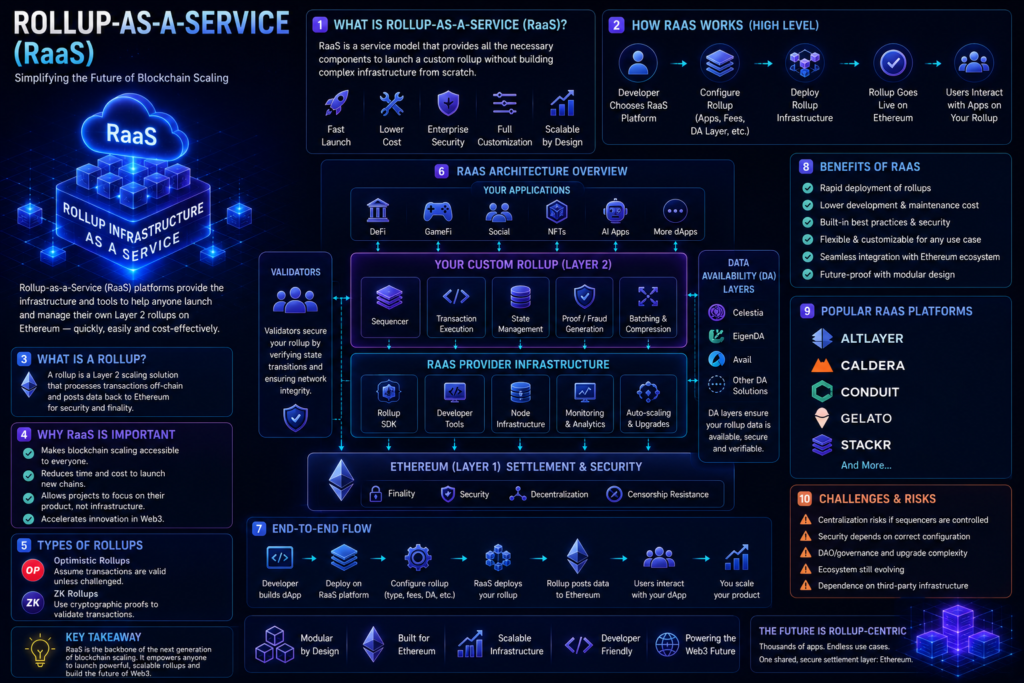
Rollup-as-a-Service (RaaS) is a service model that helps developers launch their own blockchain rollups easily.
Instead of building everything from scratch, developers can use RaaS providers to create scalable Layer 2 networks quickly.
In simple words:
RaaS works like “Shopify for blockchain rollups.”
Just like Shopify helps businesses create online stores easily, RaaS platforms help projects create blockchain rollups more efficiently.
Rollup-as-a-Service (RaaS) is becoming one of the easiest ways to launch Ethereum Layer 2 networks without building blockchain infrastructure from scratch.
Many blockchain developers choose Rollup-as-a-Service because it reduces development costs and deployment time.
Understanding Rollup-as-a-Service helps beginners learn how modern Layer 2 ecosystems are expanding rapidly.
Rollup-as-a-Service platforms provide infrastructure, security, and deployment tools for blockchain projects.
What Is a Rollup?
Before understanding RaaS, we first need to understand rollups.
A Rollup is a Layer 2 scaling solution that processes transactions outside Ethereum mainnet and later submits data back to Ethereum.
This helps:
- Reduce gas fees
- Improve scalability
- Increase transaction speed
Popular Ethereum rollups include:
- Arbitrum
- Optimism
- Base
- zkSync
- StarkNet
Rollups are becoming the backbone of Ethereum scaling.
Why RaaS Was Created
Launching a rollup manually is difficult.
Projects usually need:
- Developers
- Validators
- Infrastructure
- Data availability systems
- Sequencers
- Security architecture
This requires huge technical resources.
RaaS platforms simplify this process.
They provide ready-made infrastructure so developers can launch rollups faster.
Simple Real-Life Example
Imagine you want to start a food delivery business.
You have two options:
Option 1
Build everything yourself:
- Website
- Payment system
- Delivery system
- Tracking
- Servers
This is expensive and complicated.
Option 2
Use a ready-made platform.
Now you can launch faster and focus on your business.
RaaS works in a similar way for blockchain projects.
How RaaS Works
RaaS providers offer blockchain infrastructure tools.
Developers can use these services to launch custom Layer 2 chains.
The process usually includes:
Step 1 — Choose Rollup Type
Projects choose:
- Optimistic Rollup
- zk Rollup
Step 2 — Configure Infrastructure
Developers customize:
- Gas fees
- Security settings
- DA layers
- Token support
Step 3 — Deploy Rollup
The Layer 2 network launches on Ethereum ecosystem.
Step 4 — Scale Applications
Projects use the rollup for:
- Gaming
- DeFi
- AI applications
- NFT ecosystems
- Enterprise systems
Types of Rollups
1. Optimistic Rollups
These assume transactions are valid unless challenged.
Examples:
- Arbitrum
- Optimism
2. zk Rollups
These use cryptographic proofs to verify transactions.
Examples:
- zkSync
- StarkNet
- Polygon zkEVM
Both models are heavily used in Ethereum ecosystem.
Ethereum and Rollups
Ethereum is heavily focused on rollup-centric scaling.
Instead of increasing Layer 1 size endlessly, Ethereum supports Layer 2 ecosystems.
This improves:
- Scalability
- Speed
- User experience
- Cost efficiency
You can also read these beginner guides:
Benefits of Rollup-as-a-Service
1. Faster Deployment
Projects can launch rollups quickly.
2. Lower Development Costs
Infrastructure providers reduce technical overhead.
3. Better Scalability
Rollups process transactions more efficiently.
4. Customization
Projects can create application-specific chains.
5. Better User Experience
Users may experience lower fees and faster transactions.
Risks of RaaS
Like every technology, RaaS also has risks.
1. Centralization Risk
Some providers may control too much infrastructure.
2. Security Complexity
Blockchain security still requires careful management.
3. Dependency on Providers
Projects may become dependent on infrastructure companies.
4. New Technology Risk
The RaaS industry is still evolving.
Popular RaaS Projects
Several companies are already working in this sector.
Examples include:
- AltLayer
- Caldera
- Conduit
- Gelato
- Stackr
These platforms help projects launch scalable Ethereum-compatible rollups.
Official resources:
Why RaaS Is Important
The future of blockchain may involve thousands of specialized chains.
Different applications may use different rollups for:
- Gaming
- AI
- DeFi
- NFTs
- Social media
- Enterprise systems
RaaS helps make this future possible.
Without easy infrastructure, scaling Web3 globally becomes much harder.
RaaS and Modular Blockchain
RaaS also connects closely with modular blockchain architecture.
Modern blockchain systems separate:
- Execution
- Consensus
- Settlement
- Data Availability
RaaS platforms often integrate with:
- EigenLayer
- Celestia
- DA layers
- Ethereum rollups
This creates scalable modular ecosystems.
Future of Rollup Infrastructure
Ethereum ecosystem is moving rapidly toward rollup-centric scaling.
Today we are seeing:
- Growth of Layer 2s
- Expansion of modular blockchains
- Better DA layers
- Shared security systems
- Restaking infrastructure
RaaS may become one of the biggest infrastructure industries inside Web3.
Many experts believe future blockchain applications may launch directly as custom rollups instead of traditional smart contracts.
Conclusion
Rollup-as-a-Service (RaaS) is making blockchain infrastructure easier and more scalable.
Instead of building complex rollups manually, developers can now launch Ethereum-compatible Layer 2 networks quickly using RaaS platforms.
This improves:
- Scalability
- Speed
- Flexibility
- Web3 innovation
As Ethereum ecosystem continues evolving, RaaS may become a major part of future blockchain infrastructure.
Allso Read
Before learning about Rollup-as-a-Service (RaaS), it’s important to understand the basics of blockchain technology. Read our Blockchain: The 5000-Year Story of Trust, Records, and Digital Revolution.
Rollup-as-a-Service is built around Ethereum Layer 2 technology. Start with our What Is Optimism Crypto? Complete Beginner Guide to understand how Layer 2 scaling solutions work.
To learn about the framework that powers many Rollup-as-a-Service platforms, read our What Is OP Stack? How It Powers Ethereum Layer 2 Networks (2026).
Want to understand how multiple Layer 2 networks connect into one ecosystem? Read our What Is Superchain? Powerful Beginner Guide to Ethereum’s Future (2026).
To discover how future Layer 2 networks improve interoperability and transaction ordering, read our What Is Shared Sequencer? Complete Guide for Beginners (2026).
Also Read
FAQ
What is Rollup-as-a-Service?
Rollup-as-a-Service helps developers launch blockchain rollups using ready-made infrastructure.
What is a rollup in crypto?
A rollup is a Layer 2 scaling solution that processes transactions outside Ethereum mainnet.
Why is RaaS important?
RaaS makes blockchain scaling easier, faster, and more affordable.
Which blockchains use rollups?
Ethereum ecosystem heavily uses rollups.
What are popular RaaS platforms?
Examples include AltLayer, Caldera, Conduit, and Gelato.
join our Telegram for instant crypto updates.
Subscribe to our youtube Channel
For detailed crypto market analysis, price predictions, and investment strategies,
subscribe to our YouTube channel Coin Alert
Want to learn more about crypto, Ethereum Layer 2 projects, wallets, blockchain, and Web3?
Visit Coin Alert for more beginner-friendly crypto guides and latest crypto education content.
Disclaimer
This article is for educational purposes only and not financial advice. Cryptocurrency investments are risky. Always do your own research and consult a financial advisor before investing.

Dr. Khushwant Rana is the founder of Coin Alert and has 15+ years of business experience. He creates beginner-friendly crypto educational content focused on Bitcoin, blockchain, Web3, crypto security, and real-world crypto awareness in India.