Blockchain technology is changing how digital systems work, and one of the most important innovations in crypto is:
Smart Contracts
Smart contracts are automated digital agreements that execute automatically without needing banks, lawyers, or middlemen.
They power many blockchain applications including:
- DeFi
- NFTs
- DAOs
- crypto exchanges
- Web3 apps
In this beginner-friendly guide, you will learn:
- What smart contracts are
- How smart contracts work
- Their advantages and risks
- Real-world use cases
- Why smart contracts are important in blockchain
What Is Smart Contract?
A smart contract is a self-executing digital program stored on a blockchain.
It automatically performs actions when predefined conditions are met.
In simple words:
a smart contract works like automated software that follows rules without human intervention.
What Is Blockchain?
Who Created Smart Contracts?
The concept of smart contracts was first introduced by:
Nick Szabo
He proposed the idea in the 1990s before blockchain technology existed.
Later, Ethereum made smart contracts popular by allowing developers to build decentralized applications on blockchain networks.
How Smart Contracts Work
Smart contracts operate using:
- blockchain technology
- programming code
- automated conditions
The process is simple:
Step 1 — Rules Are Written
Developers create contract rules using programming languages.
Step 2 — Contract Is Stored on Blockchain
The smart contract is deployed on a blockchain network like Ethereum.
Step 3 — Conditions Are Met
When users complete required conditions:
the contract activates automatically.
Step 4 — Automatic Execution
The blockchain executes the programmed action instantly.
No middleman is required.
What Is Ethereum?
Smart Contract Example
Imagine buying a digital product online.
Traditional systems may require:
- payment processors
- banks
- manual verification
With smart contracts:
- payment is verified automatically
- ownership transfers instantly
- blockchain records the transaction
Everything happens automatically.
Benefits of Smart Contracts
1. Automation
No manual processing is needed.
2. Transparency
Transactions are recorded publicly on blockchain.
3. Security
Blockchain technology makes contracts difficult to alter.
4. Faster Transactions
Smart contracts can process transactions quickly.
5. Reduced Costs
Middlemen and administrative costs are reduced.
What Is DAO? https://coinalert.in/what-is-dao-in-crypto-complete-beginner-guide-2026/
Risks of Smart Contracts
1. Coding Bugs
Programming mistakes may create vulnerabilities.
2. Hacking Risks
Hackers may exploit weak smart contracts.
3. Irreversible Transactions
Blockchain transactions are usually permanent.
4. Legal Uncertainty
Smart contract regulations are still evolving globally.
Smart Contracts in Ethereum
Ethereum is the most popular blockchain for smart contracts.
Developers use Ethereum to build:
- DeFi platforms
- NFT marketplaces
- DAOs
- blockchain games
- Web3 applications
Ethereum helped make smart contracts mainstream in crypto.
What Is DeFi?
Smart Contract Use Cases
1. DeFi Platforms
Used for lending, borrowing, and staking.
2. NFTs
Smart contracts manage NFT ownership and transfers.
3. DAOs
DAOs use smart contracts for governance systems.
4. Gaming
Blockchain games use smart contracts for digital assets.
5. Supply Chain Systems
Smart contracts improve transparency in logistics and tracking.
What Is Web3?
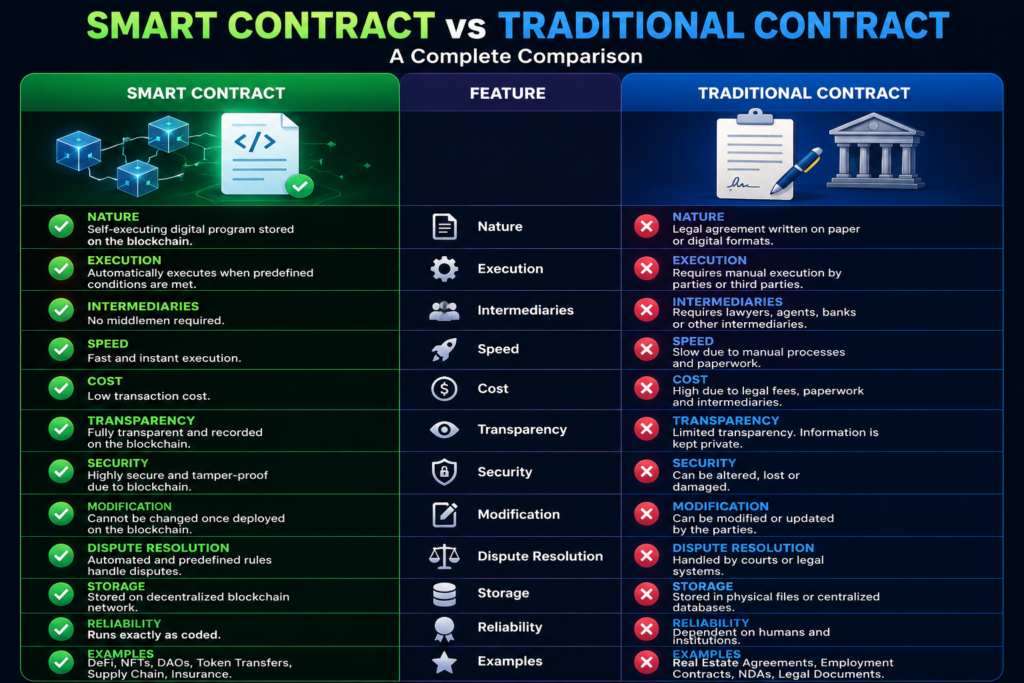
Smart Contract vs Traditional Contracts
| Smart Contracts | Traditional Contracts |
| Automated | Manual |
| Blockchain-based | Paper/legal systems |
| Fast execution | Slower processing |
| Transparent | Limited visibility |
| Lower costs | Higher administrative costs |
Why Smart Contracts Matter in Web3
Web3 focuses on decentralization and automation.
Smart contracts are the foundation of:
- decentralized apps (dApps)
- DeFi
- NFTs
- DAOs
- blockchain ecosystems
Without smart contracts, most modern blockchain systems would not function properly.
Official Ethereum Website https://ethereum.org
Future of Smart Contracts
The smart contract industry continues growing rapidly.
Future use cases may include:
- digital identity systems
- banking
- healthcare
- insurance
- voting systems
- metaverse applications
As blockchain adoption increases, smart contracts may become a major part of the digital economy.
Official Solidity Website https://soliditylang.org/
Conclusion
Smart contracts are one of the most important innovations in blockchain technology.
They allow:
- automation
- transparency
- decentralized systems
- secure transactions
For beginners entering crypto and Web3, understanding smart contracts is essential because they power many modern blockchain applications.
Official Chainlink Website https://chain.link/
FAQ
What is a smart contract?
A smart contract is an automated blockchain-based digital agreement.
Who created smart contracts?
Nick Szabo introduced the smart contract concept in the 1990s.
Which blockchain is famous for smart contracts?
Ethereum is the most popular smart contract blockchain.
Are smart contracts safe?
Smart contracts can be secure, but coding bugs and hacks remain possible.
Why are smart contracts important?
Smart contracts automate blockchain systems without middlemen.
join our Telegram for instant crypto updates.
Subscribe to our youtube Channel
For detailed crypto market analysis, price predictions, and investment strategies,
subscribe to our YouTube channel Coin Alert