Crypto staking has become one of the most popular ways to earn passive income from cryptocurrency in 2026. Instead of simply holding your crypto coins in a wallet, staking allows you to earn rewards while helping secure a blockchain network.
Many beginners hear words like staking rewards, validator, proof of stake, and APY, but they often feel confused. Don’t worry — in this beginner-friendly guide, we will explain everything in very easy language with real examples.
By the end of this article, you will clearly understand:
- What crypto staking is
- How staking works
- Best staking coins in 2026
- Advantages and risks of staking
- How beginners can start staking safely
What Is Crypto Staking?
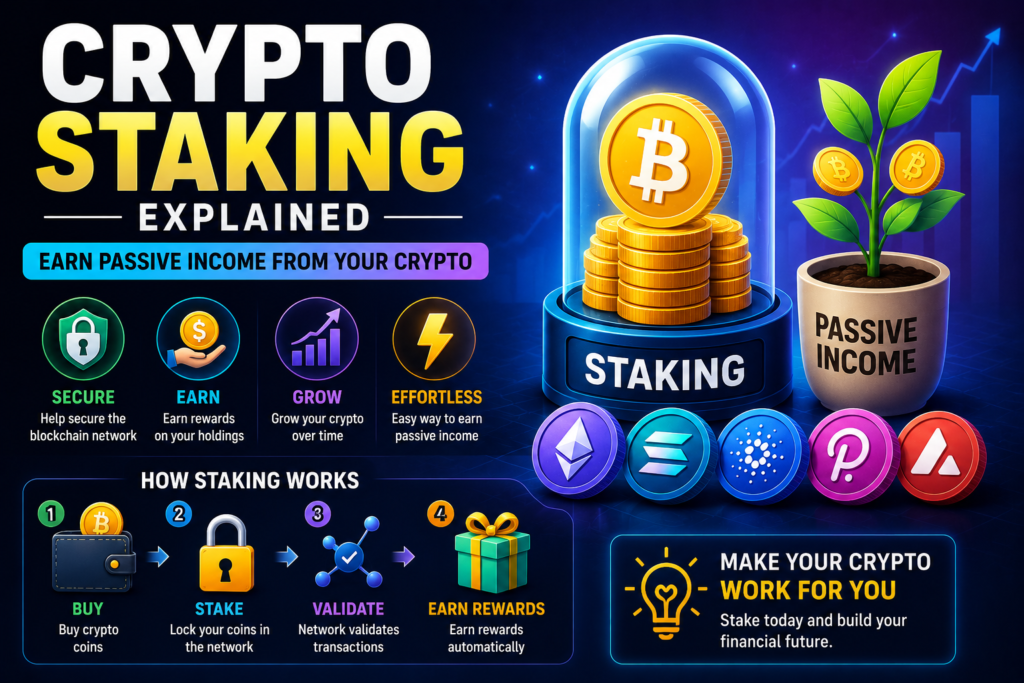
Crypto staking means locking your cryptocurrency in a blockchain network to help verify transactions and secure the network. In return, the blockchain rewards you with extra crypto coins.
You can think of staking like putting money into a savings account.
- Bank gives interest on savings
- Blockchain gives staking rewards on crypto
The main difference is that staking happens on blockchain networks that use a system called Proof of Stake (PoS).
What Is Proof of Stake (PoS)?
Proof of Stake is a blockchain system used to validate transactions without heavy mining machines.
Instead of miners competing with expensive computers, validators are selected based on the amount of crypto they stake.
This system is:
- Faster
- More energy efficient
- Cheaper than mining
- Better for scalability
Popular Proof of Stake coins include:
- Ethereum (ETH)
- Solana (SOL)
- Cardano (ADA)
- Avalanche (AVAX)
- Polkadot (DOT)
How Does Crypto Staking Work?
Let’s understand staking step-by-step.
Step 1: Buy a Staking Coin
First, you need a cryptocurrency that supports staking.
Example:
- ETH
- SOL
- ADA
- DOT
Step 2: Store Coins in Wallet or Exchange
You can stake using:
- Crypto wallets
- Exchanges like Binance or Coinbase
- DeFi staking platforms
Step 3: Lock the Coins
Your crypto gets locked temporarily to support the blockchain network.
This helps:
- Validate transactions
- Maintain security
- Keep blockchain decentralized
Step 4: Earn Rewards
After staking, you start receiving rewards regularly.
Rewards may come:
- Daily
- Weekly
- Monthly
depending on the platform.
Real Example of Crypto Staking
Imagine you stake 1 Ethereum.
If the staking reward is 5% annually, then after one year you may earn:
- 0.05 ETH as reward
If Ethereum price increases, your profits can grow even more.
This is why many long-term investors love staking.
Types of Crypto Staking
1. Flexible Staking
In flexible staking:
- You can withdraw anytime
- Lower rewards
- Better for beginners
2. Locked Staking
In locked staking:
- Funds stay locked for fixed time
- Higher rewards
- Less flexibility
3. DeFi Staking
This happens on decentralized finance platforms.
It may offer:
- Higher returns
- More risks
- Advanced features
Benefits of Crypto Staking
1. Passive Income
You earn rewards without actively trading.
2. Supports Blockchain Security
Your staked coins help secure the network.
3. Eco-Friendly
Proof of Stake uses far less electricity than Bitcoin mining.
4. Beginner Friendly
Most exchanges now allow one-click staking.
5. Compound Growth
You can restake rewards to grow your portfolio faster.
Risks of Crypto Staking
Staking is useful, but it also has risks.
1. Price Volatility
If crypto price falls heavily, staking rewards may not cover losses.
2. Lockup Periods
Some platforms lock your funds for weeks or months.
3. Platform Risks
If an exchange gets hacked, your funds may be at risk.
4. Slashing
Validators can lose part of staked funds for breaking network rules.
Best Crypto Coins for Staking in 2026
Ethereum (ETH)
- Most trusted staking ecosystem
- Strong long-term adoption
Solana (SOL)
- Fast blockchain
- Popular for DeFi and NFTs
Cardano (ADA)
- Beginner-friendly staking
- Energy efficient network
Avalanche (AVAX)
- High-speed blockchain
- Growing ecosystem
Polkadot (DOT)
- Multi-chain ecosystem
- Good staking rewards
How Beginners Can Start Staking
Choose Trusted Platform
Good options include:
- Binance
- Coinbase
- Kraken
- Ledger Wallet
Start Small
Never invest all money at once.
Research APY Carefully
Very high rewards can sometimes be risky.
Use Secure Wallets
Hardware wallets are safer for long-term staking.
Is Crypto Staking Better Than Mining?
For most beginners, yes.
Mining requires:
- Expensive hardware
- Electricity costs
- Technical setup
Staking is much simpler:
- Easy setup
- Lower cost
- Passive rewards
That’s why staking is becoming more popular in 2026.
Future of Crypto Staking
Crypto staking is expected to grow massively in coming years because:
- More blockchains are shifting to Proof of Stake
- Institutions are entering crypto
- Passive income demand is rising
- DeFi ecosystem is expanding
Many experts believe staking could become one of the biggest sectors in crypto.
Also Read
Before learning about Crypto Staking, it’s important to understand the fundamentals of blockchain technology. Read our Blockchain: The 5000-Year Story of Trust, Records, and Digital Revolution.
Crypto staking is based on the Proof of Stake (PoS) consensus mechanism. To understand how Ethereum adopted PoS and transformed the blockchain industry, read our Ethereum Story: How Vitalik Buterin Created Ethereum and Changed Crypto.
Want to understand how staking supports decentralized finance and passive income? Read our What Is DeFi in Crypto? Ultimate Easy Beginner Guide (2026).
Before staking your crypto assets, it’s important to know how blockchain transactions work. Read our How Cryptocurrency Transactions Work on Blockchain in 2026 to understand how validators secure blockchain networks.
After learning about Crypto Staking, continue with our What Is EigenLayer? Complete Beginner Guide 2026 to discover how Ethereum’s restaking technology is taking staking rewards, blockchain security, and decentralized infrastructure to the next level.
Also Read
Ethereum Official Website → https://ethereum.org
Solana Official Website → https://solana.com
Cardano Official Website → https://cardano.org
Final Thoughts
Crypto staking is one of the easiest ways for beginners to earn passive income from cryptocurrency in 2026. It allows investors to grow their holdings while supporting blockchain networks.
However, always remember:
- Crypto markets are volatile
- Rewards are not guaranteed
- Research is extremely important
Start slowly, use trusted platforms, and focus on long-term learning instead of quick profits.
The biggest advantage of staking is that your crypto can keep working for you even while you sleep.
FAQ
Is crypto staking safe?
Staking is generally safe on trusted platforms, but crypto investments always carry risks.
Can beginners do staking?
Yes, many exchanges offer beginner-friendly staking options.
What is the minimum amount needed for staking?
It depends on the coin and platform. Some platforms allow staking with very small amounts.
Which crypto gives highest staking rewards?
Different coins offer different APY rates. Higher rewards usually come with higher risks.
Can I lose money in staking?
Yes. If crypto prices fall or platforms fail, you may face losses.
join our Telegram for instant crypto updates.
Subscribe to our youtube Channel
For detailed crypto market analysis, price predictions, and investment strategies,
subscribe to our YouTube channel Coin Alert

Dr. Khushwant Rana is the founder of Coin Alert and has 15+ years of business experience. He creates beginner-friendly crypto educational content focused on Bitcoin, blockchain, Web3, crypto security, and real-world crypto awareness in India.