What Is DeFi in Crypto?
DeFi stands for Decentralized Finance.
It is a new financial system built on blockchain technology that allows people to:
- send money
- trade crypto
- earn interest
- take loans
- invest
without using banks or traditional financial companies.
In simple words:
DeFi allows people to use financial services directly through blockchain and smart contracts.
Most DeFi apps run on Ethereum and Layer 2 networks.
How Does DeFi Work?
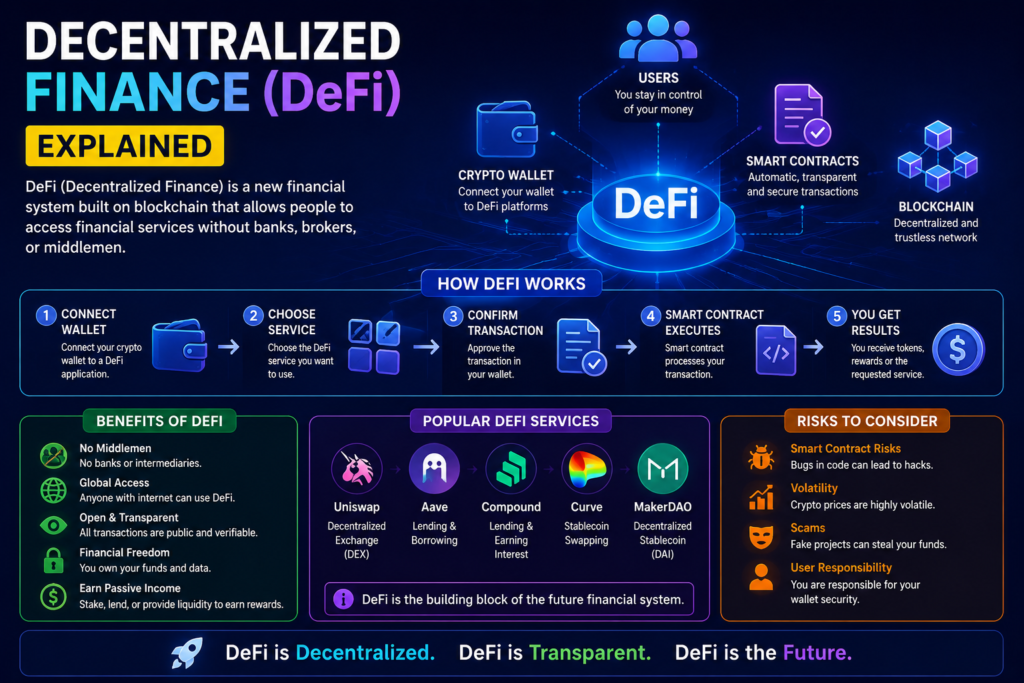
DeFi works using:
- blockchain technology
- smart contracts
- crypto wallets
Instead of banks controlling transactions, smart contracts automatically handle everything.
For example:
- lending
- borrowing
- swapping coins
- staking
- earning rewards
all happen automatically on blockchain networks.
Real Life Example
Imagine you want to exchange ETH for USDC.
Normally:
- you create account on exchange
- complete KYC
- deposit funds
- wait for approval
But in DeFi:
- connect wallet
- choose token
- click swap
Done instantly.
No bank.
No middleman.
What Are Smart Contracts?
Smart contracts are programs stored on blockchain.
They automatically execute transactions when conditions are met.
For example:
- if user deposits ETH
- then automatically receive loan
No human approval needed.
Popular DeFi Platforms
Some famous DeFi platforms are:
- Uniswap
- PancakeSwap
- Aave
- Curve Finance
- MakerDAO
These platforms allow:
- token swaps
- lending
- staking
- liquidity providing
Types of DeFi Services
1. Decentralized Exchanges (DEX)
DEX platforms allow users to trade crypto directly from wallets.
Example:
- Uniswap
- PancakeSwap
2. Lending Platforms
Users can lend crypto and earn interest.
Borrowers can take loans using crypto collateral.
Example:
- Aave
- Compound
3. Staking Platforms
Users lock crypto to earn passive rewards.
4. Yield Farming
Users provide liquidity and earn rewards from DeFi protocols.
Benefits of DeFi
1. No Middleman
No bank controls your money.
2. Global Access
Anyone with internet can use DeFi.
3. Full Control
You control your wallet and funds.
4. Fast Transactions
Transactions happen quickly on blockchain networks.
5. Passive Income
Users can earn rewards through:
- staking
- lending
- liquidity providing
Risks of DeFi
DeFi also has risks.
1. Smart Contract Hacks
Some projects get hacked due to coding bugs.
2. Scams
Fake DeFi projects can steal user funds.
3. Volatility
Crypto prices change very fast.
4. Wallet Security
If you lose your wallet seed phrase, funds may be lost forever.
DeFi vs Traditional Banking
| Feature | DeFi | Traditional Banks |
| Control | User controls funds | Bank controls funds |
| Access | Global | Restricted |
| Speed | Fast | Slower |
| KYC | Often not required | Required |
| Availability | 24/7 | Limited hours |
How Beginners Can Start Using DeFi
Step 1: Create Wallet
Use wallets like:
- MetaMask
- Trust Wallet
Step 2: Buy Crypto
Buy ETH or stablecoins from exchanges.
Step 3: Connect Wallet to DeFi App
Visit trusted DeFi platforms.
Step 4: Start Small
Never invest large money at beginning.
Future of DeFi
DeFi is growing rapidly.
Many experts believe DeFi can change:
- banking
- payments
- investing
- lending
in the future.
Layer 2 networks are also making DeFi:
- cheaper
- faster
- easier
for beginners.
Also Read
Before learning about DeFi, it’s important to understand the foundation of blockchain technology. Read our Blockchain: The 5000-Year Story of Trust, Records, and Digital Revolution.
DeFi is primarily built on Ethereum. To understand how Ethereum made decentralized finance possible, read our Ethereum Story: How Vitalik Buterin Created Ethereum and Changed Crypto.
Before using any DeFi platform, learn how cryptocurrency transactions work by reading our How Cryptocurrency Transactions Work on Blockchain in 2026.
Want to understand how Ethereum is becoming faster and cheaper for DeFi users? Read our What Is Optimism Crypto? Ultimate Complete Beginner Guide to Ethereum Layer 2 (2026).
After learning about DeFi, continue with our What Is EigenLayer? Complete Beginner Guide 2026 to discover how Ethereum’s next-generation infrastructure is improving decentralized applications, staking, and blockchain security.
Also Read
FAQ
Is DeFi safe?
DeFi can be safe if users choose trusted platforms and protect wallet security.
Do I need KYC for DeFi?
Most DeFi platforms do not require KYC.
Which blockchain is most used for DeFi?
Ethereum is the most popular blockchain for DeFi.
Can beginners use DeFi?
Yes, beginners can start using DeFi with small investments and proper learning.
join our Telegram for instant crypto updates.
Subscribe to our youtube Channel
For detailed crypto market analysis, price predictions, and investment strategies,
subscribe to our YouTube channel Coin Alert
Want to learn more about crypto, Ethereum Layer 2 projects, wallets, blockchain, and Web3?
Visit Coin Alert for more beginner-friendly crypto guides and latest crypto education content.
Disclaimer
This article is for educational purposes only and not financial advice. Cryptocurrency investments are risky. Always do your own research and consult a financial advisor before investing.

Dr. Khushwant Rana is the founder of Coin Alert and has 15+ years of business experience. He creates beginner-friendly crypto educational content focused on Bitcoin, blockchain, Web3, crypto security, and real-world crypto awareness in India.