DEX in Crypto is one of the most important concepts in the decentralized finance (DeFi) ecosystem. Unlike traditional cryptocurrency exchanges, a DEX allows users to trade digital assets directly from their wallets without relying on a central authority. As DeFi adoption continues to grow, understanding DEX in Crypto has become essential for every beginner entering the blockchain industry.
If you are learning about cryptocurrency, you have probably heard names like Binance, Coinbase, and Bybit. These are popular centralized exchanges. However, in the crypto world, decentralized exchanges are becoming increasingly important because they offer greater control, transparency, and security.
But in the crypto world, there is another important system called:
DEX
And today, because of DeFi and Web3 growth, DEX platforms are becoming more popular every year.
So what exactly is a DEX?
How does it work?
And why is it important in crypto?
In this beginner-friendly guide, we will explain everything in simple language.
DEX Full Form
DEX stands for:
Decentralized Exchange
A DEX is a crypto exchange that works without a central company controlling users’ funds.
This means:
- no bank
- no middleman
- no central authority
Users trade directly from their crypto wallets.
What Is DEX in Crypto?
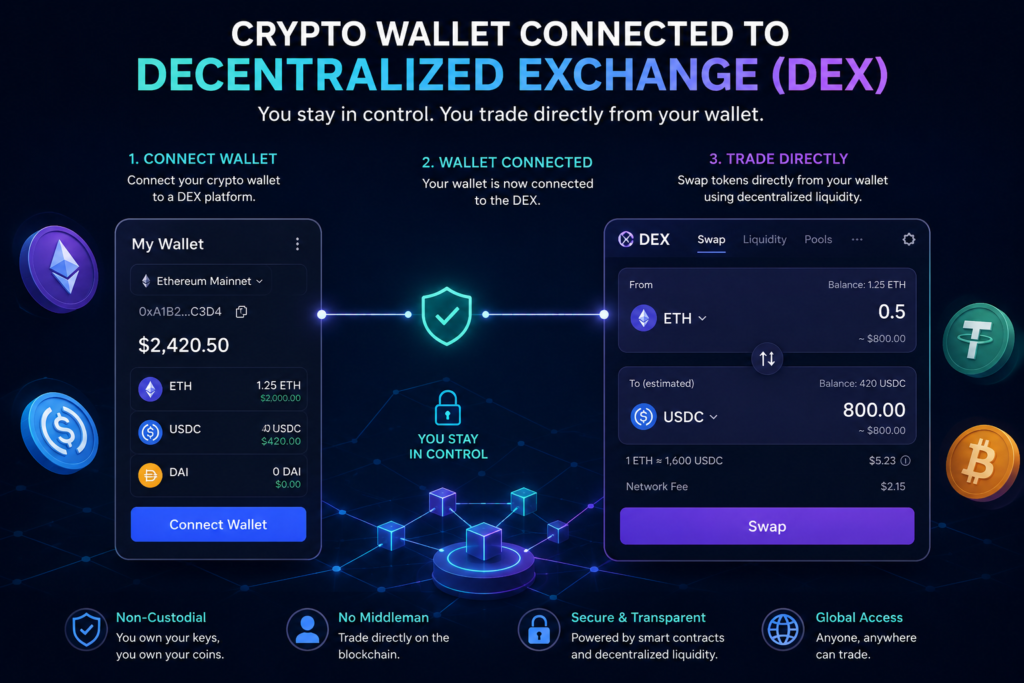
A DEX is a blockchain-based platform where users can:
- buy crypto
- sell crypto
- swap tokens
directly from their wallets.
Unlike centralized exchanges:
- users usually do not need to create accounts
- KYC is often not required
- funds stay inside the user’s wallet
This is why DEX platforms are also called:
Non-Custodial Exchanges
Because the platform does not hold your crypto.
Simple Real-Life Example
Imagine exchanging money directly with your friend.
There is:
- no bank
- no company
- no middleman
Just a direct exchange.
A DEX works in a similar way in the crypto world.
How Does a DEX Work?
DEX platforms work using:
Smart Contracts
Smart contracts are blockchain programs that automatically follow predefined rules.
When users:
- swap tokens
- provide liquidity
- trade crypto
smart contracts automatically process the transaction.
This removes the need for a traditional middleman.
DEX vs CEX
1. CEX (Centralized Exchange)
Examples:
- Binance
- Coinbase
- Bybit
In a centralized exchange:
- the company controls the platform
- user funds are often stored by the exchange
- KYC is usually required
2. DEX (Decentralized Exchange)
Examples:
- Uniswap
- PancakeSwap
- SushiSwap
In a decentralized exchange:
- users control their own wallets
- trading happens directly on the blockchain
- there is less central control
Main Difference Between DEX and CEX
| Feature | DEX | CEX |
| Wallet Control | User controls funds | Exchange controls funds |
| KYC | Usually not required | Usually required |
| Privacy | Better privacy | Lower privacy |
| Trading | Blockchain-based | Company-managed |
| Security Responsibility | User | Exchange |
Popular DEX Platforms
1. Uniswap
Uniswap is one of the most popular DEX platforms on Ethereum.
It is widely used for:
- ERC-20 token trading
- DeFi
- liquidity pools
2. PancakeSwap
PancakeSwap is popular on the BNB Chain ecosystem.
It became famous because of:
- low transaction fees
- beginner-friendly trading
- fast transactions
3. SushiSwap
SushiSwap is a multi-chain decentralized exchange offering:
- token swaps
- staking
- yield farming
- DeFi tools
Why Are DEX Platforms Important?
DEX platforms are important because they support:
Decentralization
Users have more control over their crypto assets.
Better Privacy
Most DEX platforms do not require full identity verification.
Access to New Tokens
Many new crypto projects launch first on decentralized exchanges.
Growth of DeFi
DEX platforms are a major part of the DeFi ecosystem.
What Is Liquidity in DEX?
DEX platforms need:
Liquidity
Liquidity means available crypto funds inside the platform for smooth trading.
Higher liquidity usually means:
- faster trades
- better prices
- less slippage
What Are Liquidity Pools?
Liquidity pools are collections of crypto funds locked inside smart contracts.
Users deposit crypto into these pools.
In return, they may earn:
- trading fees
- rewards
- yield farming income
What Is AMM in Crypto?
Most DEX platforms use:
AMM (Automated Market Maker)
Instead of traditional buyers and sellers matching orders manually, AMMs use algorithms to determine token prices automatically.
This helps decentralized trading work without a central authority.
Benefits of DEX
1. Full Control of Funds
Users control their own wallets and private keys.
2. Better Privacy
Most DEX platforms require little or no KYC.
3. Global Access
Anyone with internet access and a crypto wallet can use a DEX.
4. Early Access to Tokens
Many new tokens become available on DEX platforms before centralized exchanges.
Risks of DEX
DEX platforms also have risks.
1. Scam Tokens
Fake crypto tokens are common on decentralized exchanges.
2. Fake Websites
Scammers create fake DEX websites to steal funds.
3. Smart Contract Risks
If a smart contract has vulnerabilities, hackers may exploit it.
4. User Responsibility
If users:
- lose wallet access
- lose their seed phrase
- approve malicious contracts
fund recovery may be impossible.
Are DEX Platforms Safe?
DEX platforms can be safe if users follow proper security practices.
Always:
- use official websites
- double-check wallet approvals
- avoid unknown tokens
- protect your seed phrase
Future of DEX
Experts believe decentralized exchanges may continue growing because:
- Web3 is expanding
- DeFi adoption is increasing
- users prefer more control and privacy
Layer 2 technology is also making DEX trading:
- faster
- cheaper
- more scalable
Future of DEX in Crypto
The future of DEX in Crypto looks extremely promising. As blockchain technology continues to evolve, decentralized exchanges are becoming faster, cheaper, and easier to use. New innovations such as Layer-2 scaling solutions, cross-chain trading, and improved user interfaces are helping DEX platforms attract more users.
Many experts believe that DEX in Crypto could eventually handle a significant portion of global cryptocurrency trading volume. Since users maintain control over their assets, decentralized exchanges align closely with the original vision of blockchain technology.
For beginners, understanding DEX in Crypto today can provide valuable insights into the future of decentralized finance. Whether someone wants to trade tokens, provide liquidity, or explore DeFi opportunities, learning how DEX in Crypto works is becoming increasingly important.
Advantages of Using a DEX
Decentralized exchanges offer several advantages compared to traditional centralized platforms. One of the biggest benefits is self-custody, which means users always control their own private keys and funds. This reduces the risk of losing assets due to exchange hacks or company failures.
Another major advantage is privacy. Most DEX platforms allow users to trade without completing extensive identity verification processes. In addition, decentralized exchanges operate globally and are accessible to anyone with an internet connection and a crypto wallet.
Because transactions are executed through smart contracts, DEX platforms also improve transparency. Every transaction can be verified on the blockchain, creating a more open and trustworthy trading environment.
Final Thoughts
In simple words:
A DEX is a decentralized crypto exchange where users trade directly from their wallets without a middleman.
DEX platforms are becoming a major part of:
- DeFi
- Web3
- blockchain finance
However, beginners should always stay careful about:
- scams
- fake tokens
- wallet security
Also Read
- What Is DeFi in Crypto?
- What Is Web3?
- What Is Ethereum?
- What Are Ethereum Layer 2 Solutions?
- What Is Smart Contract?
Also Read
FAQ
Is DEX safe for beginners?
Yes, but beginners should only use official platforms and avoid scam tokens.
Do DEX platforms require KYC?
Most decentralized exchanges do not require KYC verification.
Which is the most popular DEX?
Uniswap is one of the most popular decentralized exchanges.
What wallet is used for DEX?
Wallets like MetaMask and Trust Wallet are commonly used.
Want to learn crypto in simple beginner-friendly language?
Visit:
👉 Coin Alert
For:
- crypto education
- blockchain guides
- Web3 explainers
beginner tutorials 🚀
join our Telegram for instant crypto updates.
Subscribe to our youtube Channel
For detailed crypto market analysis, price predictions, and investment strategies,
subscribe to our YouTube channel Coin Alert
Disclaimer
This article is for educational purposes only and not financial advice. Cryptocurrency investments are risky. Always do your own research and consult a financial advisor before investing.

Dr. Khushwant Rana is the founder of Coin Alert and has 15+ years of business experience. He creates beginner-friendly crypto educational content focused on Bitcoin, blockchain, Web3, crypto security, and real-world crypto awareness in India.