What Is Shared Sequencer?
The Ethereum ecosystem is growing rapidly.
Today, the blockchain industry is moving toward a future powered by:
- Layer 2 rollups
- Modular blockchains
- Shared security
- Data Availability layers
- Rollup-as-a-Service
- Ethereum scaling infrastructure
But as more Layer 2 networks launch, a new challenge appears:
Coordination between rollups.
This is where an important concept called Shared Sequencer becomes valuable.
If you are learning about:
- Ethereum rollups
- Layer 2 ecosystems
- Modular blockchain
- Web3 infrastructure
- Rollup interoperability
then understanding Shared Sequencers is very important.
At first, this concept may sound complicated.
But once explained simply, it becomes much easier to understand.
In this article, we will learn:
- What Shared Sequencer means
- How sequencers work
- Why Ethereum rollups need them
- Benefits of shared sequencing
- Risks and challenges
- Future of shared sequencer infrastructure
What Is a Sequencer?
Before understanding Shared Sequencers, we first need to understand what a Sequencer is.
A Sequencer is a system used by Layer 2 rollups to:
- Collect transactions
- Organize transaction order
- Process transactions
- Submit data to Ethereum
In simple words:
The Sequencer acts like a traffic controller for Layer 2 networks.
It decides:
- Which transactions happen first
- Which transactions happen later
- How transaction batches are created
Most Ethereum rollups use sequencers.
Simple Real-Life Example
Imagine a busy airport.
Thousands of airplanes are trying to land and take off.
Without air traffic control, chaos would happen.
The Sequencer works similarly for blockchain transactions.
It organizes and manages transaction flow.
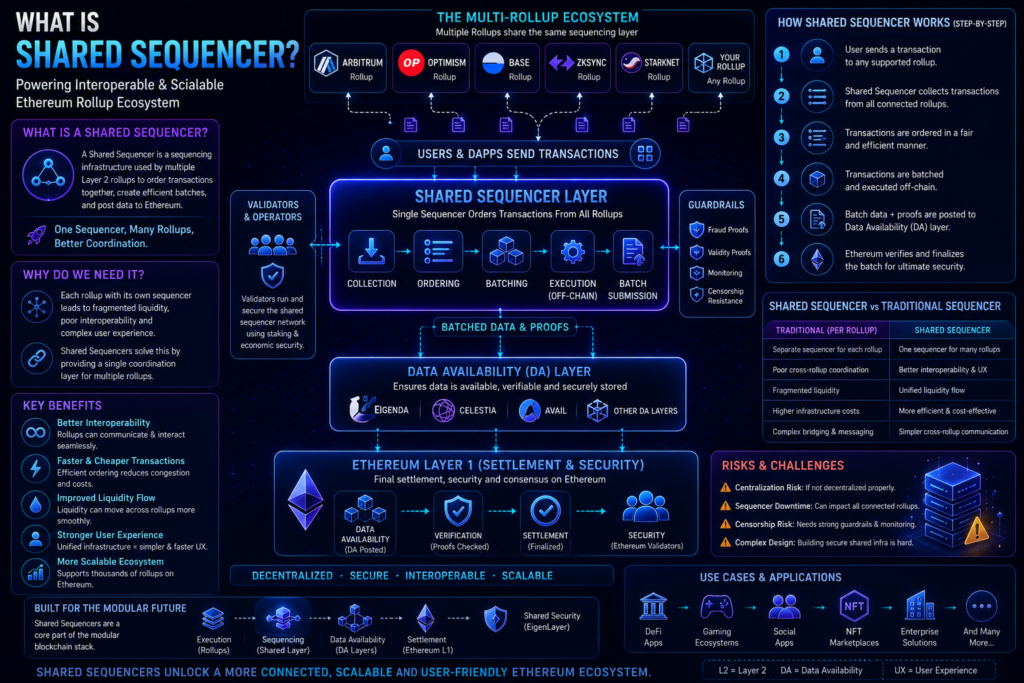
What Is Shared Sequencer?
A Shared Sequencer is a sequencing system used by multiple Layer 2 rollups together.
Instead of every rollup having its own separate sequencer, multiple rollups share the same sequencing infrastructure.
This improves:
- Coordination
- Interoperability
- Communication
- Cross-rollup efficiency
In simple words:
A Shared Sequencer acts like one central coordination layer for multiple Ethereum rollups.
Why Shared Sequencers Were Created
As Ethereum ecosystem grows, more rollups are launching.
Examples include:
- Arbitrum
- Optimism
- Base
- zkSync
- StarkNet
Each rollup normally operates independently.
This creates problems like:
- Fragmented liquidity
- Slow interoperability
- Cross-chain complexity
- Separate sequencing systems
Shared Sequencers were introduced to help solve these issues.
How Shared Sequencers Work
The process is actually simple.
Step 1 — Users Send Transactions
Users interact with Layer 2 applications.
Step 2 — Shared Sequencer Organizes Transactions
Instead of each rollup handling ordering independently, the Shared Sequencer coordinates transaction flow.
Step 3 — Transactions Are Batched
The sequencer groups transactions efficiently.
Step 4 — Data Is Posted to Ethereum
Final settlement usually happens on Ethereum Layer 1.
Step 5 — Multiple Rollups Stay Coordinated
Different Layer 2 chains can communicate more efficiently.
Ethereum Rollups and Sequencers
Ethereum rollups heavily depend on sequencers.
Without sequencers:
- Rollup transaction ordering becomes difficult
- User experience becomes slower
- Scalability decreases
Shared Sequencers may become important infrastructure for future Ethereum ecosystem scaling.
You can also read these beginner guides:
Why Shared Sequencers Matter
1. Better Interoperability
Rollups can coordinate more efficiently.
2. Faster Cross-Rollup Transactions
Communication between Layer 2 networks becomes smoother.
3. Better User Experience
Users may experience faster transactions and simpler bridging.
4. Improved Liquidity Coordination
Liquidity fragmentation may reduce over time.
5. More Scalable Infrastructure
Shared sequencing helps optimize blockchain infrastructure.
Shared Sequencer and Modular Blockchain
Shared Sequencers fit naturally into modular blockchain architecture.
Modern blockchain ecosystems are separating responsibilities like:
- Execution
- Consensus
- Settlement
- Data Availability
- Sequencing
This modular design improves scalability and flexibility.
Shared Sequencers may become a major infrastructure layer inside modular blockchain ecosystems.
Risks of Shared Sequencers
Like every technology, Shared Sequencers also have risks.
1. Centralization Concerns
If one sequencer controls too much activity, centralization risks increase.
2. Infrastructure Complexity
Shared systems require advanced coordination.
3. Security Risks
Poor sequencing infrastructure may create vulnerabilities.
4. Ecosystem Dependency
Multiple rollups depending on one system may increase systemic risk.
Shared Sequencer vs Traditional Sequencer
| Feature | Traditional Sequencer | Shared Sequencer |
| Infrastructure | Separate per rollup | Shared by multiple rollups |
| Coordination | Limited | Better interoperability |
| Liquidity | Fragmented | Better coordination |
| Complexity | Simpler | More advanced |
| Scalability | Limited ecosystem coordination | Better modular scaling |
Popular Shared Sequencer Projects
Several blockchain projects are exploring shared sequencing infrastructure.
Examples include:
- Espresso Systems
- Astria
- Radius
- SUAVE (by Flashbots)
These projects aim to improve Ethereum rollup coordination.
Official resources:
Future of Shared Sequencers
The Ethereum ecosystem is becoming increasingly modular.
Today we are seeing rapid growth in:
- Rollups
- Shared security
- DA layers
- Restaking
- Modular infrastructure
- Rollup interoperability
As the number of rollups increases, coordination infrastructure becomes more important.
Many experts believe Shared Sequencers could become one of the core infrastructure layers powering future Ethereum ecosystem scalability.
Conclusion
Shared Sequencers are becoming an important innovation inside Ethereum Layer 2 ecosystem.
Instead of every rollup managing transaction ordering independently, Shared Sequencers help coordinate multiple rollups together.
This improves:
- Interoperability
- Scalability
- User experience
- Cross-rollup communication
As modular blockchain ecosystems continue evolving, Shared Sequencers may become a major part of future Web3 infrastructure.
Also Read
Before learning about Shared Sequencer, it’s important to understand the basics of blockchain technology. Read our Blockchain: The 5000-Year Story of Trust, Records, and Digital Revolution.
Shared Sequencers are designed for Ethereum Layer 2 networks. Start with our What Is Optimism Crypto? Complete Beginner Guide to understand how Layer 2 scaling works.
To learn about the technology that powers many Layer 2 ecosystems, read our What Is OP Stack? How It Powers Ethereum Layer 2 Networks (2026).
Want to understand how multiple Layer 2 networks connect into one ecosystem? Read our What Is Superchain? Powerful Beginner Guide to Ethereum’s Future (2026).
To discover how developers launch scalable Layer 2 blockchains without building everything from scratch, read our What Is Rollup-as-a-Service (RaaS)? Ultimate Beginner Guide (2026).
Also Read
FAQ
What is a Shared Sequencer?
A Shared Sequencer is a sequencing infrastructure shared by multiple Layer 2 rollups.
What does a Sequencer do?
A Sequencer organizes, processes, and orders Layer 2 transactions.
Why are Shared Sequencers important?
They improve interoperability and coordination between rollups.
Does Ethereum use sequencers?
Ethereum Layer 2 rollups heavily depend on sequencers.
What are examples of Shared Sequencer projects?
Examples include Astria, Espresso Systems, Radius, and SUAVE.
join our Telegram for instant crypto updates.
Subscribe to our youtube Channel
For detailed crypto market analysis, price predictions, and investment strategies,
subscribe to our YouTube channel Coin Alert
Want to learn more about crypto, Ethereum Layer 2 projects, wallets, blockchain, and Web3?
Visit Coin Alert for more beginner-friendly crypto guides and latest crypto education content.
Disclaimer
This article is for educational purposes only and not financial advice. Cryptocurrency investments are risky. Always do your own research and consult a financial advisor before investing.

Dr. Khushwant Rana is the founder of Coin Alert and has 15+ years of business experience. He creates beginner-friendly crypto educational content focused on Bitcoin, blockchain, Web3, crypto security, and real-world crypto awareness in India.