This Bitcoin Whitepaper Explained guide will help you understand Satoshi Nakamoto’s original vision in simple English. On 31 October 2008, an anonymous person (or group) using the name Satoshi Nakamoto published a document that was only 9 pages long. At first glance, it looked like an ordinary technical paper. However, this small document would eventually change the way the world thinks about money, banking, and digital ownership.
That document was titled:
Bitcoin: A Peer-to-Peer Electronic Cash System
Today, Bitcoin is recognized as the world’s first successful decentralized cryptocurrency. It has inspired thousands of blockchain projects, introduced millions of people to digital assets, and created an entirely new financial ecosystem.
Yet, everything began with this single whitepaper.
Unlike traditional financial systems that depend on banks and payment companies, Satoshi Nakamoto proposed a completely different idea—a system where people could send money directly to each other without relying on any trusted third party.
More importantly, he explained how such a system could actually work.
This is why the Bitcoin Whitepaper is considered one of the most important documents in modern technology.
In this guide, Coin Alert explains the Bitcoin Whitepaper in simple English so that even complete beginners can understand Satoshi Nakamoto’s original vision without needing any programming or cryptography knowledge.
Bitcoin Whitepaper Explained : What Is a Whitepaper?
Before understanding Bitcoin, let’s first understand what a whitepaper actually is.
A whitepaper is an official document used to explain a new idea, technology, product, or solution to a specific problem.
Instead of advertising a product, a whitepaper focuses on answering important questions such as:
- What problem exists?
- Why is the current system not enough?
- What is the proposed solution?
- How does the solution work?
- Why should people trust it?
Technology companies, governments, researchers, and blockchain projects all use whitepapers to explain their innovations.
The Bitcoin Whitepaper follows exactly the same approach.
Instead of asking people to simply believe in Bitcoin, Satoshi Nakamoto explained every important concept behind it with logic and technical reasoning.
💡 Coin Alert Simplified
Think of a whitepaper as the blueprint of a building.
Before construction begins, an architect prepares a complete plan explaining how everything will work.
Similarly, before launching Bitcoin, Satoshi Nakamoto published the complete blueprint explaining how the Bitcoin network would operate.
The Title That Changed History
The title of the whitepaper is:
Bitcoin: A Peer-to-Peer Electronic Cash System
Although this title contains only a few words, it explains Bitcoin’s entire purpose.
Let’s understand each part.
Bitcoin
This is the name of the new digital currency introduced by Satoshi Nakamoto.
Unlike traditional currencies issued by governments, Bitcoin would exist only in digital form.
Peer-to-Peer
Peer-to-Peer (P2P) means two people can communicate or exchange value directly without requiring a middleman.
For example,
If you send a message using Bluetooth, it can move directly between two devices.
Similarly, Bitcoin allows value to move directly between two users.
Electronic Cash
Bitcoin was designed to work like digital cash.
Just as physical cash allows you to pay someone directly,
Bitcoin allows digital payments without depending on banks.
System
Bitcoin is not just a coin.
It is an entire system consisting of:
- Computers
- Cryptography
- Blockchain
- Miners
- Nodes
- Consensus Rules
All these components work together to create a secure financial network.
💡 Coin Alert Simplified
One sentence summarizes the entire whitepaper:
Bitcoin allows two people anywhere in the world to send digital money directly without needing a bank.
Everything else in the whitepaper explains how this is possible.
Why Did Satoshi Nakamoto Create Bitcoin?
To understand Bitcoin, we first need to understand the world before Bitcoin existed.
In 2008, the global financial system was facing one of the biggest crises in modern history.
Large investment banks collapsed.
Millions of people lost jobs.
Governments spent billions of dollars rescuing financial institutions.
This crisis raised an important question:
Should the entire financial system depend on centralized institutions?
Traditional online payments always require trust.
Whenever you make an online payment, several organizations are involved:
- Your Bank
- Card Network
- Payment Gateway
- Merchant’s Bank
Each one acts as a trusted intermediary.
This model works well most of the time.
However, it also creates several problems.
Transactions can be delayed.
Payments can be reversed.
Accounts can be frozen.
International transfers become expensive.
People living without access to banks remain excluded from the financial system.
Satoshi Nakamoto believed technology could solve these problems.
Instead of trusting institutions,
people could trust mathematics, cryptography, and a decentralized network.
That simple idea became Bitcoin.
💡 Coin Alert Simplified
Traditional banking asks you to trust an institution.
Bitcoin asks you to trust open-source code, cryptography, and network consensus.
That single difference is what makes Bitcoin revolutionary.
The Problem Bitcoin Wanted to Solve
The very first sentence of the Bitcoin Whitepaper says:
“A purely peer-to-peer version of electronic cash would allow online payments to be sent directly from one party to another without going through a financial institution.”
This sentence explains Bitcoin’s entire objective.
Satoshi Nakamoto was not trying to create a faster stock market.
He was not trying to create an investment product.
He was trying to solve a payment problem.
The challenge was simple:
How can two strangers send digital money directly without trusting each other and without depending on a bank?
At first, this sounds impossible.
If there is no bank,
who verifies the payment?
Who prevents fraud?
Who keeps transaction records?
Who makes sure the sender isn’t cheating?
These questions led to one of the biggest problems in computer science:
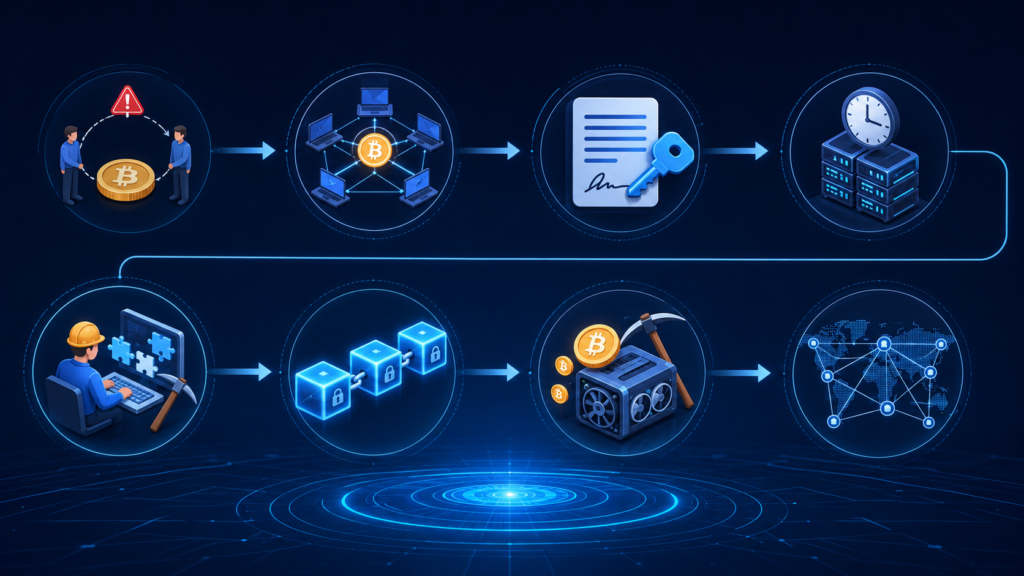
The Double Spending Problem.
Bitcoin’s greatest achievement was solving this problem without introducing a central authority.
Everything discussed in the rest of the whitepaper is built around this single objective.
💡 Coin Alert Simplified
Imagine sending cash to your friend.
With physical money, only one person can own a ₹500 note at a time.
But digital files can be copied infinitely.
Bitcoin needed a way to make digital money behave like real cash.
That is exactly what the rest of the whitepaper explains.
The Double Spending Problem
Before Bitcoin was created, many people tried to build digital money. However, every project failed because of one major challenge known as the Double Spending Problem.
To understand this problem, imagine you have a ₹500 note in your pocket.
You can only spend that note once.
If you give it to a shopkeeper, it is no longer yours.
Physical cash naturally prevents double spending because only one person can possess the note at any given time.
Digital files are completely different.
A photo can be copied.
A PDF can be copied.
A video can be copied.
If digital money behaved like a normal computer file, someone could simply duplicate it and spend the same money multiple times.
Obviously, such a financial system would never work.
This is why every digital payment system before Bitcoin relied on a central authority, such as a bank or payment company, to verify transactions.
Whenever you make an online payment today, your bank checks your account balance, confirms that you own the money, deducts the amount from your account, and updates its records.
The bank prevents you from spending the same money twice.
Bitcoin wanted to remove this trusted middleman.
The biggest question became:
How can thousands of strangers agree that a Bitcoin has already been spent without depending on a bank?
The rest of the Bitcoin Whitepaper is dedicated to solving this single problem.
💡 Coin Alert Simplified
Imagine there is no bank.
You tell your friend:
“I have sent you 1 Bitcoin.”
How does your friend know you did not send the same Bitcoin to someone else five seconds earlier?
Bitcoin solves this by allowing the entire network to verify every transaction together instead of trusting one company.
Transactions
After explaining the problem, Satoshi Nakamoto introduces the first technical concept:
Transactions.
A Bitcoin transaction is simply a digital record that proves ownership of Bitcoin has moved from one person to another.
Unlike traditional banking, Bitcoin does not use names or account numbers.
Instead, every user has a wallet address.
Whenever you send Bitcoin, your wallet creates a transaction containing three important pieces of information:
- Which Bitcoin is being spent.
- Who is receiving it.
- A digital signature proving you are the rightful owner.
This transaction is then broadcast to thousands of computers connected to the Bitcoin network.
These computers independently verify the transaction before accepting it.
No bank is required.
No payment company approves it.
The network itself performs the verification.
💡 Coin Alert Simplified
Think of sending a registered parcel.
You write:
- Sender
- Receiver
- Signature
Bitcoin transactions work almost the same way.
The difference is that everything happens digitally using cryptography instead of paper.
Digital Signatures
One of the most important innovations in Bitcoin is the use of Digital Signatures.
A digital signature proves that only the rightful owner can spend Bitcoin.
Every Bitcoin wallet contains two cryptographic keys:
Public Key
The Public Key can be shared with anyone.
It is used to generate your wallet address so people can send Bitcoin to you.
Think of it like your email address.
Anyone can know it.
Private Key
The Private Key is completely secret.
It gives you control over your Bitcoin.
Anyone who knows your Private Key can spend your coins.
This is why protecting your Private Key is one of the most important responsibilities of every Bitcoin owner.
Whenever you send Bitcoin, your wallet automatically uses your Private Key to create a unique digital signature.
The network checks this signature using your Public Key.
If everything matches, the transaction is considered valid.
If someone tries to create a fake transaction without the correct Private Key, the network immediately rejects it.
💡 Coin Alert Simplified
Imagine your signature on a legal document.
Anyone can see it.
But only you can create your real signature.
Bitcoin works in a similar way.
Instead of using a handwritten signature, it uses advanced cryptography.
This allows the entire network to verify ownership without revealing your Private Key.
Timestamp Server
The next concept introduced in the Bitcoin Whitepaper is the Timestamp Server.
This may sound technical, but the idea is surprisingly simple.
Every Bitcoin transaction needs proof of when it happened.
If two people claim ownership of the same Bitcoin, the network must know which transaction happened first.
The Timestamp Server solves this problem.
Instead of storing transactions individually, Bitcoin groups many transactions into a block.
Each block receives:
- A timestamp.
- A cryptographic fingerprint called a hash.
- A reference to the previous block.
This creates a permanent timeline of every transaction ever made.
Because every block depends on the previous one, changing old records becomes extremely difficult.
This chain of connected blocks eventually became known as the Blockchain.
💡 Coin Alert Simplified
Imagine writing every Bitcoin transaction in a diary.
At the end of each page, you write the page number of the previous page.
If someone secretly changes page 15, every page after it also becomes incorrect.
That is exactly how Blockchain protects Bitcoin’s transaction history.
Why Transactions Cannot Be Changed Easily
One of Bitcoin’s biggest strengths is that confirmed transactions are extremely difficult to modify.
This is because every new block strengthens the security of all previous blocks.
To change one old transaction, an attacker would need to:
- Change that block.
- Recalculate every block after it.
- Produce more computing power than the rest of the Bitcoin network combined.
As the blockchain grows, this becomes practically impossible.
This clever design allows Bitcoin to create trust without relying on a central authority.
💡 Coin Alert Simplified
Imagine a tower built with thousands of bricks.
Removing the brick at the bottom would require rebuilding the entire tower.
Bitcoin works the same way.
Every new block makes the previous blocks stronger and more secure.
Proof of Work: The Innovation That Made Bitcoin Possible
So far, we have learned that Bitcoin allows people to send digital money directly without a bank and prevents Double Spending through a decentralized verification system.
But one important question still remains.
What stops someone from creating fake blocks or manipulating the blockchain?
This is where Satoshi Nakamoto introduced one of Bitcoin’s greatest innovations:
Proof of Work (PoW).
Proof of Work is the security mechanism that protects the Bitcoin network. Instead of trusting people, Bitcoin requires computers to perform real computational work before they can add a new block to the blockchain.
This work is intentionally difficult to perform but very easy for everyone else to verify.
That simple idea changed digital money forever.
💡 Coin Alert Simplified
Imagine your school organizes a competition.
Only the student who correctly solves a very difficult puzzle earns the right to write the next page in the school’s official record book.
Before accepting that page, every teacher checks whether the answer is correct.
Bitcoin follows the same principle.
Miners solve a difficult mathematical puzzle, while thousands of other computers verify the solution within seconds.
What Exactly Is Proof of Work?
Proof of Work is not about solving useful mathematics.
Instead, computers repeatedly try different numbers until they find one that satisfies Bitcoin’s predefined rules.
This special number is called a Nonce.
A miner may need to try trillions of different Nonces before finding the correct one.
Finding the answer requires enormous computing power and electricity.
However, once the correct answer is found, every other node can verify it almost instantly.
This creates an interesting balance.
- Finding the solution is difficult.
- Checking the solution is easy.
Because producing a valid block is expensive, attacking the Bitcoin network also becomes extremely expensive.
💡 Coin Alert Simplified
Think of a combination lock with millions of possible passwords.
Finding the correct password takes a lot of effort.
But once someone opens the lock, everyone else can immediately see that it is correct.
Proof of Work works in exactly the same way.
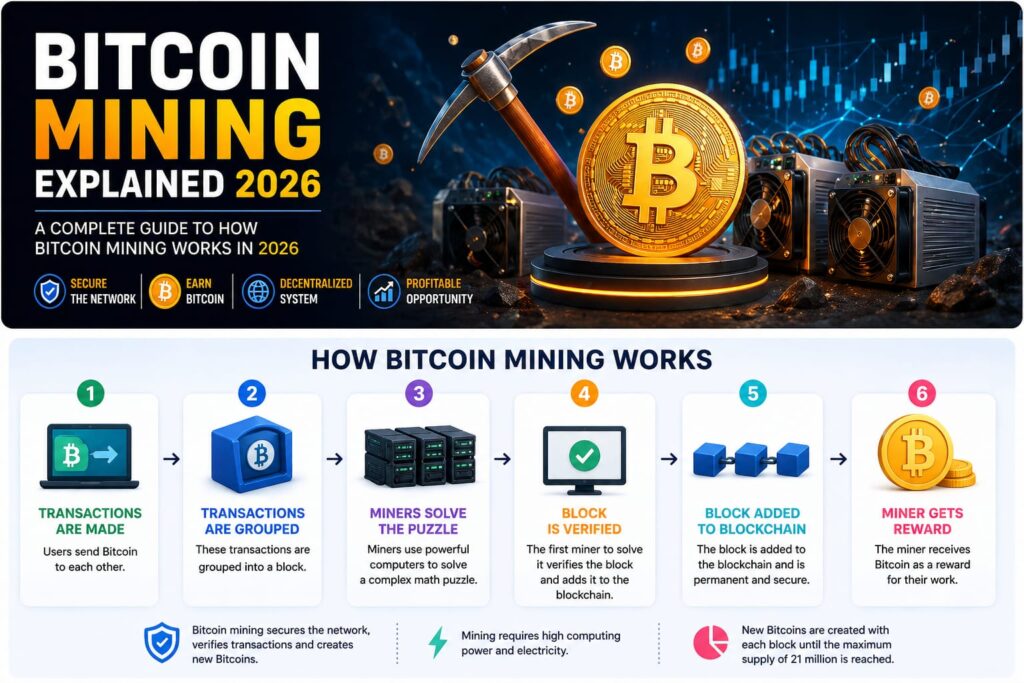
Bitcoin Mining Explained
The process of performing Proof of Work is called Bitcoin Mining.
Many beginners think mining means digging Bitcoin out of the ground.
That is not true.
Bitcoin mining is actually the process of verifying transactions and securing the blockchain.
Miners collect newly broadcast transactions from the network.
They organize those transactions into a block.
Then they compete with miners around the world to solve the Proof of Work puzzle.
The first miner who finds the correct solution broadcasts the new block to the network.
If every node agrees that the block follows Bitcoin’s rules, the block becomes a permanent part of the blockchain.
The process starts again with the next block.
This competition happens approximately every 10 minutes.
💡 Coin Alert Simplified
Imagine hundreds of students taking the same exam.
The first student to submit a completely correct answer wins the prize.
The teacher quickly checks the answer before announcing the winner.
Bitcoin miners compete in a very similar way.
Why Do Miners Spend Money on Mining?
Mining requires expensive computers.
It also consumes electricity.
So why do miners continue doing it?
Satoshi Nakamoto solved this problem through an economic incentive.
Whenever a miner successfully creates a valid block, they receive:
- Newly created Bitcoins (Block Reward)
- Transaction fees paid by users
These rewards motivate miners to continue securing the network.
As long as mining remains profitable, thousands of independent miners continue protecting Bitcoin.
This creates one of the strongest security models ever designed for a decentralized system.
💡 Coin Alert Simplified
Imagine a city hires security guards.
The guards receive salaries for protecting the city.
Bitcoin does something similar.
Instead of paying security guards with salaries, the network rewards miners with Bitcoin.
The result is the same:
The network stays secure because people are rewarded for protecting it.
Network Consensus
Bitcoin has no headquarters.
No CEO.
No manager.
No central server.
So how do thousands of computers agree on which transactions are valid?
The answer is called Consensus.
Consensus simply means that every computer follows exactly the same rules.
Before accepting a new block, every node checks:
- Is the Proof of Work valid?
- Are all transactions valid?
- Has anyone tried to spend the same Bitcoin twice?
- Does this block correctly connect to the previous block?
If every rule is satisfied, the block is accepted.
If even one rule is broken, the block is rejected automatically.
No human approval is required.
The software itself enforces the rules.
💡 Coin Alert Simplified
Imagine 10,000 referees watching the same football match.
If one referee makes a strange decision but the other 9,999 disagree, the incorrect decision is ignored.
Bitcoin works in the same way.
The majority of honest nodes decide which version of the blockchain is valid.
Why Is Bitcoin So Difficult to Hack?
Many people ask:
Can someone hack Bitcoin?
The answer is not impossible—but it is extremely impractical.
To successfully change Bitcoin’s blockchain, an attacker would need to:
- Rewrite previous blocks.
- Solve Proof of Work again for every rewritten block.
- Catch up with the honest blockchain.
- Control more computing power than the entire global Bitcoin network.
This type of attack is known as a 51% Attack.
Because Bitcoin has one of the largest decentralized computing networks in the world, carrying out such an attack would cost billions of dollars and still provide no guarantee of success.
That is why Bitcoin is considered one of the most secure digital networks ever created.
💡 Coin Alert Simplified
Imagine trying to secretly change one page in a history book that has already been copied into millions of libraries around the world.
Even if you changed one copy, millions of other copies would still contain the original version.
Bitcoin protects its history in exactly the same way.
The Genius Behind Proof of Work
The true brilliance of Satoshi Nakamoto was not simply inventing a new digital currency.
His greatest achievement was combining:
- Cryptography
- Game Theory
- Economic Incentives
- Distributed Computing
- Mathematics
into one system that allows strangers across the world to agree on the same financial records without trusting each other.
That is why Proof of Work remains one of the most revolutionary concepts in blockchain history.
💡 Coin Alert Simplified
Bitcoin does not work because people trust each other.
Bitcoin works because the rules make cheating more expensive than being honest.
That simple principle is one of the greatest ideas introduced in the Bitcoin Whitepaper.
Simplified Payment Verification (SPV)
One common question people ask is:
“Does everyone who uses Bitcoin have to download the entire blockchain?”
The answer is No.
Satoshi Nakamoto introduced an idea called Simplified Payment Verification (SPV).
SPV allows users to verify that a payment has been included in the blockchain without downloading every single transaction ever made.
Instead of storing the complete blockchain, SPV wallets only download block headers, which are much smaller in size.
When someone receives Bitcoin, the wallet checks whether the transaction exists inside a valid block.
This makes Bitcoin much easier to use on laptops, smartphones, and lightweight devices.
Today, many popular crypto wallets use ideas inspired by SPV to provide a faster and more user-friendly experience.
💡 Coin Alert Simplified
Imagine a library containing one million books.
You do not need to read every book to confirm that a particular book exists.
You only need the library catalogue.
SPV works in a similar way.
Instead of downloading the entire blockchain, your wallet downloads only the essential information needed to verify transactions.
Privacy in Bitcoin
Another important topic discussed in the Bitcoin Whitepaper is privacy.
Many people believe Bitcoin is completely anonymous.
That is not correct.
Bitcoin is pseudonymous.
Every Bitcoin transaction is permanently stored on the public blockchain.
Anyone can see:
- Wallet Address of the sender
- Wallet Address of the receiver
- Amount transferred
- Time of the transaction
However, these wallet addresses are not automatically linked to your real identity.
Unless someone can connect a wallet address to a real person, the blockchain only shows a series of letters and numbers.
This approach provides transparency while offering a level of privacy.
💡 Coin Alert Simplified
Think of every Bitcoin wallet like a locker number.
Everyone can see that Locker #2456 sent money to Locker #9812.
But unless someone knows who owns those lockers, the real identities remain hidden.
That is why Bitcoin is transparent but not completely anonymous.
Can Bitcoin Be Hacked?
This is one of the most searched questions about Bitcoin.
The Bitcoin Whitepaper explains that security comes from the combined power of honest participants.
To successfully change the blockchain, an attacker would need to control more than half of the network’s total computing power.
This is known as a 51% Attack.
Even if someone achieved this, it would require enormous amounts of money, electricity, hardware, and continuous effort.
For the Bitcoin network, such an attack is considered extremely impractical because of its massive global mining network.
💡 Coin Alert Simplified
Imagine trying to secretly rewrite a history book that has already been copied into millions of schools around the world.
Changing one copy changes nothing.
You would have to replace almost every copy at the same time.
Bitcoin works exactly like that.
Why the Bitcoin Whitepaper Still Matters Today
More than fifteen years have passed since Satoshi Nakamoto published the Bitcoin Whitepaper.
During this time, thousands of cryptocurrencies and blockchain projects have been launched.
Technologies such as:
- Ethereum
- Smart Contracts
- DeFi
- NFTs
- Layer 2 Networks
- Web3
- Stablecoins
all emerged after Bitcoin.
However, almost every modern blockchain project still builds upon ideas first introduced in those nine pages.
The Bitcoin Whitepaper is not simply the beginning of Bitcoin.
It is the foundation of the entire blockchain industry.
Whether you are a developer, investor, researcher, or complete beginner, understanding the whitepaper helps you understand why blockchain technology exists in the first place.
💡 Coin Alert Simplified
If blockchain technology were a university,
the Bitcoin Whitepaper would be its first textbook.
Everything else came later.
Common Misconceptions
❌ Myth 1: The Whitepaper is only for programmers.
Reality:
The concepts can be understood by anyone when explained in simple language.
❌ Myth 2: Bitcoin was created only for investment.
Reality:
The Whitepaper never discusses getting rich.
Its goal is creating a decentralized electronic cash system.
❌ Myth 3: Satoshi Nakamoto controls Bitcoin.
Reality:
Bitcoin is maintained by thousands of independent participants around the world.
No single person controls the network.
❌ Myth 4: Blockchain and Bitcoin are the same thing.
Reality:
Bitcoin is an application.
Blockchain is the underlying technology.
Final Thoughts
The Bitcoin Whitepaper is much more than a technical document.
It is the blueprint of the world’s first successful decentralized digital currency.
In just nine pages, Satoshi Nakamoto introduced ideas that challenged traditional banking, solved the Double Spending Problem, and demonstrated that strangers could exchange value securely without trusting a central authority.
More than fifteen years later, Bitcoin continues to prove that those ideas were not just theoretical—they work in practice.
If you truly want to understand cryptocurrency, blockchain, or Web3, the best place to begin is not with price charts or market predictions.
📚 Sources & References
This article is based on official documentation and trusted educational resources.
- Bitcoin: A Peer-to-Peer Electronic Cash System (Original Whitepaper)
- Official Bitcoin Website
- Bitcoin Core GitHub Repository
Continue Your Bitcoin Journey
You’ve just learned the ideas that started the crypto revolution. Continue exploring Bitcoin and blockchain with Coin Alert’s beginner-friendly guides.
📚 Related Articles
FAQ
Who published the Bitcoin Whitepaper?
Satoshi Nakamoto published the Bitcoin Whitepaper on 31 October 2008.
How many pages does the Whitepaper have?
The original Bitcoin Whitepaper contains 9 pages.
Is the Whitepaper difficult to read?
The original document contains technical concepts.
However, once those ideas are explained in simple language, beginners can understand its core message.
Can anyone read the original Whitepaper?
Yes.
It is publicly available and free to download from the official Bitcoin website.
Why should beginners read the Whitepaper?
Because it explains the original purpose of Bitcoin, the problem it solves, and the principles that later inspired the entire blockchain industry.
It is with the Bitcoin Whitepaper.
Once you understand these nine pages, every other blockchain concept becomes much easier to learn.
🚀 Continue Your Bitcoin Learning Journey
Congratulations! 🎉 You have just understood the ideas that changed the world of money forever. But this is only the beginning. Continue learning with Coin Alert’s step-by-step Bitcoin series and become confident in blockchain and cryptocurrency.
🎓 Learn With Coin Alert Academy
Watch beginner-friendly Hindi videos, premium documentaries and step-by-step crypto lessons designed for new investors.
📢 Join Our Crypto Community
Receive daily crypto updates, educational quizzes, beginner-friendly tips and exclusive Coin Alert content directly on Telegram.
🌐 Explore Coin Alert
Explore hundreds of beginner-friendly crypto articles, practical guides, glossary terms, crypto tools and educational resources.

Dr. Khushwant Rana is the founder of Coin Alert and has 15+ years of business experience. He creates beginner-friendly crypto educational content focused on Bitcoin, blockchain, Web3, crypto security, and real-world crypto awareness in India.