A Crypto Bridge is a technology that allows users to transfer assets and data between different blockchain networks. In 2026, crypto bridges play a major role in connecting ecosystems such as Ethereum, Solana, BNB Chain, Polygon, and Arbitrum.
The crypto industry contains many different blockchain networks like:
- Ethereum
- Solana
- BNB Chain
- Arbitrum
- Polygon
But these blockchains cannot naturally communicate with each other.
To solve this problem, blockchain technology introduced:
Crypto Bridges
Crypto bridges help users transfer assets and data between different blockchain networks.
Today, crypto bridges are an important part of:
- Web3
- DeFi
- Layer 2 ecosystems
- cross-chain applications
In this beginner-friendly guide, you will learn:
- What crypto bridges are
- How blockchain bridges work
- Benefits and risks
- Popular bridge examples
- Why bridges matter in Web3
What Is Crypto Bridge?
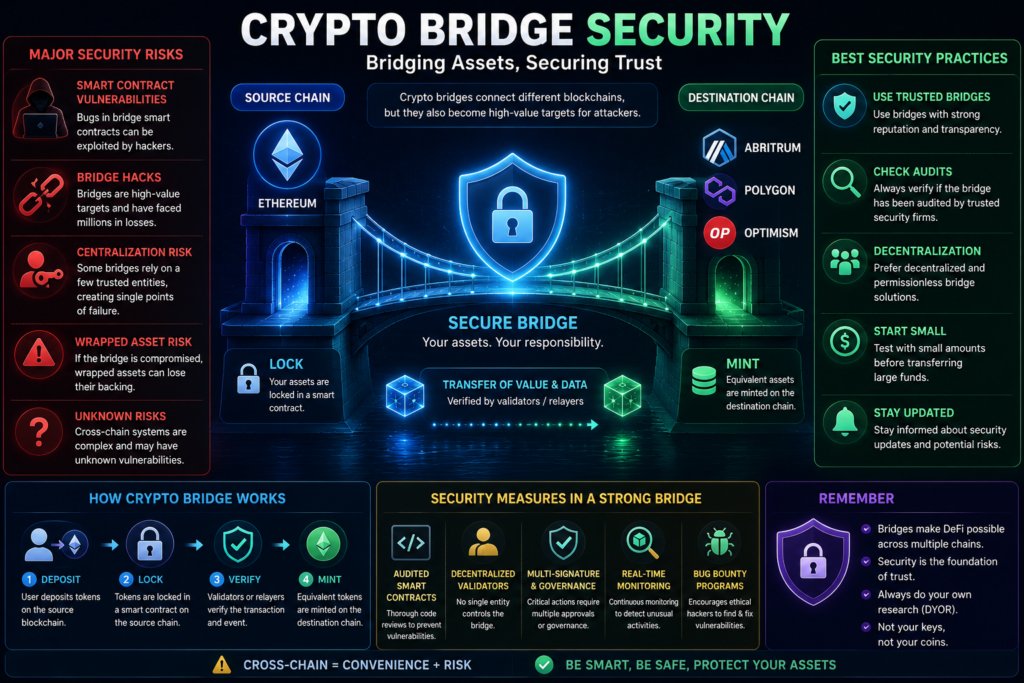
A crypto bridge is a blockchain tool that allows users to transfer cryptocurrencies or digital assets between different blockchain networks.
For example:
- moving ETH from Ethereum to Arbitrum
- transferring assets from Ethereum to Polygon
- using tokens across multiple chains
Bridges improve blockchain interoperability.
Why Crypto Bridges Were Created
Different blockchains have separate ecosystems.
Without bridges:
- users cannot easily move assets between chains
- DeFi systems become isolated
- blockchain ecosystems remain disconnected
Crypto bridges help solve this fragmentation problem.
How Crypto Bridges Work
Crypto bridges usually follow a lock-and-mint process.
Step 1 — Assets Are Locked
A user sends tokens to a bridge smart contract.
The original tokens are temporarily locked.
Step 2 — Verification Happens
The bridge verifies the transaction.
Step 3 — Wrapped Tokens Are Created
Equivalent tokens are minted on the destination blockchain.
Example:
ETH on Ethereum may become wrapped ETH on another network.
Step 4 — User Receives Assets
The user can now use tokens on the new blockchain network.
Types of Crypto Bridges
1. Trusted Bridges
Controlled by centralized entities.
They are easier to use but rely on trust.
2. Trustless Bridges
Use smart contracts and decentralized systems.
These are more decentralized but technically complex.
Popular Crypto Bridges
Arbitrum Bridge
Used to transfer assets between Ethereum and Arbitrum.
Polygon Bridge
Connects Ethereum with Polygon.
Wormhole Bridge
Supports multiple blockchain ecosystems.
Optimism Bridge
Used for Ethereum Layer 2 transfers.
Benefits of Crypto Bridges
1. Cross-Chain Transfers
Users can move assets across networks.
2. Lower Fees
Layer 2 bridges may reduce gas fees.
3. Faster Transactions
Some chains process transactions faster than Ethereum.
4. Better DeFi Access
Users can access more DeFi ecosystems.
5. Blockchain Interoperability
Bridges help connect isolated blockchain systems.
Risks of Crypto Bridges
1. Smart Contract Hacks
Bridges are major hacking targets.
2. Security Risks
Cross-chain systems are technically complex.
3. Centralization Risks
Some bridges depend on centralized operators.
4. Wrapped Asset Risks
Wrapped tokens depend on bridge security.
Crypto Bridges in DeFi
Crypto bridges are heavily used in:
DeFi ecosystems
They help users:
- move liquidity
- access yield farming
- transfer stablecoins
- use Layer 2 platforms
Without bridges, modern DeFi ecosystems would be less connected.
Cross-Chain Technology Explained
Cross-chain technology allows blockchains to communicate and exchange information.
This is important because:
- blockchain ecosystems continue growing
- users want flexibility
- Web3 apps need interoperability
Crypto bridges are one of the main solutions for cross-chain communication.
Why Crypto Bridges Matter in Web3
Web3 aims to create decentralized internet systems.
Crypto bridges help:
- connect ecosystems
- improve blockchain usability
- expand DeFi access
- support multi-chain applications
They are becoming increasingly important in the future blockchain economy.
Future of Crypto Bridges
The crypto bridge industry is evolving rapidly.
Future developments may include:
- safer bridge security
- faster cross-chain transfers
- AI-powered blockchain interoperability
- advanced Web3 infrastructure
As blockchain adoption grows, cross-chain technology may become even more important.
Conclusion
Crypto bridges are essential tools that connect blockchain ecosystems.
They help users:
- transfer assets
- reduce fees
- access multiple chains
- participate in DeFi and Web3
For beginners entering crypto, understanding bridges is important because modern blockchain systems increasingly rely on cross-chain technology.
Also Read
Before learning about Crypto Bridges, it’s important to understand the fundamentals of blockchain technology. Read our Blockchain: The 5000-Year Story of Trust, Records, and Digital Revolution.
Crypto Bridges are widely used to transfer assets between different blockchain networks. Before using one, learn how blockchain transactions work in our How Cryptocurrency Transactions Work on Blockchain in 2026.
Many Crypto Bridges connect Ethereum with Layer 2 networks like Optimism, Base, and Arbitrum. To understand why these networks exist, read our What Is Optimism Crypto? Ultimate Complete Beginner Guide to Ethereum Layer 2 (2026).
Want to understand how decentralized applications use bridges for cross-chain transfers? Read our What Is DeFi in Crypto? Ultimate Easy Beginner Guide (2026) to explore the world of decentralized finance.
After learning about Crypto Bridges, continue with our What Is Modular Blockchain? 7 Ultimate Benefits Explained for Beginners (2026 Guide) to discover how the future of blockchain depends on interoperability, scalability, and seamless communication between multiple blockchain networks.
Also Read
Official Polygon Bridge https://polygon.technology/
Official Arbitrum Bridge https://arbitrum.io/
Official Wormhole Website https://wormhole.com/
FAQ
What is a crypto bridge?
A crypto bridge allows users to transfer digital assets between different blockchains.
Why are crypto bridges important?
They improve blockchain interoperability and connect different ecosystems.
Are crypto bridges safe?
Some bridges are secure, but hacks and vulnerabilities remain risks.
What is wrapped crypto?
Wrapped crypto represents assets transferred from one blockchain to another.
What is cross-chain technology?
Cross-chain technology allows communication between separate blockchains.
join our Telegram for instant crypto updates.
Subscribe to our youtube Channel
For detailed crypto market analysis, price predictions, and investment strategies,
subscribe to our YouTube channel Coin Alert

Dr. Khushwant Rana is the founder of Coin Alert and has 15+ years of business experience. He creates beginner-friendly crypto educational content focused on Bitcoin, blockchain, Web3, crypto security, and real-world crypto awareness in India.