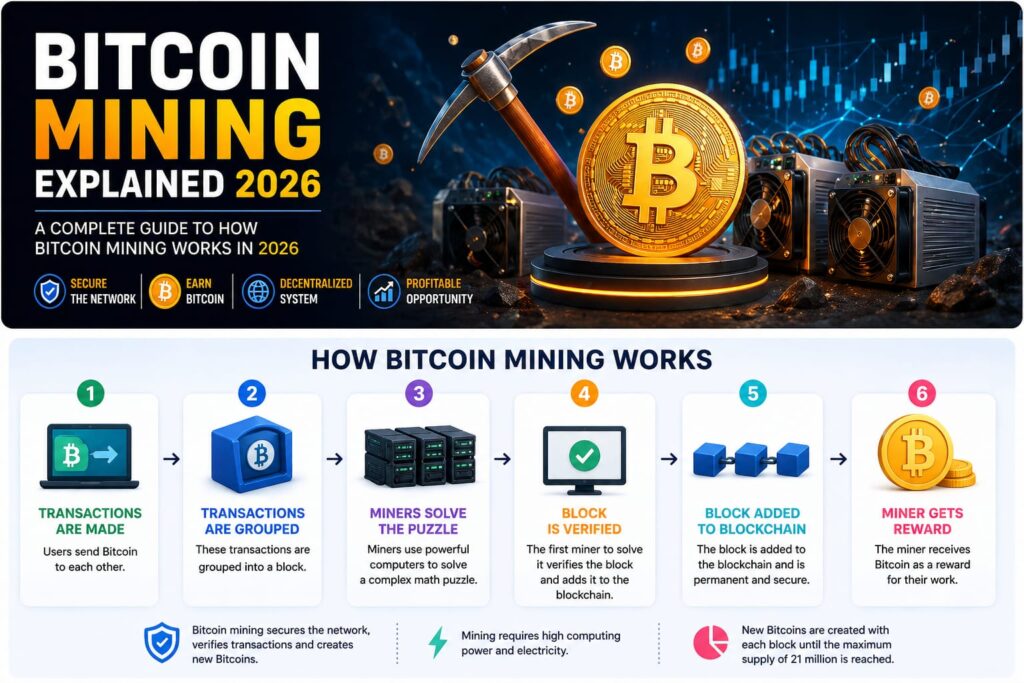
Bitcoin’s Journey from an unknown digital experiment to a Global Financial Asset is one of the most remarkable stories in modern financial history. What started as a decentralized currency project in 2009 has evolved into an asset followed by governments, institutions, corporations, and millions of investors worldwide.
The Financial Experiment Nobody Believed In
In 2010, Bitcoin was almost worthless.
There was no media attention. There were no crypto influencers. There were no billion-dollar crypto companies. Most people had never even heard the word Bitcoin.
The few people who knew about it considered it a strange internet experiment created by an anonymous person called Satoshi Nakamoto.
No government supported it.
No bank trusted it.
No financial institution wanted anything to do with it.
Yet today, Bitcoin is discussed by governments, investment firms, banks, hedge funds, and some of the largest financial institutions in the world.
How did that happen?
How did a digital experiment become one of the most talked-about financial assets of the 21st century?
To understand that, we need to go back to the early days of Bitcoin.
The Day Bitcoin Bought Two Pizzas
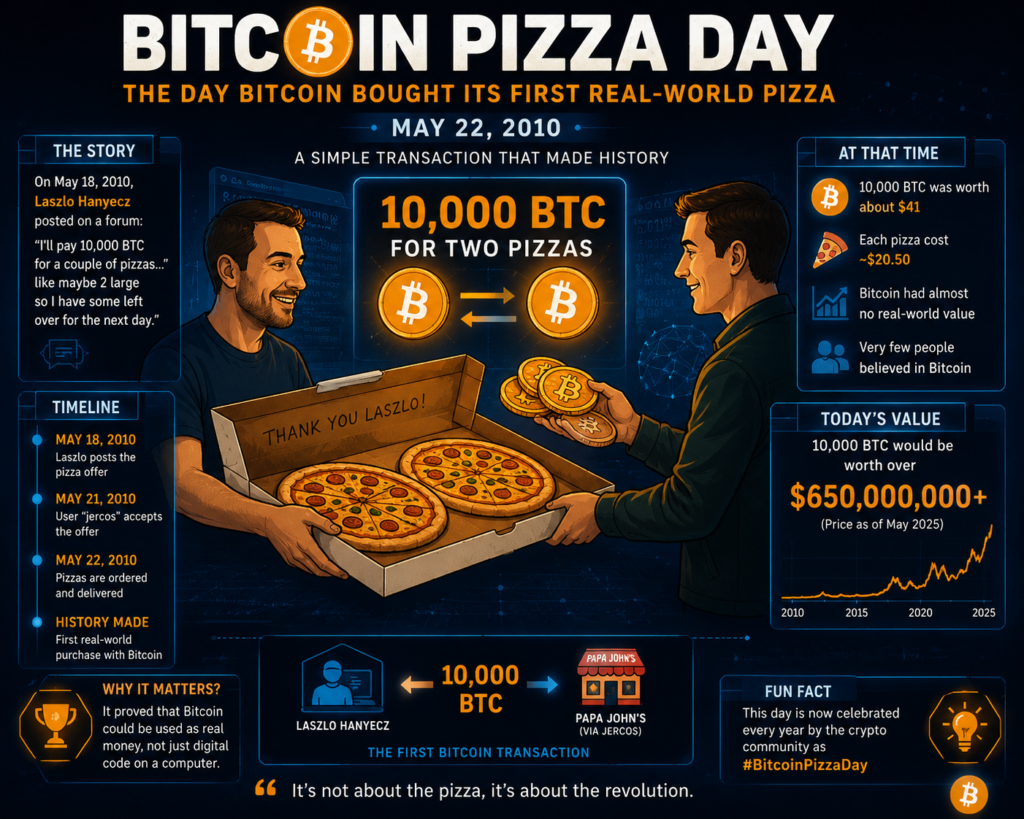
One of the most famous moments in crypto history happened on May 22, 2010.
A programmer named Laszlo Hanyecz posted a message on an online forum.
He offered 10,000 Bitcoin to anyone willing to buy him two pizzas.
At that time, Bitcoin had almost no real-world value.
After some time, another user accepted the offer and arranged the pizza delivery.
The transaction was completed.
For the first time in history, Bitcoin was used to purchase a real product.
Today, that transaction is known as Bitcoin Pizza Day.
At current Bitcoin prices, those 10,000 BTC would be worth hundreds of millions of dollars.
Many people look at this story and laugh.
However, Laszlo did not make a mistake.
He helped prove that Bitcoin could be used as money.
Without that transaction, Bitcoin may have taken much longer to gain real-world credibility.
The pizza was not the important part.
The proof of value was.
Why Most People Thought Bitcoin Was a Joke
Even after Bitcoin Pizza Day, very few people believed Bitcoin had a future.
Many newspapers described it as “internet money.”
Others called it “fake money.”
Some experts predicted that Bitcoin would disappear within a few years.
The idea sounded strange.
Why would anyone trust digital money that was not issued by a government?
Why would anyone use a currency that only existed on computers?
Traditional finance had existed for centuries.
Bitcoin looked like a temporary experiment.
As a result, most people ignored it.
Some laughed at it.
Others called it a scam.
But while the world was mocking Bitcoin, a small group of believers was quietly building the foundation of a revolution.
The Early Believers Who Saw the Future
One of the most important names in Bitcoin’s early history is Hal Finney.
Hal Finney was a software developer and cryptography expert.
He was one of the first people to communicate directly with Satoshi Nakamoto.
In fact, Hal Finney received the first known Bitcoin transaction ever sent.
At a time when almost nobody cared about Bitcoin, Hal believed the technology could become something important.
There were other early believers too.
Developers, privacy advocates, and technology enthusiasts continued improving the Bitcoin ecosystem.
They were not motivated by quick profits.
They were motivated by the idea of creating a decentralized financial system.
These early supporters played a critical role in Bitcoin’s survival.
Without them, Bitcoin might have disappeared before the world even noticed it.
Silk Road and Bitcoin’s First Reputation Crisis
As Bitcoin became more popular, it also became more controversial.
Around 2011, Bitcoin started receiving attention because of a dark web marketplace known as Silk Road.
Silk Road allowed people to buy and sell products anonymously.
Bitcoin became one of the preferred payment methods on the platform.
The media quickly connected Bitcoin with criminal activity.
Headlines described Bitcoin as a currency used by criminals.
Governments began paying attention.
Public opinion turned negative.
For many people, Bitcoin became associated with illegal activities rather than innovation.
However, an important question emerged.
Was Bitcoin itself the problem?
Or was it simply being used by some people for illegal purposes?
The same debate exists today.
Cash can be used for crime.
The internet can be used for fraud.
Yet neither cash nor the internet is considered inherently criminal.
Bitcoin faced a major reputation crisis, but the technology itself continued to evolve.
The Mt. Gox Collapse: The Day Bitcoin Almost Died
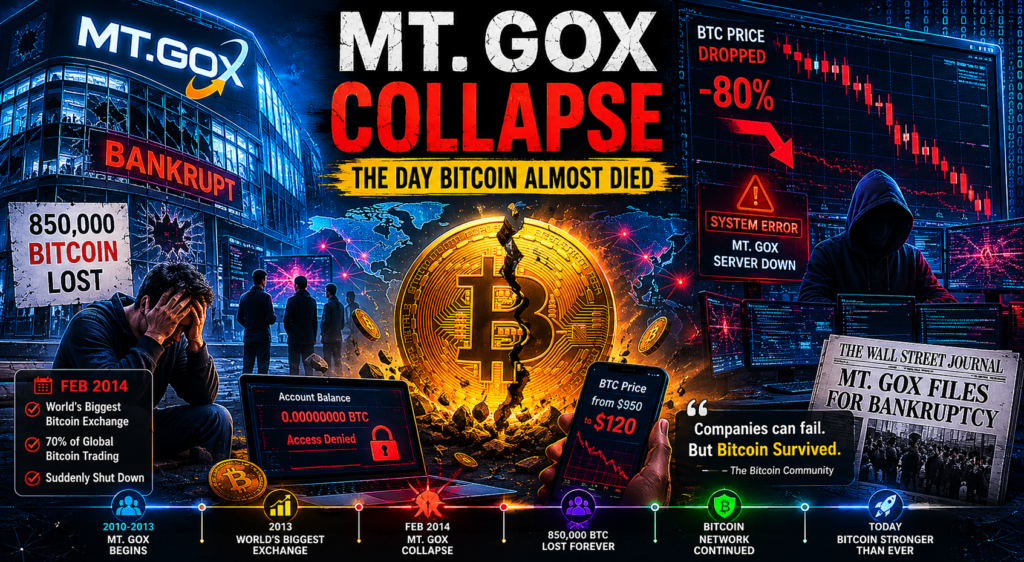
If there was ever a moment when Bitcoin truly seemed close to failure, it was 2014.
At the time, Mt. Gox was the largest Bitcoin exchange in the world.
Reports suggested that around 70% of global Bitcoin trading volume passed through the platform.
People trusted Mt. Gox.
They stored their Bitcoin there.
They traded there.
Many believed it was the future of crypto trading.
Then disaster struck.
Mt. Gox suddenly collapsed.
The company filed for bankruptcy protection.
According to reports, approximately 850,000 Bitcoin were lost or missing.
The crypto market entered panic mode.
News organizations declared that Bitcoin was finished.
Critics argued that the experiment had failed.
Investors lost confidence.
Prices crashed.
But something unexpected happened.
Bitcoin itself did not stop working.
The exchange failed.
The Bitcoin network did not.
This distinction became one of the most important lessons in crypto history.
Bitcoin and crypto companies are not the same thing.
Companies can fail.
The decentralized Bitcoin network can continue operating.
This realization helped Bitcoin survive one of the darkest periods in its history.
China’s War Against Bitcoin
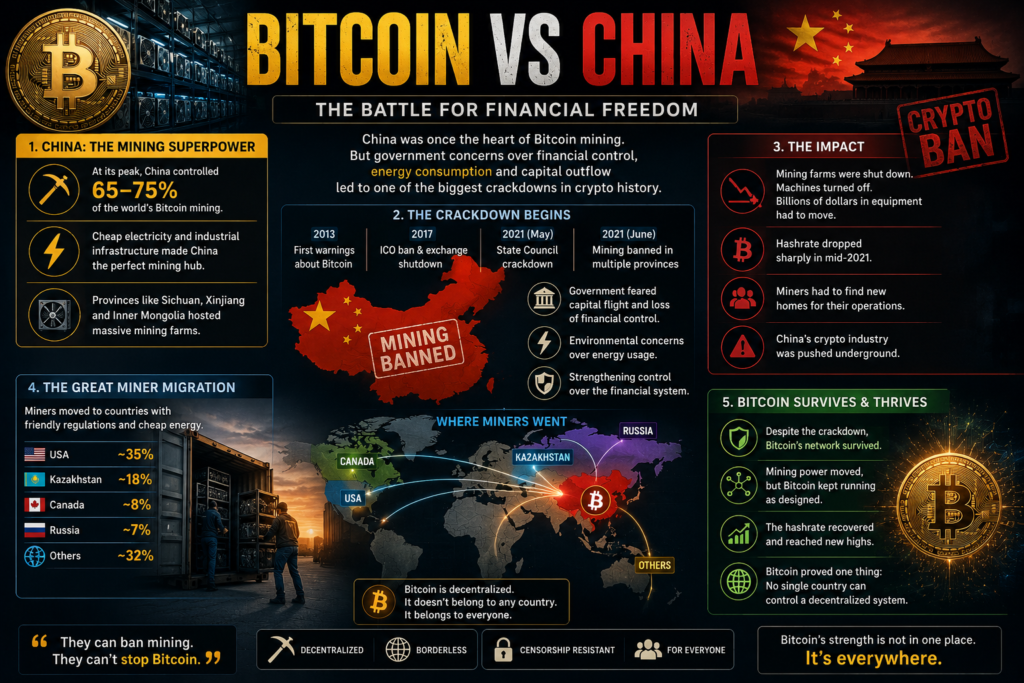
If Mt. Gox was Bitcoin’s biggest company crisis, then China became Bitcoin’s biggest government challenge.
For years, China played a major role in the Bitcoin ecosystem.
A significant portion of global Bitcoin mining was located in China because electricity costs were relatively low in some regions.
As Bitcoin grew, Chinese authorities became increasingly concerned about capital flows, financial stability, and the growing influence of cryptocurrencies.
The first major restrictions appeared in 2013.
Then more pressure came in 2017.
But the most dramatic move happened in 2021.
China launched a major crackdown on Bitcoin mining and crypto-related activities.
Mining farms were shut down.
Companies were forced to relocate.
Billions of dollars worth of mining equipment had to move to other countries.
Many critics believed this would be the end of Bitcoin.
But something unexpected happened.
The Bitcoin network survived.
Mining power temporarily dropped but later recovered.
Operations moved to countries such as the United States, Kazakhstan, and other regions.
For many Bitcoin supporters, this was proof that Bitcoin was stronger than any single country.
For critics, it remained a risky experiment.
But one thing became clear.
Bitcoin was no longer a small internet project.
Governments were now taking it seriously.
India’s Bitcoin Journey: Fear, Regulation and Opportunity
India’s relationship with Bitcoin has been complicated.
Unlike some countries that fully embraced Bitcoin and others that completely banned it, India has taken a cautious approach.
In 2018, the Reserve Bank of India introduced restrictions that affected crypto-related businesses.
The market entered a period of uncertainty.
Investors were worried.
Many people believed crypto would disappear from India.
However, in 2020, the Supreme Court of India overturned the RBI banking restrictions.
This decision became one of the most important moments in Indian crypto history.
It gave the industry a chance to grow again.
New exchanges expanded.
Millions of Indians entered the crypto market.
Then another major development came.
In 2022, India introduced a 30% tax on crypto gains along with a 1% TDS on certain crypto transactions.
The government did not declare crypto illegal.
At the same time, it did not provide complete regulatory clarity either.
This created a unique situation.
India became one of the world’s largest crypto markets while still operating in an evolving regulatory environment.
For Indian investors, the lesson is simple.
Crypto adoption is growing.
But education and risk management remain more important than ever.
Wall Street: The Financial Kingdom Bitcoin Was Supposed to Fight
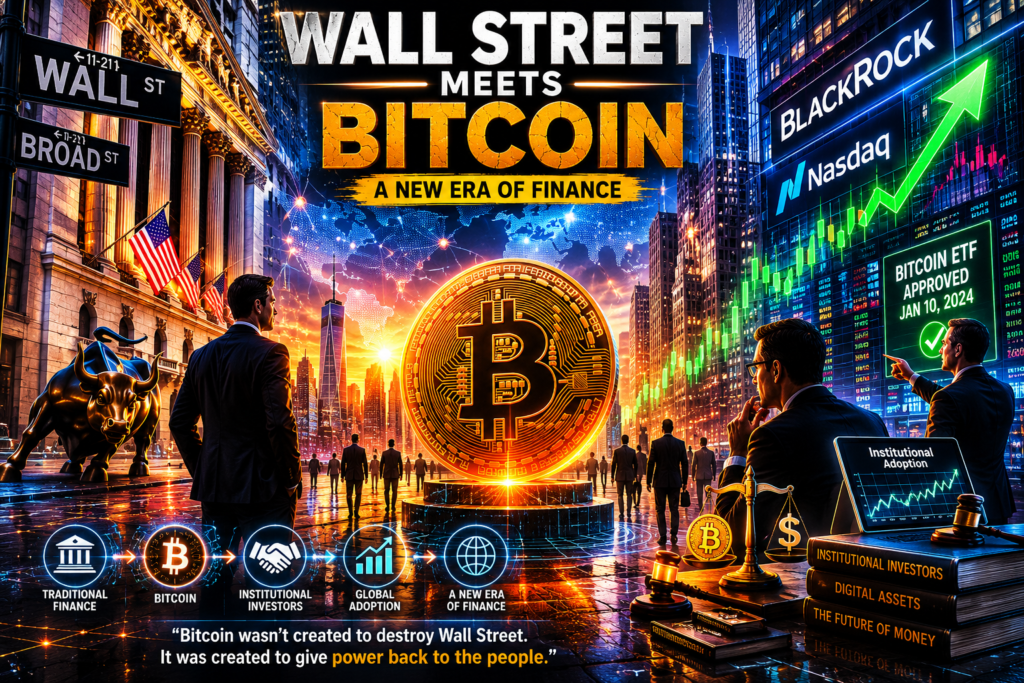
To understand Bitcoin’s success, we need to understand Wall Street.
Wall Street is not just a street in New York.
It is one of the most powerful symbols of global finance.
Its origins go back more than two centuries.
In 1792, a group of traders signed what became known as the Buttonwood Agreement.
That agreement eventually led to the creation of what became the New York Stock Exchange.
Over time, Wall Street became the center of global finance.
Banks.
Investment firms.
Hedge funds.
Institutional investors.
Major financial decisions affecting trillions of dollars.
All became connected to Wall Street.
Now think about Bitcoin.
Bitcoin was created in the aftermath of the 2008 financial crisis.
Many early supporters saw it as an alternative to traditional finance.
In some ways, Bitcoin represented a challenge to the financial system.
That is why one of the biggest ironies in modern finance is this:
The same Wall Street that once ignored Bitcoin eventually started embracing it.
The SEC: The Regulator That Controlled Bitcoin’s Next Chapter
Whenever people discuss Bitcoin ETFs, they often mention the SEC.
But many beginners do not know what the SEC actually is.
The Securities and Exchange Commission was created in 1934 after the Great Depression.
The goal was simple.
Protect investors.
Improve transparency.
Reduce market manipulation.
For decades, the SEC became one of the most important financial regulators in the United States.
As Bitcoin grew, ETF applications were repeatedly submitted.
Many were rejected.
Year after year, regulators remained cautious.
Supporters argued that Bitcoin had matured.
Critics argued that it remained too risky.
Then history was made.
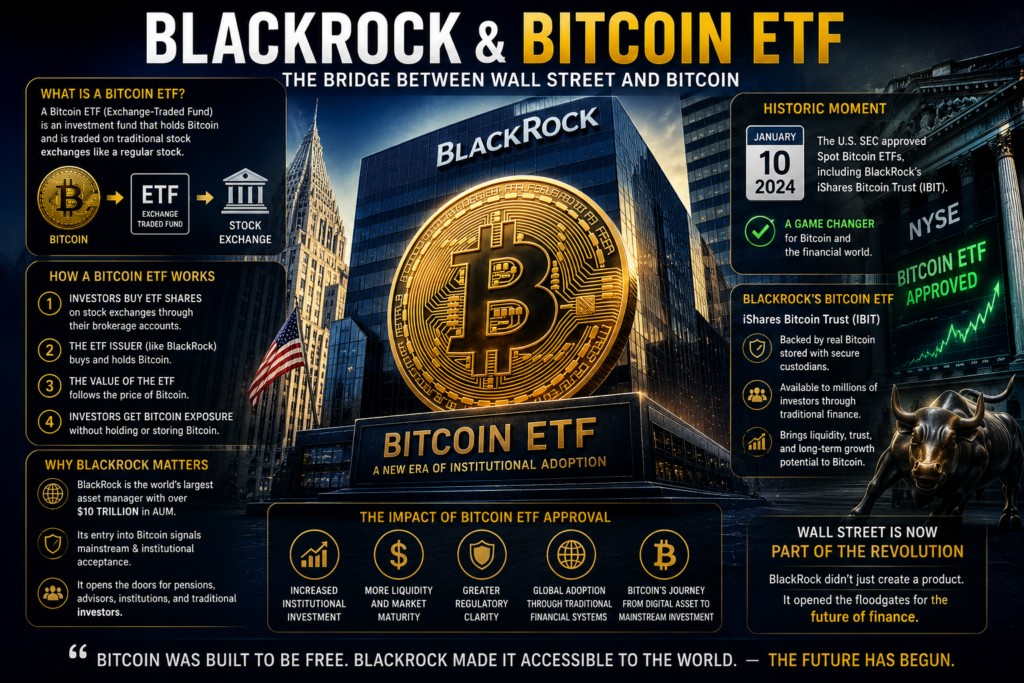
On January 10, 2024, the SEC approved spot Bitcoin exchange-traded products.
This was one of the most important moments in Bitcoin’s history.
Because it signaled that Bitcoin was entering a new phase of legitimacy within traditional financial markets.
BlackRock: The Company That Changed The Conversation
When people hear the name BlackRock, many assume it is simply another investment company.
The reality is far more interesting.
BlackRock was founded in 1988.
Its founders wanted to build a company focused on risk management and institutional investing.
Over the decades, BlackRock expanded into one of the most influential financial institutions in the world.
Today, BlackRock manages trillions of dollars in assets.
Its influence reaches pension funds, governments, institutions, and investment portfolios across the globe.
One of BlackRock’s most important innovations is its technology platform known as Aladdin.
Aladdin helps institutions analyze risk and manage portfolios at massive scale.
This is one reason why financial markets pay attention when BlackRock makes a move.
And that is exactly what happened with Bitcoin.
When BlackRock launched its spot Bitcoin ETF product, many investors saw it as a turning point.
Not because Bitcoin suddenly became safe.
But because one of the world’s largest asset managers was now willing to offer Bitcoin exposure to clients.
For many observers, this represented a major shift in perception.
Bitcoin was no longer viewed only as an internet experiment.
It was becoming an institutional asset.
The Bitcoin ETF Revolution
For years, one of the biggest barriers to Bitcoin adoption was complexity.
New investors had to learn:
- Wallets
- Private keys
- Exchanges
- Security practices
Many traditional investors found this intimidating.
Bitcoin ETFs changed the conversation.
Instead of directly holding Bitcoin, investors could gain exposure through a familiar investment structure.
This opened the door for a much larger audience.
Financial advisors.
Retirement accounts.
Institutional investors.
Traditional market participants.
All could now access Bitcoin through regulated financial products.
This does not remove risk.
Bitcoin remains volatile.
But it does make access easier.
And easier access often leads to greater adoption.
What Bitcoin’s Story Teaches Investors
Bitcoin’s history contains several powerful lessons.
First, innovation is often rejected before it is accepted.
Second, volatility does not automatically mean failure.
Third, education matters more than hype.
Many people bought Bitcoin without understanding it.
Many sold Bitcoin because they did not understand it.
The people who studied the technology, the risks, and the long-term vision were often better prepared to navigate the journey.
Bitcoin teaches us that financial markets are influenced by psychology as much as technology.
Fear.
Greed.
Hope.
Uncertainty.
All play major roles.
The Future of Bitcoin
Today, Bitcoin stands in a very different position than it did in 2010.
It has survived exchange collapses.
Government pressure.
Media criticism.
Market crashes.
Regulatory battles.
And countless predictions of its death.
Yet Bitcoin remains one of the most discussed financial assets in the world.
Will Bitcoin become digital gold?
Will it become a global reserve asset?
Will governments create stricter regulations?
The future remains uncertain.
But one fact is impossible to ignore.
Bitcoin has already changed the financial conversation forever.
And its story is still being written.
Why Bitcoin’s Journey Still Inspires Investors
Bitcoin’s Journey continues to inspire investors because it proves that innovation can challenge traditional financial systems. Over the years, Bitcoin survived exchange hacks, government bans, regulatory pressure, market crashes, and criticism from major financial institutions. Despite these challenges, Bitcoin continued to grow and attract new users worldwide.
Today, Bitcoin is viewed as a Global Financial Asset by many investors. Major companies hold Bitcoin on their balance sheets, investment funds offer Bitcoin exposure, and financial institutions continue to expand Bitcoin-related products. This transformation from an internet experiment into a recognized asset class highlights the importance of innovation, decentralization, and long-term conviction.
For beginners entering the crypto market, Bitcoin’s Journey provides valuable lessons about patience, risk management, and understanding technology before investing. Its story remains one of the most significant developments in modern finance.
Conclusion
Bitcoin started as an experiment.
An idea shared by an anonymous creator.
A technology dismissed by critics.
A project ignored by traditional finance.
Today, it sits at the center of discussions involving governments, regulators, Wall Street institutions, and millions of investors around the world.
Its journey from pizza purchases to Bitcoin ETFs is one of the most remarkable stories in financial history.
Whether you believe Bitcoin is the future or not, understanding its history is essential for understanding the future of money itself.
Also Read
If you’re new to cryptocurrency, start with our What Is Bitcoin? Complete Beginner Guide to understand how Bitcoin works and why it was created.
To learn about the revolutionary technology behind Bitcoin, read our Blockchain: The 5000-Year Story of Trust, Records, and Digital Revolution.
Bitcoin inspired Ethereum and the entire Web3 ecosystem. Discover the full story in our Ethereum Story: How Vitalik Buterin Created Ethereum and Changed Crypto.
Want to know why the world’s biggest financial institutions now trust Bitcoin? Read our BlackRock History: How Larry Fink Built a $11 Trillion Financial Giant.
If you’re interested in how Bitcoin became a Wall Street investment product, don’t miss our What Is Bitcoin ETF? Complete Beginner Guide.
Also Read
- Official Bitcoin Whitepaper PDF
- Official Bitcoin Website
- Official BlackRock Website
- Official iShares Bitcoin Trust ETF by BlackRock
- U.S. Securities and Exchange Commission Official Website
- Official Nasdaq Website
FAQ
What was the first real Bitcoin transaction?
The first widely recognized real-world Bitcoin transaction took place on May 22, 2010, when Laszlo Hanyecz paid 10,000 BTC for two pizzas. Today, this event is celebrated as Bitcoin Pizza Day.
Why is Mt. Gox important in Bitcoin history?
Mt. Gox was once the world’s largest Bitcoin exchange. Its collapse in 2014 caused massive panic in the crypto market and became one of the biggest crises in Bitcoin history.
Why did China ban Bitcoin mining?
China imposed restrictions on Bitcoin mining and crypto-related activities due to concerns about financial stability, capital controls, and energy consumption.
Is Bitcoin legal in India?
Bitcoin is not illegal in India. However, crypto transactions are subject to taxation and regulatory rules that investors should understand before investing.
What is a Bitcoin ETF?
A Bitcoin ETF (Exchange-Traded Fund) allows investors to gain exposure to Bitcoin through traditional financial markets without directly holding Bitcoin in a wallet.
Why is BlackRock important for Bitcoin?
BlackRock is one of the world’s largest asset managers. Its entry into the Bitcoin ETF market signaled growing institutional acceptance of Bitcoin.
Is Bitcoin still a risky investment?
Yes. Bitcoin remains a highly volatile asset. Investors should always conduct research, understand the risks, and never invest more than they can afford to lose.
join our Telegram for instant crypto updates.
Subscribe to our youtube Channel
For detailed crypto market analysis, price predictions, and investment strategies,
subscribe to our YouTube channel Coin Alert
What Do You Think About Bitcoin’s Journey?
Bitcoin started as a small digital experiment and eventually became one of the most discussed financial assets in the world.
Do you believe Bitcoin will become digital gold in the future?
Share your opinion in the comments below.
For more beginner-friendly crypto education, in-depth guides, and documentary-style crypto stories, visit Coin Alert regularly.
🌐 Website: https://coinalert.in
📢 Telegram: https://t.me/coinalert
🎥 YouTube: Coin Alert
Stay informed. Stay secure. Learn before you invest.

Dr. Khushwant Rana is the founder of Coin Alert and has 15+ years of business experience. He creates beginner-friendly crypto educational content focused on Bitcoin, blockchain, Web3, crypto security, and real-world crypto awareness in India.