
Coin Alert Partners with Pulse Verity to Bring Verified Live Crypto Market Data
Coin Alert has integrated Pulse Verity Index into its Crypto Tools platform, bringing live cryptocurrency market data and a new layer of data verification concepts to its growing crypto and Web3 community.
The cryptocurrency market moves continuously.
Bitcoin, Ethereum, Solana and other digital assets can change in price within seconds, making reliable and understandable market information an important part of the modern crypto experience.
At Coin Alert, our mission has always been to make cryptocurrency, blockchain and Web3 easier to understand—especially for beginners.
As part of that mission, we are pleased to announce that Pulse Verity Index is now integrated into the Coin Alert Crypto Tools platform.
The integration is live and available to visitors through our Cryptocurrency Market Overview.
What Is the Coin Alert × Pulse Verity Integration?
The new integration brings live market information directly into the Coin Alert website.
Visitors can access market information for major cryptocurrencies including:
- Bitcoin (BTC)
- Ethereum (ETH)
- Solana (SOL)
- BNB
- XRP
- Dogecoin (DOGE)
The information is presented through a clean market dashboard designed to make the experience easy to understand.
Instead of forcing beginners to navigate complicated financial dashboards, Coin Alert provides a straightforward view of the market while introducing users to some of the technology and concepts behind crypto market data.
Explore the live Crypto Tools
The Crypto Tools page is powered by Pulse Verity Index, with the appropriate attribution and link displayed on the live page.
What Is Pulse Verity Index?
Pulse Verity Index provides signed and verifiable cryptocurrency index prices.
One of the key ideas behind the technology is that a price observation can come with a cryptographic signature that can be independently verified.
Pulse Verity’s documentation describes its price observations as cryptographically signed using ECDSA P-256, with verification possible against its published public keys. (Pipeworx)
For a beginner, this may sound highly technical.
But the basic concept is actually simple:
Instead of looking only at a price, we can also ask whether the data behind that price can be verified.
This is particularly relevant to the broader Web3 ecosystem, where cryptographic verification and data integrity are important concepts.
Why Does Verification Matter in Crypto?
Imagine you see:
Bitcoin — $85,000
A normal user may simply ask:
“What is the current Bitcoin price?”
But someone learning about Web3 may ask a deeper question:
“Where did this number come from, and can the information be verified?”
That second question is where things become much more interesting.
Pulse Verity’s signed price system is designed to provide a cryptographically signed price observation that can subsequently be verified. Its documentation explains that verification can be performed locally using ECDSA P-256/SHA-256 and a published public-key ring. (Glama)
This doesn’t mean that every piece of market information becomes automatically “true” simply because it is signed.
Rather, the signature provides a mechanism for checking whether the signed data itself is authentic and unaltered.
That distinction is important.
What Does a Signed Crypto Price Mean?
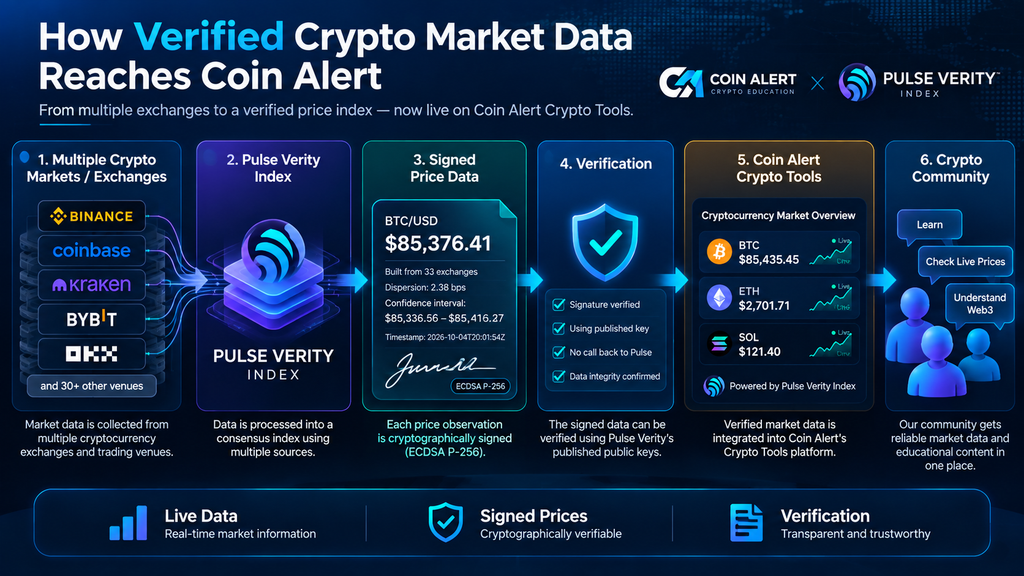
Let’s simplify it.
Suppose Pulse Verity publishes a particular BTC price together with information such as its timestamp and other signed fields.
A cryptographic signature is attached to that observation.
A verifier can then use the appropriate public key to check the signature.
If the signed information has been altered, the verification process can detect that the cryptographic data no longer matches.
This is one of the concepts that makes cryptographic systems powerful.
And it gives Coin Alert an opportunity to introduce our audience to something deeper than simply watching numbers move on a screen.
Market Data Is More Than Just a Price
Another interesting aspect of the Pulse Verity sample provided to Coin Alert is the additional market context around an observation.
The supplied BTC verification example showed:
- 33 exchanges
- 2.38 bps dispersion across venues
- A displayed confidence interval
- Cryptographic signature verification using ECDSA P-256
These details provide additional context around the market observation.
For beginners, the terminology can initially look complicated.
So let’s break it down.
What Does Exchange Dispersion Mean?
Cryptocurrency trading takes place across many different venues.
Because markets operate independently, the price of an asset can differ slightly between venues at a particular moment.
Dispersion provides a way of describing how prices differ across those venues.
In the supplied Pulse Verity BTC example, the displayed dispersion was 2.38 basis points (bps).
The important lesson for beginners is not simply to memorize the number.
It is to understand that a crypto market price can be viewed in the context of multiple market venues rather than as an isolated number.
What Is a Confidence Interval?
The sample provided by Pulse Verity also displayed a confidence interval alongside the BTC index price.
In the example:
BTC/USD: $85,376.41
Confidence interval: $85,336.56 – $85,416.27
For beginners, the easiest way to think about a confidence interval is as additional statistical context around an estimate.
It helps users understand that market data can contain more information than one single displayed price.
However, users should not interpret a confidence interval as a guarantee that the market price must remain inside that range.
The Web3 Connection: Cryptographic Verification
This is perhaps the most interesting educational aspect of the integration.
Blockchain and Web3 technologies rely heavily on cryptography.
For example, Coin Alert has previously explained how private keys are used to create digital signatures in cryptocurrency transactions. Our beginner-friendly guide to crypto private keys explains the relationship between private keys, public keys and digital signatures in more detail. (coinalert.in)
The Pulse Verity integration gives us another practical example of cryptography being used outside a traditional blockchain transaction.
Instead of using cryptographic signatures only for wallet transactions, signed market data can provide a way to verify a published price observation.
This creates a useful educational bridge:
Crypto ownership → Cryptography → Digital signatures → Verifiable data
Why Coin Alert Added Pulse Verity
The purpose of this integration is not simply to put another price widget on our website.
Coin Alert is an educational platform.
Our goal is to help people understand cryptocurrency and Web3 in simple language.
That means practical tools are just as important as educational articles.
A beginner can visit the Crypto Tools page and simply check the current market.
But that same beginner can also start learning:
- How crypto market prices are represented
- Why prices can differ across venues
- What market dispersion means
- What confidence intervals represent
- What digital signatures are
- How public-key verification works
- Why data integrity matters
This creates a connection between learning and using.
A Practical Learning Experience for Beginners
Imagine a new user visiting Coin Alert.
They see Bitcoin’s current market price.
At first, that may be all they want.
But then they discover that market data can include information about different venues, statistical context and cryptographic verification.
Suddenly, a simple price becomes the beginning of a much bigger lesson.
This is exactly the type of experience we want to create at Coin Alert.
We don’t want users to simply consume information.
We want them to understand it.
Coin Alert’s Six-Month Pulse Verity Partnership
As part of the partnership, Pulse Verity has provided the Coin Alert developer account with a complimentary Basic plan for six months.
According to the partnership communication, the higher limits associated with the Basic plan are active and no card or checkout was required.
This gives Coin Alert the opportunity to continue using the integration while introducing the technology to our community.
We are pleased to have Pulse Verity supporting this stage of the Coin Alert Crypto Tools journey.
What Can Coin Alert Users Expect?
The immediate experience is simple.
Users can visit the Crypto Tools page and view live market information for the supported assets.
But the longer-term value is educational.
As Coin Alert continues developing its Web3 resources, tools like this can help us explain technical concepts through real-world examples.
Instead of explaining cryptographic verification only through theory, users can see where such concepts can be applied.
That is an important part of practical Web3 education.
Live Crypto Data Meets Crypto Education
Crypto education should not stop at:
“Bitcoin is going up.”
It should also help users understand:
Why is the number changing?
Where does market data come from?
How can data be represented?
How can certain information be verified?
What does a cryptographic signature actually do?
These are the types of questions that help users move from simply following crypto prices to actually understanding the technology.
Coin Alert × Pulse Verity
The integration represents another step in Coin Alert’s goal of bringing practical Web3 tools and beginner-friendly education together.
Pulse Verity brings signed and verifiable crypto index data, while Coin Alert provides an educational environment where users can interact with that information and learn about the concepts behind it. (Pipeworx)
We believe this combination can make technical Web3 concepts easier to approach.
For experienced crypto users, the market dashboard provides a convenient way to view market information.
For beginners, it can become the starting point for learning about market data, cryptography and verification.
Explore the Live Coin Alert Crypto Tools
The Pulse Verity-powered market overview is now live on Coin Alert.
You can explore the live market dashboard here:
Explore Coin Alert Crypto Tools → Crypto Tools
The page currently displays live market information for BTC, ETH, SOL, BNB, XRP and DOGE and includes the Powered by Pulse Verity Index attribution.
What Comes Next?
The integration is now live, but this is only one step in the larger Coin Alert journey.
Our focus remains simple:
Make Web3 easier to understand.
We will continue exploring practical tools, educational resources and real-world examples that can help our community understand how cryptocurrency and blockchain technology work.
We are pleased to have Pulse Verity as part of this stage of that journey.
Coin Alert × Pulse Verity
Live market data. Practical tools. Easier crypto education.
EXPERT INSIGHT
Dr. Khushwant Rana — Founder, Coin Alert
“For beginners, cryptocurrency often starts with a price chart. But real understanding begins when we start asking where that data comes from, how it is represented, and how it can be verified. At Coin Alert, our goal is to make these technical concepts easier to understand through practical tools and real-world examples.”
Coin Alert focuses on beginner-friendly education covering cryptocurrency, blockchain, Web3, crypto security and practical digital-asset awareness. (coinalert.in)
FINAL THOUGHTS
The crypto industry is moving toward an environment where users need more than fast information.
They also need to understand the quality, context and verifiability of information.
The Coin Alert × Pulse Verity integration gives our community an opportunity to explore that idea through a practical live market tool.
For experienced users, it provides another market-data resource.
For beginners, it provides a starting point for understanding an important question:
In a digital world, how do we know that the information we receive can be verified?
That question sits at the heart of much of Web3.
And at Coin Alert, we believe the best way to learn it is not just through theory—but through practical experience.
Frequently Asked Questions (FAQs)
What is Pulse Verity Index?
Pulse Verity Index is a crypto price index that provides signed price observations designed to be cryptographically verifiable. Its documentation describes ECDSA P-256-based verification for signed price prints. (Pipeworx)
What is a signed crypto price?
A signed crypto price is a market-data observation accompanied by a cryptographic signature. The signature can be checked against the appropriate published public key to verify the signed information.
What does ECDSA P-256 mean?
ECDSA P-256 is a cryptographic signature scheme based on the P-256 elliptic curve. In Pulse Verity’s verification system, it is used to sign and verify price observations. (Glama)
What does exchange dispersion mean?
Exchange dispersion describes the difference or spread between market observations across different trading venues. It provides additional context about how closely prices align across venues.
What is a confidence interval in crypto market data?
A confidence interval provides statistical context around an estimated market value. It should not be interpreted as a guarantee that the asset’s future price will remain within that range.
Which cryptocurrencies are available on Coin Alert Crypto Tools?
The current Coin Alert integration displays BTC, ETH, SOL, BNB, XRP and DOGE.
Is the Coin Alert Crypto Tools page useful for beginners?
Yes. The interface is designed to make basic market information easy to understand while giving users an opportunity to learn about deeper concepts such as market data, dispersion and cryptographic verification.
Is Pulse Verity a cryptocurrency or an exchange?
No. Pulse Verity is being used here as a source of crypto index market data and verification infrastructure, not as a cryptocurrency exchange or investment product.
Related Coin Alert Guides
crypto volatility: Crypto markets can change rapidly, and understanding crypto volatility is essential for anyone trying to interpret market movements. Crypto Volatility Guide
crypto slippage: Rapid market movement can also affect trade execution, which is why understanding crypto slippage is important. Crypto Slippage Guide
crypto private keys: To understand the wider role of cryptography in cryptocurrency, beginners can also learn about crypto private keys and digital signatures. Crypto Private Key Guide
MetaMask wallet: Users who are new to Web3 can also start with our beginner-friendly MetaMask wallet guide. MetaMask Wallet Guide
Continue Your Web3 Journey with Coin Alert 🚀
Join the Coin Alert community to explore blockchain, NFTs, Web3, DeFi, cryptocurrency security, and practical tutorials designed for beginners.
If you found this guide helpful, consider sharing it with your friends and fellow Web3 learners. Every share helps us educate more people about blockchain technology.
🚀 Learn. Build. Grow with Coin Alert.

Dr. Khushwant Rana is the founder of Coin Alert and has 15+ years of business experience. He creates beginner-friendly crypto educational content focused on Bitcoin, blockchain, Web3, crypto security, and real-world crypto awareness in India.
