The cryptocurrency industry is moving toward a more decentralized future. Instead of companies or centralized authorities controlling platforms, many blockchain projects now rely on communities to make important decisions.
This concept is known as a DAO, which stands for Decentralized Autonomous Organization.
DAOs allow communities to manage blockchain projects through transparent voting systems powered by smart contracts. These organizations operate without traditional management structures and rely on token holders to decide how the project evolves.
In this guide, we will explain what a DAO is, how it works, and why it has become an important part of the cryptocurrency ecosystem in 2026.
What Is a DAO in Crypto
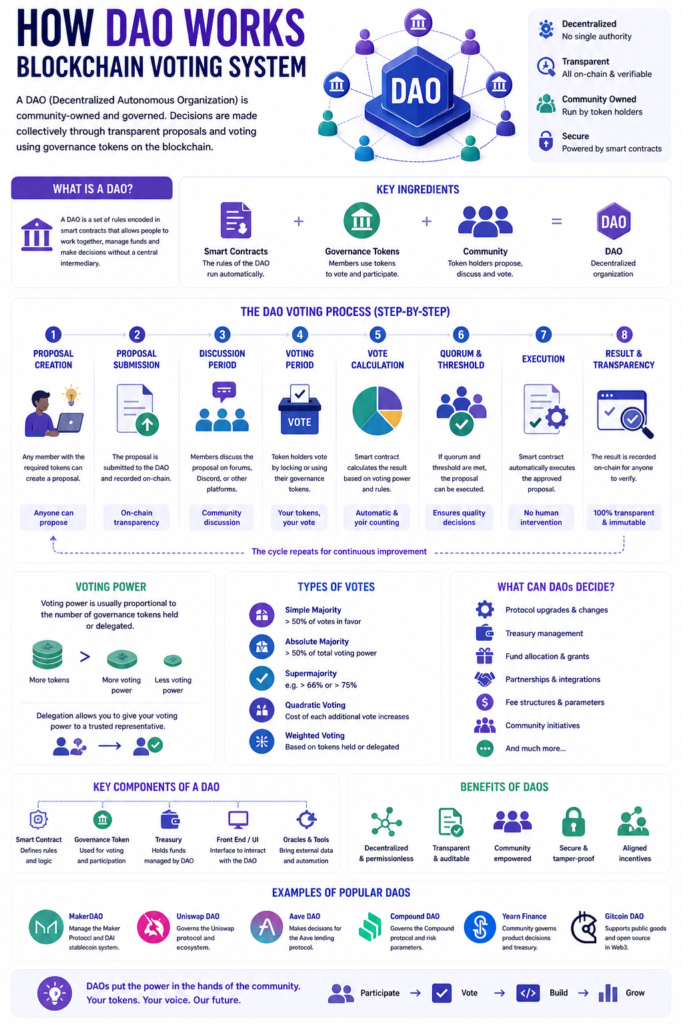
A DAO (Decentralized Autonomous Organization) is a blockchain-based organization governed by smart contracts and community voting instead of centralized leadership.
In a DAO, decisions are made collectively by token holders who vote on proposals related to the project.
These proposals may include:
Protocol upgrades
Development funding
Changes to platform rules
Launching new features
Most DAOs operate on blockchain networks such as Ethereum, which supports smart contracts and decentralized applications.
How DAO Works
A DAO works through a system of smart contracts that automatically execute decisions approved by community votes.
Here is how the typical DAO process works:
1. Proposal Creation
Members of the community submit proposals suggesting improvements or changes to the platform.
2. Community Voting
Token holders vote on the proposal using governance tokens.
3. Smart Contract Execution
If the proposal receives enough votes, the smart contract automatically executes the decision.
This process ensures that the platform remains decentralized and transparent.
Crypto data platforms such as CoinMarketCap track many projects that operate as DAOs.
Examples of Popular DAOs
Several successful crypto projects operate using DAO governance systems.
Some well-known examples include:
Uniswap – A decentralized exchange governed by UNI token holders.
Maker – A DAO that manages the stablecoin DAI.
Aave – A decentralized lending platform governed by AAVE token holders.
These projects demonstrate how communities can successfully manage decentralized systems.
Benefits of DAO
DAOs offer several advantages compared to traditional organizations.
Decentralization
DAOs remove the need for centralized control and allow communities to govern projects.
Transparency
All voting activities and financial transactions are recorded on the blockchain.
Community Participation
DAO members actively participate in shaping the future of the platform.
Risks of DAO
Despite their benefits, DAOs also have some potential risks.
Security Risks
Smart contract vulnerabilities can sometimes be exploited.
Low Participation
Many token holders do not participate in voting decisions.
Regulatory Uncertainty
Governments are still developing regulations for decentralized organizations.
Educational resources such as Binance Academy provide detailed explanations of DAO governance systems.
Also Read
Before learning about DAOs (Decentralized Autonomous Organizations), it’s important to understand the fundamentals of blockchain technology. Read our Blockchain: The 5000-Year Story of Trust, Records, and Digital Revolution to understand how decentralized networks make community governance possible.
DAOs became popular because of Ethereum and Smart Contracts. To understand how Ethereum introduced programmable blockchain technology, read our Ethereum Story: How Vitalik Buterin Created Ethereum and Changed Crypto.
Every DAO operates through Smart Contracts that automatically execute community decisions. Before exploring DAOs, read our What Is a Smart Contract? Real Examples Explained for Beginners (2026). Complete Ultimate Guide.
Many DAOs manage decentralized finance (DeFi) protocols, lending platforms, and crypto communities. To understand the DeFi ecosystem, read our What Is DeFi? Powerful Beginner Guide to Decentralized Finance in 2026.
After learning about DAOs, continue with our What Is Web3 Gaming? Ultimate Complete Beginner Guide for 2026 to discover how decentralized governance, Smart Contracts, and community ownership are shaping the future of blockchain games, NFTs, and the Web3 ecosystem.
Also Read
Websites like CoinMarketCap provide a full DAO crypto projects list showing many decentralized organizations in the blockchain ecosystem.coinmarketcap
According to Binance Academy, this guide explains what is a DAO and how decentralized governance works in blockchain networks. Binance
Conclusion
DAOs represent one of the most important innovations in blockchain technology. They enable decentralized governance where communities manage projects collectively through transparent voting systems.
As Web3 technology continues to evolve, DAOs will likely play a major role in shaping the future of decentralized platforms and digital economies.
Understanding DAOs is essential for anyone interested in cryptocurrency, decentralized finance, and the future of the internet.
FAQ
join our Telegram for instant crypto updates.
Subscribe to our youtube Channel
For detailed crypto market analysis, price predictions, and investment strategies,
subscribe to our YouTube channel Coin Alert

Dr. Khushwant Rana is the founder of Coin Alert and has 15+ years of business experience. He creates beginner-friendly crypto educational content focused on Bitcoin, blockchain, Web3, crypto security, and real-world crypto awareness in India.