What Is DeFi and why is it becoming one of the fastest-growing sectors in cryptocurrency?
DeFi, short for Decentralized Finance, is a blockchain-based financial system that allows users to borrow, lend, trade, and earn interest without relying on traditional banks.
The traditional financial system depends heavily on banks, brokers, and middlemen.
The traditional financial system depends heavily on banks, brokers, and middlemen.
If you want to:
- Send money
- Take a loan
- Earn interest
- Trade assets
you usually need a bank or financial institution.
But cryptocurrency introduced a new idea called DeFi.
DeFi stands for:
Decentralized Finance
DeFi allows people to use financial services directly through blockchain technology without depending on banks or middlemen.
In this beginner-friendly guide, we will understand what DeFi is, how it works, popular DeFi applications, advantages, risks, staking, lending, and the future of decentralized finance in 2026.
What Is DeFi?
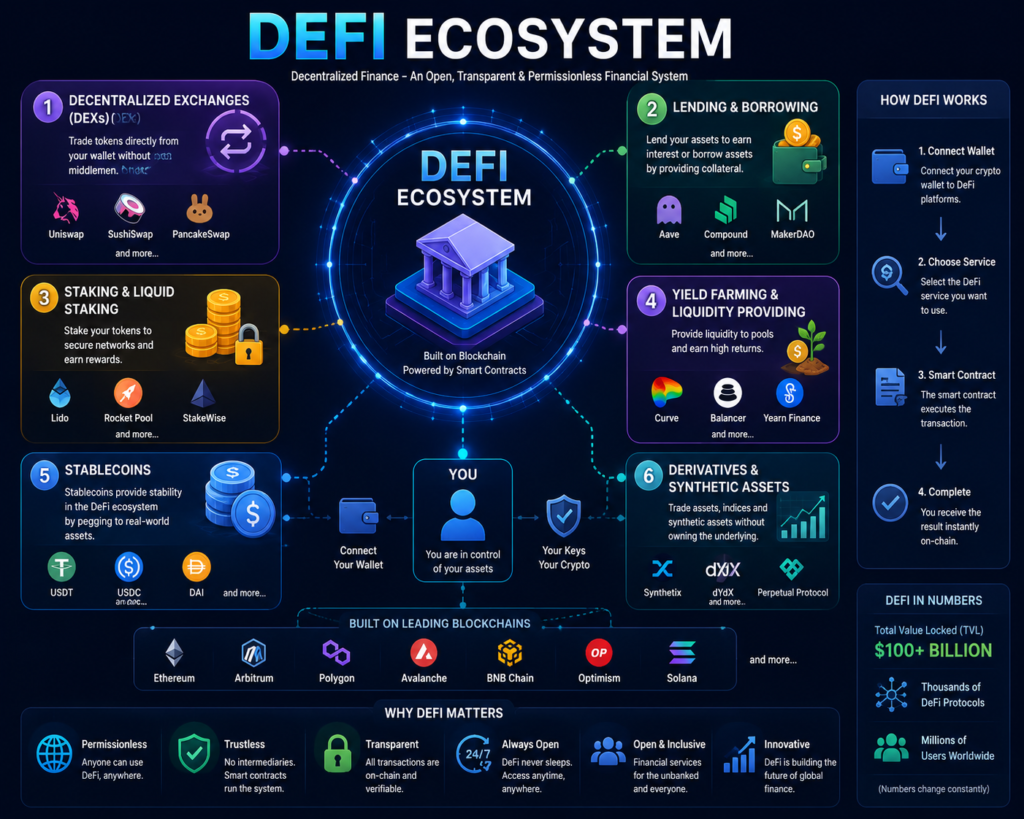
DeFi is a blockchain-based financial system that allows users to access financial services without traditional banks.
Instead of banks, DeFi uses:
- Smart contracts
- Blockchain networks
- Decentralized applications (dApps)
This means users can:
- Trade crypto
- Earn interest
- Borrow money
- Lend crypto
- Stake assets
directly from their crypto wallets.
How Does DeFi Work?
DeFi works mainly through smart contracts.
Smart contracts are self-executing blockchain programs that automatically follow predefined rules.
Example:
In traditional banking:
- A bank controls your savings account.
In DeFi:
- Smart contracts manage the system automatically.
This removes many intermediaries.
Which Blockchains Support DeFi?
Many blockchain networks support DeFi applications.
Popular DeFi blockchains include:
- Ethereum
- Solana
- Avalanche
- BNB Chain
- Polygon
- Arbitrum
Ethereum remains the largest DeFi ecosystem.
Popular DeFi Applications
Decentralized Exchanges (DEXs)
Platforms where users trade crypto without centralized exchanges.
Examples:
- Uniswap
- PancakeSwap
- SushiSwap
Crypto Lending
Users can lend crypto and earn interest.
Others can borrow crypto using collateral.
Example:
- A user deposits Ethereum
- Earns passive income from lending
Staking
Users lock crypto to support blockchain networks and earn rewards.
Popular staking coins include:
- Ethereum
- Solana
- AVAX
- DOT
Yield Farming
Users move crypto between DeFi platforms to maximize rewards.
This is more advanced and risky.
Stablecoins
Stablecoins are cryptocurrencies linked to stable assets like the US dollar.
Examples:
- USDT
- USDC
- DAI
Stablecoins are heavily used in DeFi.
Real-World Example of DeFi
Imagine you want a loan.
Traditional system:
- Bank verification
- Paperwork
- Delays
- Credit checks
DeFi system:
- Connect wallet
- Deposit crypto collateral
- Receive loan automatically
This entire process can happen within minutes.
Advantages of DeFi
No Middlemen
Users control their own funds.
Global Access
Anyone with internet access can use DeFi.
Fast Transactions
Many DeFi transactions happen quickly.
Passive Income Opportunities
Users can earn through:
- Lending
- Staking
- Yield farming
Transparency
Blockchain transactions are publicly visible.
Risks of DeFi
Smart Contract Hacks
Poorly coded projects may get hacked.
Scams and Rug Pulls
Fake DeFi projects exist.
High Volatility
Crypto prices can change rapidly.
Regulatory Uncertainty
Governments are still developing crypto regulations.
Complex for Beginners
Some DeFi platforms can be difficult to understand initially.
Is DeFi Safe?
DeFi can be powerful, but users must stay careful.
Safety tips:
- Use trusted platforms
- Research projects carefully
- Avoid unknown websites
- Protect wallet seed phrases
- Use hardware wallets when possible
Never invest money you cannot afford to lose.
Best Wallets for DeFi
Popular DeFi wallets include:
- MetaMask
- Trust Wallet
- Rabby Wallet
- Coinbase Wallet
- Ledger Wallet
These wallets allow users to connect directly with DeFi platforms.
DeFi vs Traditional Banking
| Feature | Traditional Banking | DeFi |
| Controlled By | Banks | Smart Contracts |
| Access | Limited by banks | Global |
| Working Hours | Limited | 24/7 |
| Middlemen | Required | Minimal |
| Speed | Sometimes slow | Faster |
| Transparency | Limited | Public blockchain |
Why Is DeFi Important?
DeFi is important because it creates a more open financial system.
Many people worldwide:
- Do not have bank accounts
- Cannot access loans
- Face banking restrictions
DeFi may help provide financial access globally through blockchain technology.
Future of DeFi in 2026
DeFi continues expanding rapidly.
Growth areas include:
- Web3
- Real-world asset tokenization
- AI integration
- Cross-chain finance
- Institutional adoption
Many experts believe DeFi could become one of the biggest blockchain industries in the future.
Is DeFi a Good Investment Sector?
Many investors believe DeFi has strong long-term potential because:
- It solves real financial problems
- Blockchain adoption is increasing
- Web3 growth supports DeFi
- More developers are building DeFi applications
However, DeFi investments remain risky and volatile.
Always research carefully before investing.
Advantages of DeFi
DeFi offers several advantages compared to traditional financial systems.
- 24/7 access to financial services
- No need for bank approval
- Greater transparency through blockchain
- Global accessibility
- Opportunities for passive income through staking and lending
These benefits have made DeFi one of the fastest-growing sectors in the crypto industry.
Future of DeFi in 2026 and Beyond
The future of DeFi looks promising as more blockchain networks continue to improve scalability, security, and user experience.
Many experts believe that DeFi could become a major alternative to traditional financial services in the coming years. New innovations such as Layer 2 solutions, cross-chain protocols, and real-world asset tokenization are making decentralized finance more practical for everyday users.
However, challenges such as regulation, smart contract risks, and market volatility still need to be addressed. Investors should always conduct research before using DeFi platforms.
As blockchain adoption grows globally, DeFi may play an important role in creating a more open, transparent, and accessible financial system for everyone.
Final Thoughts
DeFi is changing how people interact with money and financial systems.
By removing middlemen and using blockchain technology, DeFi creates faster, more open, and globally accessible financial services.
For beginners entering the crypto world, understanding DeFi is extremely important because it plays a major role in Web3 and blockchain innovation.
Also Read
Before learning about Decentralized Finance (DeFi), it’s important to understand the fundamentals of blockchain technology. Read our Blockchain: The 5000-Year Story of Trust, Records, and Digital Revolution.
DeFi became possible because of Ethereum and Smart Contracts. To understand how Ethereum transformed the blockchain industry, read our Ethereum Story: How Vitalik Buterin Created Ethereum and Changed Crypto.
Every DeFi application runs on Smart Contracts. Before using any decentralized platform, read our What Is Smart Contract in Blockchain? Complete Ultimate Beginner Guide for 2026 to understand how automated blockchain agreements work.
Want to explore one of the most popular DeFi applications? Read our What Is DEX in Crypto? Powerful Beginner Guide for 2026 to learn how decentralized exchanges allow users to trade cryptocurrencies without intermediaries.
After learning about DeFi, continue with our What Is Crypto Staking? Ultimate Complete Beginner Guide for 2026 to discover how investors earn passive income by staking cryptocurrencies and participating in decentralized blockchain networks.
Also Read
What Is Blockchain?
What Is Stablecoin?
What Is Arbitrum Crypto?
FAQ
What does DeFi mean?
DeFi stands for Decentralized Finance.
What is DeFi used for?
DeFi is used for trading, lending, staking, borrowing, and earning rewards without banks.
Is DeFi safe?
DeFi has risks, including hacks and scams, so users should research carefully.
Which blockchain is best for DeFi?
Ethereum is currently the largest DeFi blockchain ecosystem.
Can beginners use DeFi?
Yes, but beginners should start slowly and learn basic wallet security first.
join our Telegram for instant crypto updates.
Subscribe to our youtube Channel
For detailed crypto market analysis, price predictions, and investment strategies,
subscribe to our YouTube channel Coin Alert

Dr. Khushwant Rana is the founder of Coin Alert and has 15+ years of business experience. He creates beginner-friendly crypto educational content focused on Bitcoin, blockchain, Web3, crypto security, and real-world crypto awareness in India.