What Is Data Availability in Crypto?
The blockchain industry is evolving rapidly.
As Ethereum, Layer 2 networks, and Web3 applications continue growing, scalability has become one of the biggest challenges in crypto.
This is where an important concept called Data Availability becomes extremely valuable.
If you are learning about:
- Ethereum scaling
- Layer 2 networks
- Rollups
- Modular blockchain
- Celestia
- Web3 infrastructure
then understanding Data Availability is very important.
At first, this topic may sound technical.
But in reality, the concept is easier than most beginners think.
In this article, we will understand:
- What Data Availability means
- Why blockchain networks need it
- How Ethereum uses it
- Why Layer 2 networks depend on it
- What role Celestia plays
- Why Data Availability could shape the future of Web3
What Is Data Availability?
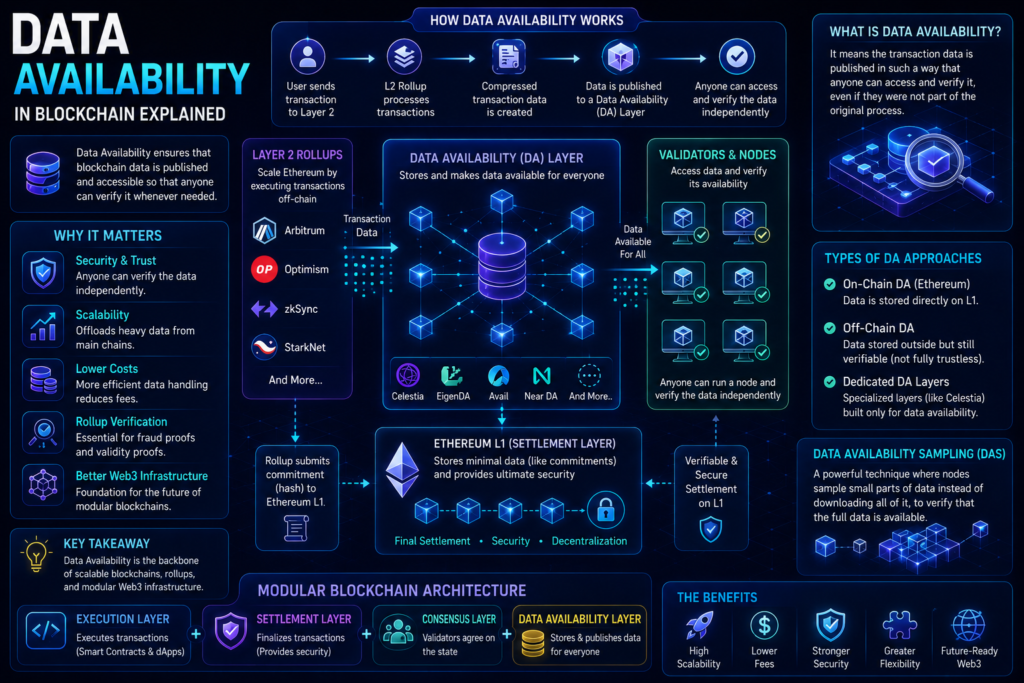
Data Availability means ensuring that blockchain transaction data is publicly accessible and available for verification.
In simple words:
When a blockchain processes transactions, the data must remain available so users and validators can verify everything properly.
If transaction data is hidden or unavailable, users cannot fully trust the blockchain.
This creates serious security risks.
Data Availability ensures:
- Transparency
- Verification
- Security
- Trust
inside blockchain systems.
Simple Real-Life Example
Imagine a teacher checking exam results.
If students can see the answer sheets, everyone can verify the marks honestly.
But if the answer sheets are hidden, nobody knows whether the results are correct.
Blockchain works in a similar way.
Transaction data must remain available for everyone to verify.
That is the core idea behind Data Availability.
Why Blockchain Needs Data Availability
Modern blockchain networks process massive amounts of data.
For example:
- Ethereum transactions
- NFT activity
- DeFi trading
- Gaming transactions
- Stablecoin transfers
All of this creates huge amounts of blockchain data.
If networks fail to store and share this data properly:
- Users lose trust
- Verification becomes difficult
- Security risks increase
- Rollups may fail
This is why Data Availability is becoming one of the most important parts of blockchain infrastructure.
How Data Availability Works
When users send blockchain transactions:
- Transactions are processed
- Data gets stored
- Validators verify the information
- Nodes access the data
For a blockchain to remain secure, nodes must be able to access transaction data whenever needed.
If the data disappears or becomes inaccessible, verification becomes impossible.
This is called a Data Availability problem.
Ethereum and Data Availability
Ethereum is currently one of the biggest ecosystems using Data Availability solutions.
Ethereum originally handled everything directly on Layer 1.
But as usage increased, the network became expensive and congested.
This created problems like:
- High gas fees
- Slow transactions
- Network congestion
To solve this, Ethereum started moving toward Layer 2 scaling solutions.
You can also read these related beginner guides:
- Complete Beginner Guide to Ethereum
- Complete Guide to Layer 2 in Crypto
- What Is Modular Blockchain?
- What Is Arbitrum?
Data Availability in Layer 2 Rollups
Layer 2 rollups process transactions outside Ethereum mainnet.
Examples include:
- Arbitrum
- Optimism
- Base
- zkSync
- StarkNet
These networks improve scalability and reduce fees.
However, transaction data still needs to remain available.
This is where Data Availability becomes critical.
Rollups usually publish transaction data somewhere so Ethereum or users can verify it later.
Without proper Data Availability:
- Rollups become risky
- Fraud detection becomes difficult
- Security decreases
What Are DA Layers?
DA stands for Data Availability.
A DA Layer is a blockchain layer specifically designed to store and distribute blockchain data efficiently.
Instead of making Ethereum store all data itself, separate DA layers help reduce workload.
This improves scalability significantly.
DA layers are becoming extremely important in modular blockchain architecture.
Celestia and Data Availability
One of the most popular Data Availability projects is Celestia.
Celestia focuses heavily on:
- Data Availability
- Consensus
- Modular blockchain infrastructure
Its goal is to help developers build scalable blockchain applications more efficiently.
Celestia separates execution from data availability.
This creates a modular architecture that can scale more effectively.
Official resources:
Why Data Availability Is Important
1. Blockchain Security
Users must verify transactions independently.
Accessible data improves trust and transparency.
2. Better Scalability
Separate DA layers reduce workload on main blockchains.
This improves scalability.
3. Lower Fees
Efficient data handling can reduce transaction costs.
4. Rollup Verification
Rollups need transaction data to prove transactions are valid.
5. Future Web3 Infrastructure
Modern Web3 applications require scalable data systems.
Data Availability could become a core foundation of future blockchain infrastructure.
Data Availability Sampling (DAS)
Another important concept is Data Availability Sampling.
This technology allows nodes to verify data availability without downloading all blockchain data.
Instead of downloading everything, nodes randomly sample small parts of the data.
This improves efficiency and scalability.
Many modular blockchain systems are exploring DAS technology.
Challenges of Data Availability
Even though Data Availability is powerful, there are still challenges.
Complexity
The concept is technical for beginners.
Storage Costs
Blockchain data storage still requires resources.
New Infrastructure
Many DA systems are still developing.
Long-term adoption is still growing.
Data Availability vs Traditional Blockchain Storage
| Feature | Traditional Blockchain | DA-Focused Systems |
| Data Handling | Entire chain handles data | Specialized DA layers |
| Scalability | Limited | Higher scalability |
| Fees | Higher during congestion | More efficient |
| Flexibility | Limited | More modular |
| Rollup Support | Basic | Optimized |
Future of Data Availability
The crypto industry is moving toward modular infrastructure.
Today we are seeing growth in:
- Ethereum Layer 2s
- Rollups
- Modular blockchains
- DA layers
- Celestia ecosystem
As Web3 applications continue growing, scalable data infrastructure will become even more important.
Many experts believe Data Availability could become one of the core technologies behind the future internet economy.
Conclusion
Data Availability is one of the most important concepts in modern blockchain infrastructure.
It ensures blockchain transaction data remains accessible, verifiable, and secure.
As Ethereum scaling solutions and Layer 2 networks continue growing, Data Availability systems will become even more valuable.
Projects like Celestia are helping build the next generation of scalable Web3 infrastructure.
For beginners learning about Ethereum, Layer 2s, and modular blockchain technology, understanding Data Availability is extremely important.
Data Availability means ensuring blockchain transaction data remains publicly accessible for verification.
Also Read
Before learning about Data Availability in Crypto, it’s important to understand the basics of blockchain technology. Read our Blockchain: The 5000-Year Story of Trust, Records, and Digital Revolution.
Data Availability plays a major role in Ethereum’s scaling ecosystem. To understand why Layer 2 networks need it, read our What Is Optimism Crypto? Complete Beginner Guide.
Want to learn how developers build scalable Layer 2 blockchains? Read our What Is Rollup-as-a-Service (RaaS)? Ultimate Beginner Guide (2026).
To understand the technology behind Ethereum’s modular future, read our What Is OP Stack? How It Powers Ethereum Layer 2 Networks (2026).
After understanding Data Availability, continue with our What Is EigenLayer? Complete Beginner Guide 2026 to learn how Ethereum is introducing shared security and restaking for the next generation of decentralized applications.
Also Read
FAQ
What is Data Availability in crypto?
Data Availability means ensuring blockchain transaction data remains publicly accessible for verification.
Why is Data Availability important?
It improves blockchain security, transparency, scalability, and rollup verification.
What is a DA Layer?
A DA Layer is a blockchain layer designed specifically for storing and distributing blockchain data.
What is Celestia?
Celestia is a modular blockchain project focused on Data Availability and consensus infrastructure.
Does Ethereum use Data Availability?
Yes, Ethereum Layer 2 rollups and scaling solutions rely heavily on Data Availability systems.
join our Telegram for instant crypto updates.
Subscribe to our youtube Channel
For detailed crypto market analysis, price predictions, and investment strategies,
subscribe to our YouTube channel Coin Alert
Want to learn more about crypto, Ethereum Layer 2 projects, wallets, blockchain, and Web3?
Visit Coin Alert for more beginner-friendly crypto guides and latest crypto education content.
Disclaimer
This article is for educational purposes only and not financial advice. Cryptocurrency investments are risky. Always do your own research and consult a financial advisor before investing.

Dr. Khushwant Rana is the founder of Coin Alert and has 15+ years of business experience. He creates beginner-friendly crypto educational content focused on Bitcoin, blockchain, Web3, crypto security, and real-world crypto awareness in India.